


A graduate does not become workplace-ready simply by knowing how to ask a chatbot a question. The useful skill is turning a real business task into a reliable output, checking the result and protecting information entrusted to the organisation. For Tanzanian interns and first-job professionals, five manageable exercises can demonstrate this ability: drafting a professional email, summarising an invented meeting, organising a fictional spreadsheet, preparing a presentation outline and checking a customer-service response. Each exercise can be practised without uploading an employer's private records.
That distinction matters in a market where better-quality jobs depend on productive skills, not certificates alone. The World Bank's October 2026 Tanzania Economic Update, Making Jobs Work highlights the need to strengthen foundational skills and move workers into more productive employment. AI can help someone practise communication and analysis, but it cannot replace judgement, workplace policies or competence in the underlying task.
What a supervisor actually needs from a new employee
Imagine an intern in a Dar es Salaam logistics office. A supervisor asks for a meeting summary before 3 p.m. A poor response is a polished-looking page with incorrect delivery dates and invented decisions. A useful response accurately separates decisions, owners and deadlines, notes uncertainties and is ready for the supervisor to review. The employer is buying reliability, not the appearance of technological sophistication.
Use this simple quality test for any AI-assisted task: Is it accurate? Is it relevant to the audience? Is the underlying information safe to use? Can I explain and correct the result myself? If any answer is no, the work is not ready to submit. For trainees, this habit is more valuable than memorising dozens of prompts.
Exercise 1: Write an email that gets an action, not merely attention
Use a fictional scenario: your team needs confirmation of a training room for a workshop with 18 participants on Tuesday. Write the facts yourself: proposed time, location, contact person and the response deadline. Ask an AI tool to draft a concise, respectful email with a specific subject line and one clear request. Then remove vague phrases and confirm that the recipient can respond in a single sentence.
A suitable practice instruction is: Draft a polite, 120-word email requesting confirmation of a training room for 18 participants on Tuesday from 9 a.m. to noon. Use only the facts supplied. If something is missing, mark it as a question rather than inventing it. Compare the result with your own version. The learning objective is not speed alone; it is clarity, accuracy and control of tone.
For a second attempt, write the email in English and then prepare a professional Kiswahili version. Check whether the translated request preserves the date, number of participants and decision needed. This is a realistic skill in Tanzanian workplaces where colleagues and customers may prefer different languages.
Exercise 2: Turn meeting notes into an accountable action register
Create a fictional ten-line meeting transcript about delayed inventory deliveries. Include two decisions, three actions, one unresolved risk and a deadline. Ask the tool to produce a table with decision, action, owner, due date and outstanding question. Inspect every row against the original notes. If the tool assigns an owner where none was named, replace that name with not yet assigned.
The strongest exercise adds a verification column. Mark each entry confirmed in notes, needs confirmation or suggested next step. That makes it clear which items are facts and which are proposed actions. It also creates a useful handover format for administrative assistants, HR trainees, project coordinators and operations interns.
Never paste actual internal meeting minutes into an external AI service without the organisation's explicit authorisation and an approved data-processing arrangement. Use fictional information in public practice tools. For live work, follow your employer's IT, confidentiality and data-protection policies.
Exercise 3: Analyse a small, fictional Excel table
Build a 12-row spreadsheet with invented purchase orders, departments, order dates, promised delivery dates and completion dates. Calculate the number of late orders, average delay and a count by department using spreadsheet formulas. Only after you have worked out the logic should you ask AI to suggest an alternative formula or explain why an existing formula is wrong.
Suppose four of twelve fictional orders arrived late. The correct observation is that four of twelve orders in the exercise were late, not that the company has a 33% late-delivery rate. Small synthetic datasets are for learning, not business performance claims. If the tool proposes a percentage, check the denominator and whether cancelled orders should be excluded.
A stronger follow-up asks the intern to write a two-sentence management note: what the sample shows, what it does not prove and what data would be required before a real decision. This habit protects against the confident but unsupported conclusions that automated analysis can produce.
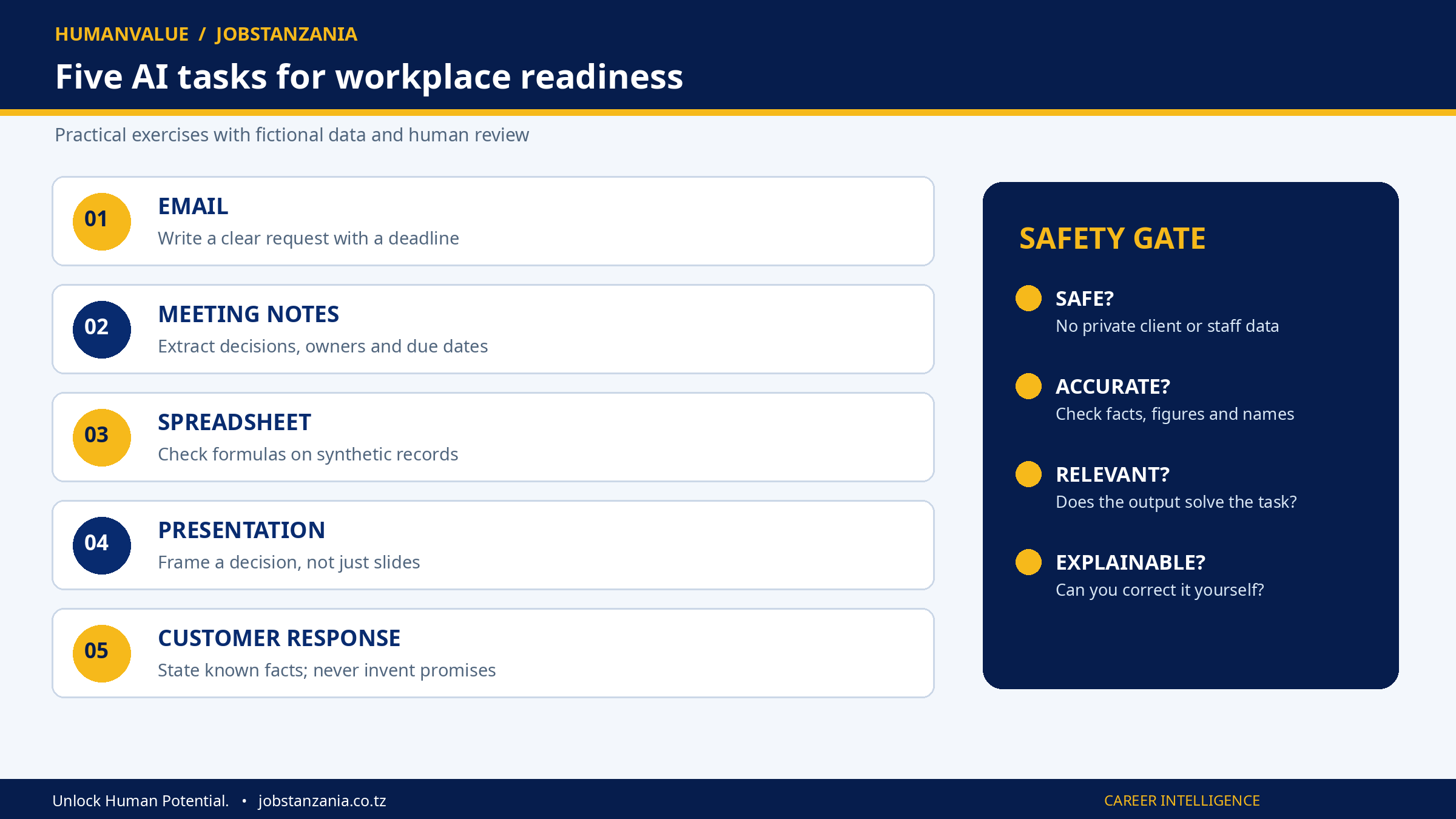
Exercise 4: Build a presentation outline with a decision at the end
A five-slide presentation for a supervisor should not be five slides of generic definitions. Use a fictional problem such as long queues at an internal service desk. Ask for an outline with the current problem, evidence required, two feasible options, implementation responsibilities and a proposed decision. Rewrite the slides in your own language and add only verified numbers.
A useful structure is: the decision we need, what we know, what we still need to check, options and trade-offs, recommended next action. Even a trainee can add value by helping a manager see the decision clearly. Where the presentation involves an actual employer, use approved corporate templates and do not expose client records, payroll data or identifiable employees.
Exercise 5: Improve a customer response without inventing promises
Create a hypothetical complaint: a customer says a service appointment was delayed, but the cause is not yet confirmed. Ask the tool for a courteous response that acknowledges the concern, states only known facts and gives a clear next step. Remove any invented refund, deadline or admission of fault. Then create a simple escalation note for the supervisor.
This exercise demonstrates judgement under uncertainty. An effective service message is not always the most apologetic or longest. It is the one that respects the customer, accurately states what is known and explains what happens next. Human review is essential before a message is sent on behalf of a real business.
A seven-day practice plan for job seekers
Day 1: Complete the email exercise and ask a trusted colleague to check clarity. Day 2: Build the meeting action register. Day 3: Create the synthetic spreadsheet. Day 4: Check formulas and write a management summary. Day 5: Develop the five-slide outline. Day 6: Practise the customer response and privacy checklist. Day 7: Put your best three fictional or authorised samples into a small evidence pack, labelled clearly as training exercises.
When applying for an internship, describe the capability precisely: Prepared structured meeting-action registers using fictional training data; checked action ownership and deadlines manually. Do not claim that a training exercise delivered a real employer's savings. Recruiters can value disciplined practice without inflated results.
If you want a guided route, HumanValue's AI Productivity Essentials for Interns is currently advertised as a free recorded Learning Center course with practice resources and a knowledge check. It fits naturally after these exercises because it helps learners practise safe workplace productivity rather than merely collecting AI vocabulary. <strong>Course availability and enrolment terms should be reconfirmed at the point of registration.</strong>
How to show this capability in a job application
First, read the vacancy and identify the work output the employer needs. For an administrative assistant, lead with correspondence, scheduling and accurate records. For an operations trainee, lead with tracking, reporting and handovers. For an HR intern, lead with professional communication and careful handling of personnel information. A portfolio should contain only synthetic, anonymised or explicitly authorised material.
The JobsTanzania jobs directory helps candidates find live roles to compare against their skills. If the application itself needs improvement, the HumanValue CV & Application Pack Lab teaches a vacancy-to-application workflow. Candidates who want alerts and additional career support can also compare the current Job Seeker Premium terms, while ordinary local job applications remain free. These are optional services, not prerequisites for employment.
Frequently asked questions
Can I use AI at work without telling my manager?
Follow the employer's policy. If the tool is not approved or the information is confidential, do not upload it. For public practice, use invented examples and disclose AI assistance when required by an assessment or workplace rule.
Does an AI course guarantee an internship or job?
No. A course can build capability and provide practice resources, but recruitment depends on a genuine vacancy, the candidate's overall suitability and the employer's decision.
What if AI gives the wrong answer?
Compare its output against your source material, recalculate numbers and correct the result. If you cannot verify a critical statement, leave it out or ask a qualified colleague.
Should I put every AI tool I have tried on my CV?
No. Name only tools you can use competently and connect them to a relevant, demonstrable task. Evidence of sound judgement is stronger than a long list of software names.
The practical next step
Choose one of the five exercises today, complete it without confidential data and request feedback from a supervisor, mentor or peer. A small, accurate work sample is more valuable than a polished claim you cannot defend. Then use the HumanValue Learning Center to close the next genuine skill gap and JobsTanzania to target roles where that skill matters.
Editorial note: This article provides career education, not legal, employment or information-security advice. Employer policies and applicable data-protection obligations take precedence.