


HumanValue Global Career Intelligence | 8 November 2026
A strong asynchronous handover lets a colleague continue work without waiting for you to come online. It states the current position, the evidence, the next decision, the owner and the deadline with its time zone. For African professionals applying to international remote roles, an original fictional handover exercise can demonstrate this skill without exposing a current employer’s information.
Asynchronous work means people can contribute at different times; it does not mean messages can remain unanswered indefinitely or that every role offers flexible hours. Employers set their own location, availability, security and employment requirements. This guide is a practical communication exercise, not a vacancy list or work-permission guide.
1. Write for the person receiving the work
Imagine an operations analyst in Dar es Salaam handing a fictional supplier-data issue to a colleague in another country. A message saying “Please see the spreadsheet” forces the recipient to reconstruct the problem. A better note explains which sheet matters, what was checked and the exact question remaining.
Avoid treating East Africa Time as the recipient’s local time. Give the date, time and named zone for a real deadline, then verify the receiving team’s current zone and daylight-saving arrangement. Do not assume a fixed difference from a city name throughout the year. Use the organisation’s agreed calendar or time-zone tool.
2. Build a one-page handover packet
| Component | What the receiver needs |
|---|---|
| Outcome | The result the task is meant to achieve |
| Current state | What is complete, pending or blocked |
| Evidence | Approved links, version and relevant findings |
| Decision | One clear question with available options |
| Ownership | Who acts next and who can approve |
| Time | Deadline, time zone and next update |
| Fallback | The agreed route if the owner is unavailable |
Keep the source of truth in an approved shared system. A chat message can point to it, but a private copy on a personal laptop creates version and access problems. Check permissions before handover and use the least information needed to explain the issue.
3. Use a decision card instead of a message trail
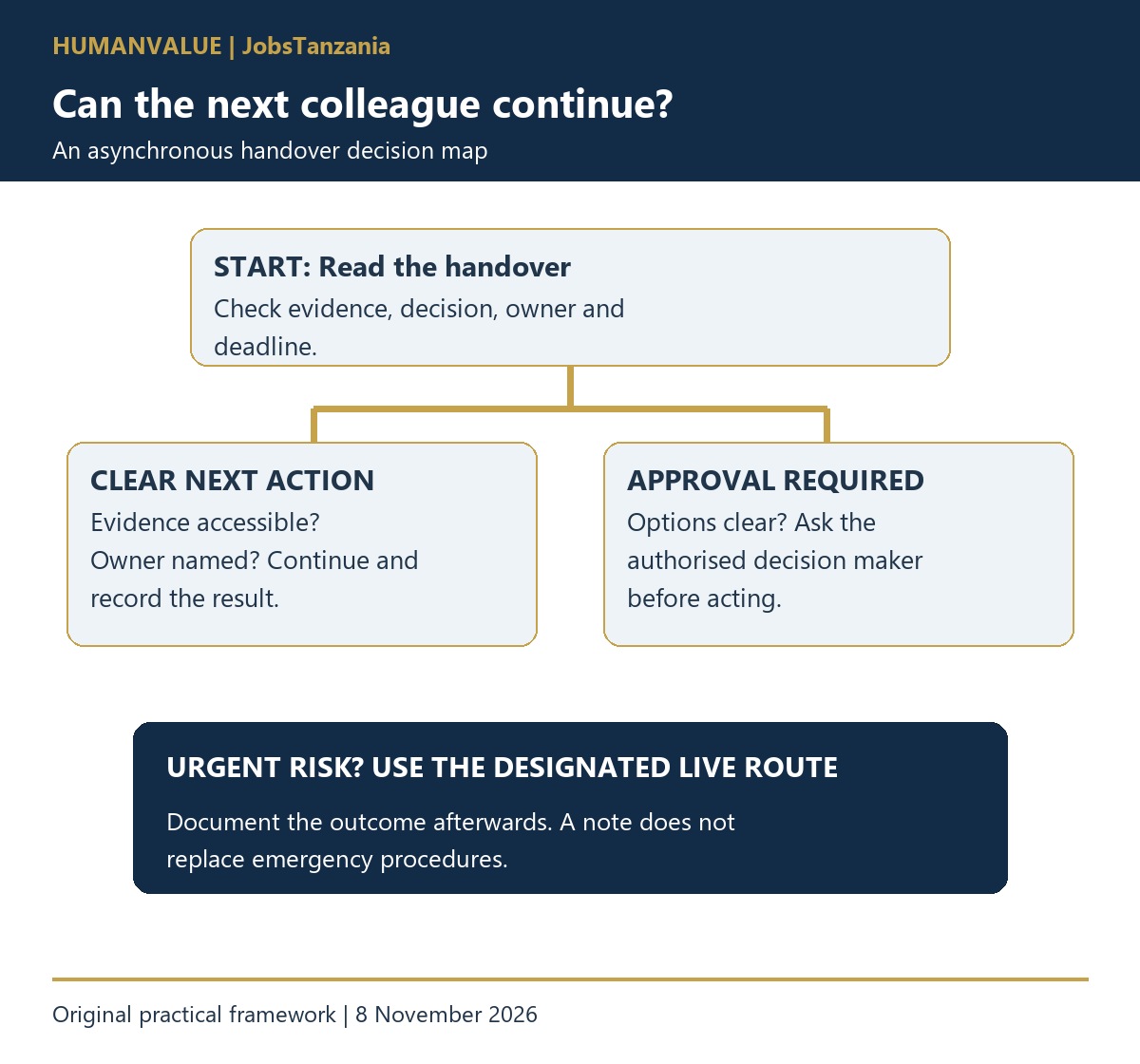
This branching format prevents a common problem: a long background summary with no actionable request. Limit each decision card to one main decision. Put supplementary detail behind a descriptive link rather than burying the request under a full conversation history.
4. Practise with a fictional data-quality problem
Example handover: “The training dataset has 24 supplier records. I checked all rows against the fictional reference list and flagged four mismatches. The review tab contains the row numbers and reasons. Please confirm whether we should correct the four values using that reference or request a revised source. You own the decision; I will update the file after approval.”
These numbers are invented for an exercise. Add a fictional deadline with an explicit zone, a version number and a safe fallback. Include one ambiguous record so the reviewer can see how you handle uncertainty. Do not quietly replace missing evidence with an assumption to make the file look complete.
5. Test the packet without explaining it aloud
Give the packet to a peer and ask them to identify the next action, owner, deadline and unresolved risk. Let them inspect it before you speak. Any question they must ask reveals a possible gap. Revise once and keep a short change log explaining what improved.
For an interview, present the initial note, revised note and a brief reflection. Explain what you would do if a deadline changed, a link failed or the decision owner was unavailable. Describe your own contribution accurately; one practice exercise does not establish experience managing a global team.
6. Know when a meeting is the better choice
Written communication is useful when the issue is bounded and the necessary context can be shared. A short live discussion may be more appropriate for urgent risks, a confusing disagreement or a sensitive matter. After a discussion, record the agreed decision, owner and next step in the shared system.
GitLab’s public communication handbook provides an example of documented remote communication practices. Its approach belongs to that organisation; candidates should adapt to the actual employer’s requirements rather than claim that every international company works the same way.
7. Connect the exercise to a real application
Read the role’s required collaboration tools, working hours and eligible hiring locations. Use the fictional packet as one relevant work sample if the employer welcomes portfolios. Keep it concise and accessible, with a clear label stating that it is a practice project. Never publish client data, login details or internal documents.
Next step: Create one decision card and test it with a peer. Explore Global Career Intelligence for related preparation and the HumanValue Learning Center for skills development. A useful portfolio demonstrates your working method; it cannot guarantee an interview or an overseas role.