


Canada's 2026 Express Entry French-language category may be relevant to qualified applicants from Tanzania and other African countries who can demonstrate strong French ability. The core language test is specific: at least NCLC 7 in speaking, listening, reading and writing, supported by accepted test results. But French ability alone is not enough. The applicant must first qualify for one of the three immigration programmes managed through Express Entry and then compete under the rules of an invitation round.
The official Immigration, Refugees and Citizenship Canada category page, updated on 16 October 2026, lists French-language proficiency among current categories. This is an informational guide, not a job advertisement, immigration application service or promise of selection.
Understand the three separate gates
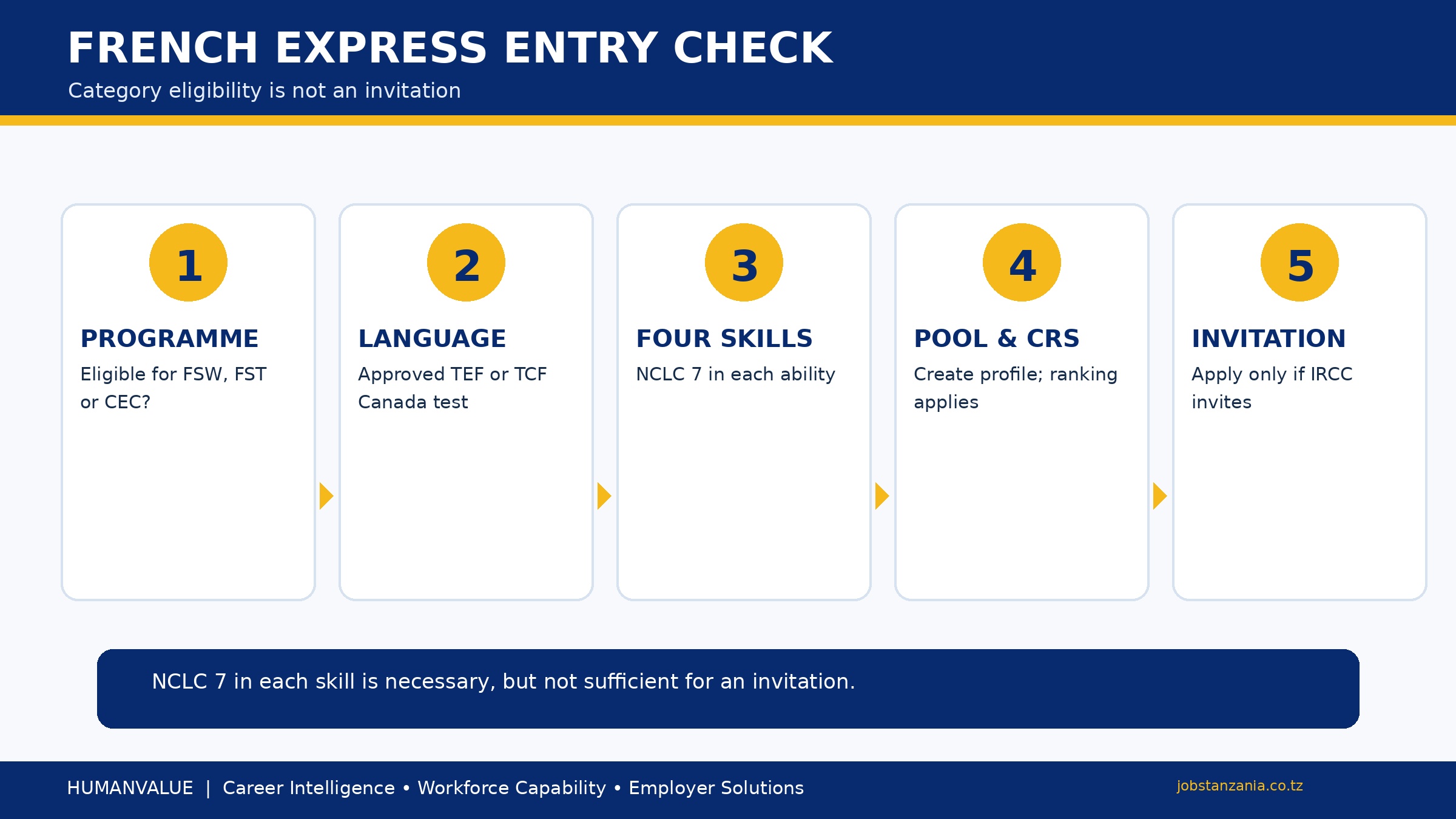
Gate one is eligibility for the Federal Skilled Worker Program, Federal Skilled Trades Program or Canadian Experience Class. Gate two is eligibility for the French-language category, including the language threshold and any round-specific instructions. Gate three is ranking and invitation: eligible profiles receive Comprehensive Ranking System (CRS) scores and IRCC invites candidates according to the round's criteria and ranking.
A professional may satisfy NCLC 7 but not qualify for any Express Entry programme. Another may qualify for the pool but have insufficient CRS ranking for an invitation. A third may receive an invitation but fail to provide accurate documents or meet admissibility requirements. Keeping these decisions separate prevents costly misunderstandings.
NCLC 7 means four distinct language abilities
NCLC is the Canadian French-language benchmark system. A single overall score cannot compensate for a weak skill. You need at least level 7 separately in oral expression, oral comprehension, reading comprehension and written expression. IRCC's accepted French tests for Express Entry are TEF Canada and TCF Canada.
Do not confuse a general French course certificate, a school grade or an unapproved online test with the official test result. Before booking, check the current test provider, availability, test format, identification requirements and how IRCC converts scores into NCLC levels. An applicant who speaks conversational French may still need targeted preparation for writing and reading under timed conditions.
Compare TEF Canada and TCF Canada responsibly
Both are accepted by IRCC, but they have different scoring systems and test structures. Neither is universally easier. Choose based on access to an authorised test centre, practice material, your strengths and the ability to complete all required modules. Use the exact conversion tables on the IRCC language-test page, not a screenshot circulating in a WhatsApp group.
IRCC states that language results must be less than two years old when the Express Entry profile is completed and when a permanent-residence application is submitted. Plan backwards from likely document preparation and application timelines. An expiring result can disrupt an otherwise promising profile.
How a Tanzanian professional might assess readiness
Consider a fictional software quality analyst in Dar es Salaam with four years of documented work experience, a degree and intermediate French. She should first identify which Express Entry programme she may qualify for, including education, work experience, language and other criteria. She should then take a diagnostic French assessment, prepare for an approved test and gather verifiable employment records.
If she eventually achieves NCLC 7 in all four abilities, she can examine category eligibility. She still needs an accurate Express Entry profile and must review her CRS ranking. Her nationality alone does not provide an invitation advantage. Nor does this pathway automatically mean a Canadian employer has offered her a job.
Documents to prepare before spending heavily
Start with identity and travel documents, education records, employment letters, pay or tax evidence where relevant, and details of job duties and dates. Check whether an educational credential assessment is required for the underlying programme and which organisation is authorised to issue it. Keep test results, names and dates consistent across forms.
An employer letter should describe actual work performed, not copy an occupation description word for word. If you have mixed salaried, contract and self-employed experience, identify the evidence available for each period. IRCC's programme rules determine what counts. Translation requirements, proof of funds and police or medical documents depend on the stage and circumstances; do not order every document prematurely without checking the official checklist.
French-language category versus Francophone Mobility work permits
The two pathways are not interchangeable. The French-language Express Entry category is part of a permanent-residence selection system. Francophone Mobility is a separate employer-specific work-permit route with different conditions. An applicant should not assume that meeting the language standard for one route establishes eligibility for the other.
Similarly, an employer-sponsored vacancy is different from an Express Entry invitation. A candidate may pursue career preparation and legitimate job searches in parallel, but the immigration route must be assessed independently. JobsTanzania Global Career Intelligence can help readers compare information sources; it is not an official Canadian immigration authority.
Budget for uncertainty, not a guaranteed outcome
Potential costs include approved language tests, credential assessments, translations, medical examinations and government processing charges if an application reaches that stage. Fees change and vary by family composition and circumstances. Do not use old social-media fee screenshots as a budget. Confirm all official charges through IRCC and test providers before payment.
Beware of anyone offering a guaranteed invitation, a purchased CRS score or a secret employer allocation. An immigration invitation is issued by IRCC, not by a private recruitment platform. Verify the status and authorisation of anyone offering paid immigration advice under Canadian rules.
A twelve-week language and documentation plan
Weeks one and two: read the official eligibility rules and identify the underlying programme. Weeks three and four: take a diagnostic assessment in all four French abilities. Weeks five through eight: practise weak skills using a structured schedule and authentic test-format tasks. Weeks nine and ten: confirm test-centre arrangements and assemble employment evidence. Weeks eleven and twelve: sit the approved test if ready, then evaluate the actual results against IRCC's conversion table. This is a planning example, not a guarantee that twelve weeks will be enough to reach NCLC 7.
For wider career-readiness development, the HumanValue Learning Center offers professional learning resources. International Opportunities lists separate programmes and a TZS 50,000 career assessment option; that assessment is a HumanValue service, not an IRCC eligibility determination, invitation or visa approval. Read the programme scope and checkout terms before paying.
Frequently asked questions
Does NCLC 7 guarantee permanent residence?
No. It is one category requirement. You must qualify for an Express Entry programme, meet the relevant round instructions, receive an invitation and pass the application assessment.
Can I use DELF or a university French certificate?
Not as a substitute for IRCC's accepted Express Entry French tests. The official page lists TEF Canada and TCF Canada.
Must I have a Canadian job offer?
Not every Express Entry programme or invitation route requires a job offer. The exact answer depends on your underlying programme and circumstances; consult IRCC's current criteria.
Can experience from Tanzania count?
Some underlying programmes accept qualifying foreign work experience. Its duties, duration and documentation must meet the applicable programme rules. Category eligibility does not override those rules.
Is this the same as the Canada Francophone Mobility work permit?
No. It is a separate permanent-residence selection category. Check each route independently.
Make your next decision from official evidence
Begin with the IRCC category-based selection rules, confirm programme eligibility and then assess your four French skills. The right next step may be language study, better documentation or choosing a different pathway. None requires paying an unverified agent for a guaranteed outcome.