


An experienced welder, electrician or carpenter may see a Canadian immigration headline and assume it opens a direct application route. The practical question is more precise: which programme can you qualify for, does your experience fit the relevant category, and can you prove it?
This guide focuses on trades preparation rather than general Canadian job searching. It uses official IRCC guidance checked on 19 October 2026 and highlights a forthcoming change that applicants must distinguish from rules already in force.
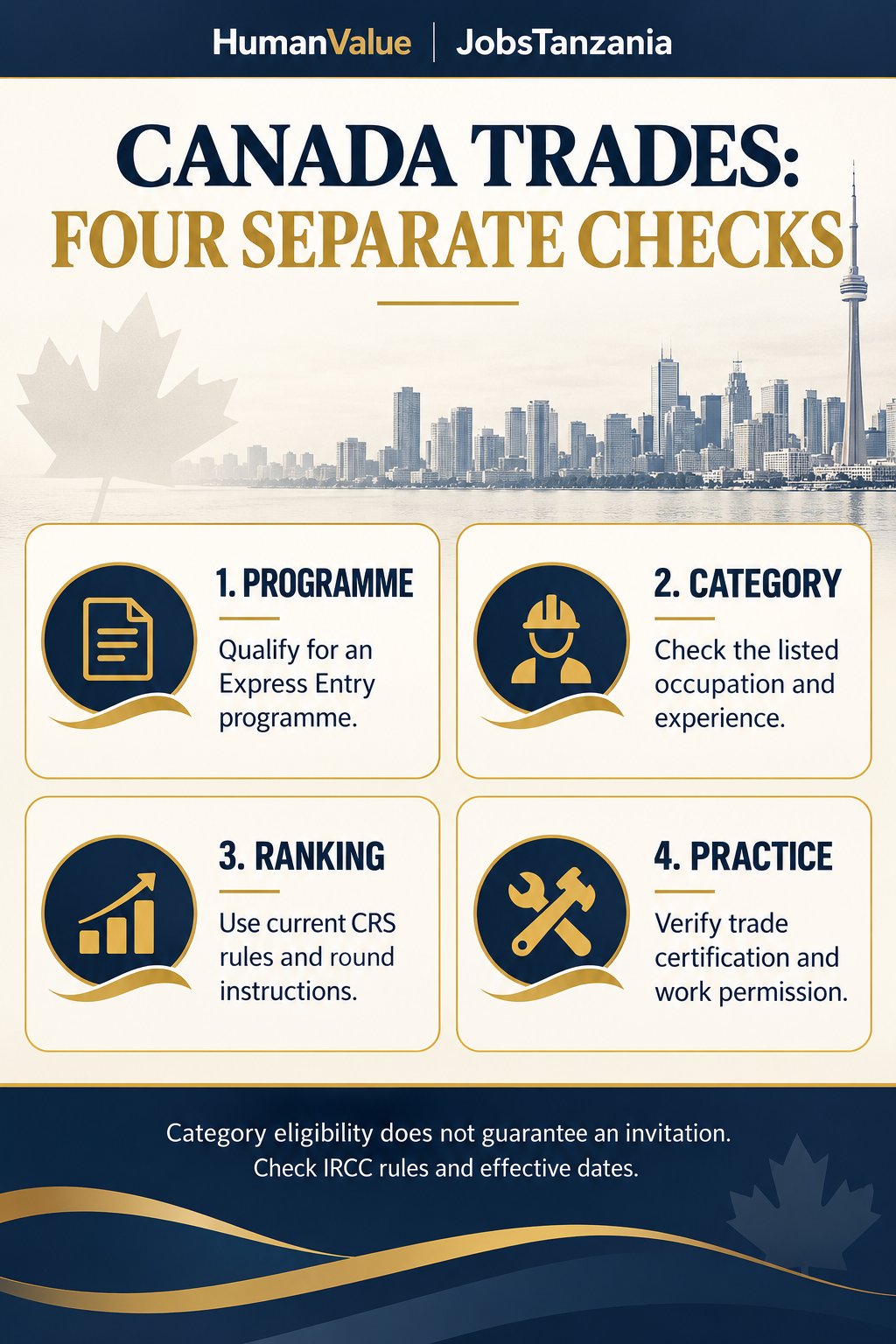
Keep four decisions separate
Express Entry manages applications under three federal programmes: Canadian Experience Class, Federal Skilled Worker Program and Federal Skilled Trades Program. You first need to qualify for a programme before you can be considered in the pool.
A category-based round is a way IRCC selects candidates from that pool. It is not a separate visa or a replacement for programme eligibility. Your ranking and the instructions for a particular round also matter. Finally, immigration status and the professional requirements for practising a trade are separate checks.
Use a four-column planning sheet: programme eligibility, category fit, ranking evidence and trade authorisation. Keep the official source and date beside each entry. An unanswered question in one column should not be hidden by confidence in another.
What the Federal Skilled Trades Program requires
The current programme page requires eligible paid trade experience equivalent to at least two years within the preceding five years. Work must align with the required NOC duties and have been gained where you were qualified to practise. Hours above 30 per week do not accelerate the count, and student work does not count towards its minimum experience requirement.
Applicants need either a valid full-time job offer for at least one year or a qualifying certificate issued by a Canadian provincial, territorial or federal authority. A Tanzanian trade certificate should not be described as that Canadian certificate. Check the relevant authority’s assessment process rather than assuming equivalence.
The programme comparison gives minimum language levels of CLB 5 in speaking and listening and CLB 4 in reading and writing for Federal Skilled Trades. Use approved tests and check each ability. The programme has no education requirement, although education can affect ranking.
These are key checks, not a complete individual eligibility decision. Read the full official requirements, including admissibility, settlement location and funds.
The trades category uses a different experience test
The current category-based selection page requires at least 12 months of full-time experience, or equivalent part-time work, within the last three years in one listed occupation. It can be Canadian or overseas experience and need not be continuous. The round’s instructions apply.
Listed examples include welders and related machine operators, electricians, plumbers and carpenters. Check the exact NOC and current table; do not infer inclusion from a broad label such as “construction worker”. The category test does not reduce the Federal Skilled Trades Program’s separate two-year requirement. A candidate may qualify for the pool through another managed programme and still need the category’s own conditions.
Important: a change is announced for 3 November 2026
IRCC’s 2026 changes page, updated 16 October, announces changes taking effect 3 November 2026. They concern CRS treatment of Canadian experience and qualifying job offers, including a new Labour Market Integration factor. The page also announces changed job-offer assessment requirements and a temporary pause in invitation rounds while profiles are recalculated.
Those announced changes are not yet effective on this article’s review date. Read the effective-date instructions before calculating a score or assessing a job offer. Do not reuse an old screenshot or assume a forthcoming rule already applies. Programme eligibility and job-offer ranking points remain separate questions.
This timing is particularly relevant to anyone preparing a profile in late October. Save the assumptions used in your assessment and recheck the official guidance immediately before submission or updating your profile.
Match your duties to the right NOC
Start with what you did, the equipment involved, the level of responsibility and the work setting. Compare that evidence with the official occupation description. Job titles can differ across countries, so a title alone is weak support.
An illustrative maintenance worker may have performed basic repairs across several systems without having the duties of a qualified industrial electrician. Another applicant may have a broad local title but a consistent record of a specific skilled trade. Investigate the facts rather than selecting the code that appears most favourable.
Ask employers for accurate letters describing dates, paid hours, responsibilities and contact details. Support them with lawful employment and payment records where available. Never rewrite your work history to copy a NOC description.
Treat qualification assessment as its own project
Identify the province or territory where you intend to work and find the authority governing your trade. Record assessment requirements, evidence, examinations and any practical experience conditions. Ask how overseas applicants are assessed before spending on travel.
Maintain a training history with apprenticeship periods, qualifications, practical tasks, supervisors and subsequent work. Separate training from independent practice. If a document is missing, request a lawful replacement or ask what alternative evidence the authority accepts.
Plan funds and document timing
Use IRCC’s proof-of-funds page for the current family-size amounts and applicable exemptions. Do not treat a job offer alone as a universal exemption. Keep settlement funds distinct from language tests, qualification assessments, government fees, travel and professional services.
Track expiry dates and the stage at which evidence is required. Check names and dates across your passport, qualifications, employment letters and test results. Keep a secure copy of every submitted version.
Career preparation and trustworthy support
The HumanValue Learning Center can support application and workplace preparation. Use JobsTanzania International Opportunities for discovery and enquiries while checking Canadian eligibility through IRCC and relevant trade authorities. This article does not advertise a Canadian job, invitation or employer sponsorship arrangement.
If you hire an immigration representative, verify their authorisation and written service scope. A paid service cannot create qualifying experience or control an invitation round. Keep optional CV support separate from immigration representation.
Frequently asked questions
Does twelve months in a listed trade qualify me automatically? No. Category fit is only one part of the process; programme eligibility and round conditions also apply.
Is my home-country qualification a Canadian certificate of qualification? Do not assume so. Check the issuing-authority requirement and assessment process.
Does an Express Entry profile authorise work in Canada? A profile is part of an immigration selection process. Verify work permission separately.
What should I do first? Document your actual paid duties and dates, identify the likely NOC, then assess programme and category requirements separately.
Sources
IRCC Express Entry, Federal Skilled Trades, programme comparison, category selection, announced November changes, proof of funds. Checked 19 October 2026. Practical planning methods are original editorial guidance.