


JobsTanzania Global Career Intelligence | Canada and Francophone Africa | 19 October 2026
Canada's Francophone Mobility work permit offers a specific opportunity for eligible French-speaking foreign workers who have a qualifying Canadian job offer outside Quebec. It is not a visa lottery, a general open work permit or a promise of permanent residence. Under the current Immigration, Refugees and Citizenship Canada (IRCC) rules, an applicant generally needs French speaking and listening ability equivalent to NCLC 5 or higher, an eligible offer of employment, and an employer that completes the required LMIA-exempt offer process using exemption code C16. This guide explains the worker and employer responsibilities, where African applicants often misread the rules, and how to prepare without paying for invented job offers.
Why this route deserves a closer look in 2026
A French-speaking logistics coordinator in Senegal, a bilingual customer-support professional in Cameroon or a Tanzanian engineer who genuinely speaks French may be interested in Canadian employment. Many online articles focus only on Canada's points-based permanent-residence programmes, leaving applicants unaware that Francophone Mobility is an employer-specific temporary work permit mechanism. The distinction matters: strong French is not a job offer, and the route does not allow someone to arrive in Canada and work for any employer.
The authoritative starting point is IRCC's Francophone Mobility eligibility page, checked on 19 October 2026. Read that page before relying on social media claims or paying an intermediary.
Eligibility gate one: a real job outside Quebec
The worker must intend to live and work in one of Canada's nine provinces or three territories outside Quebec. A job in Ontario, Alberta, British Columbia or Nova Scotia can potentially meet the location condition; a job physically based in Montreal or Quebec City does not. A French-language advertisement in Quebec is not automatically eligible just because the applicant speaks French.
The current rule generally covers offers in any National Occupational Classification (NOC) TEER category, with an important exclusion for primary-agriculture jobs in TEER 4 and 5. This is broader than older online descriptions limited to TEER 0–3. However, classification depends on the actual duties and the applicable NOC code, not merely the job title. A warehouse position and a farm labour position cannot be treated as identical for eligibility purposes.
A useful employer-verification step is to match the written duties, location, working hours and pay to the advertised role. Check that the employer is a real operating organisation and that the person corresponding with you has authority to hire. A forwarded PDF with a company logo is not independent verification.
Eligibility gate two: French speaking and listening at NCLC 5
For applications on or after 15 June 2023, IRCC requires an intermediate level of French oral proficiency equivalent to NCLC 5 or higher in speaking and listening. IRCC says proof of French reading and writing is not required for this particular LMIA exemption. That does not mean an employer cannot require stronger communication or other language skills for the job.
The IRCC application instructions describe acceptable supporting evidence, including TEF or TCF speaking/listening results and certain French-language education records. A candidate should use the official instructions rather than assume that a school French grade or conversational confidence will always be sufficient.
For a Tanzanian professional who studied mainly in English, the sensible first action is to assess genuine oral French proficiency. If you cannot yet demonstrate the required level, do not pay for a supposed guaranteed C16 placement. Develop the language skill, then seek a suitable employer.
Eligibility gate three: the employer must act before the worker applies
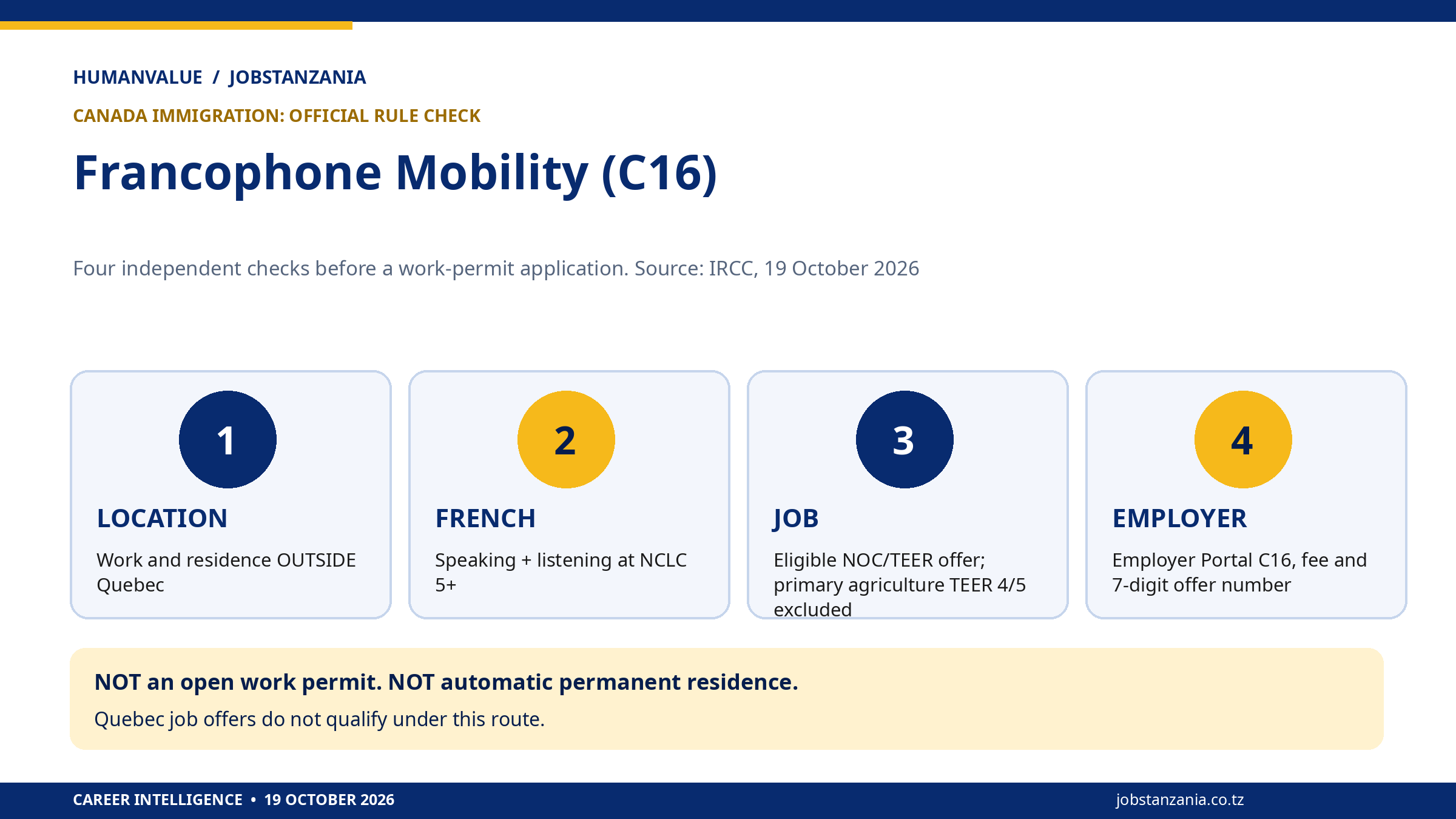
Francophone Mobility is LMIA-exempt, but LMIA-exempt does not mean employer paperwork-free. IRCC instructs the Canadian employer to submit the offer through the Employer Portal using exemption code C16, pay the published CAD 230 employer compliance fee, and provide the worker with the seven-digit offer-of-employment number. The worker uses that number in the work-permit application. The employer should confirm any specific fee exemption with IRCC rather than assume one applies.
A red flag is an intermediary asking the worker to send the employer's compliance fee to a private mobile-money number while refusing to identify the employer. Another is a recruiter promising a C16 permit without a Canadian employer, job duties or offer number. The employer compliance fee and the worker's own government application charges are different obligations.
Eligibility gate four: the ordinary work-permit rules still apply
Applicants must also satisfy the general requirements for a Canadian work permit, submit truthful supporting documents, pay applicable government fees and complete biometrics or other steps where required. The exact document checklist depends on the applicant's circumstances and application location. IRCC, not a recruiter, decides whether to issue the permit. Check IRCC's official how-to-apply instructions and the government fee pages at the time of filing.
Do not confuse this programme with Express Entry French-language category selection. The latter has different criteria and does not automatically follow from obtaining a C16 work permit. A temporary permit also does not guarantee a permanent-residence pathway.
A realistic application sequence for African professionals
First, identify a legitimate Canadian employer recruiting for a role outside Quebec. Second, compare the job duties with the NOC/TEER classification and the C16 occupation exclusion. Third, prepare credible proof of French oral ability. Fourth, confirm that the employer understands and completes the C16 Employer Portal steps. Fifth, obtain the official offer number and submit your own work-permit application using IRCC's instructions. Sixth, wait for an actual decision before making irreversible relocation commitments.
Consider an illustrative candidate, Nadia, a bilingual maintenance planner with four years of documented industrial experience. She receives an Alberta job offer. Her employer is willing to complete C16, and she has suitable French evidence. She still needs to meet general work-permit requirements and convince IRCC that her application is genuine. Her qualifications and language ability make an application plausible, not guaranteed. The example is fictional.
How to make an international CV useful to Canadian employers
A Canadian employer needs to understand your actual responsibilities, technologies, results and professional registration where relevant. Avoid submitting a generic CV that lists only the name of your degree and the countries you hope to visit. For a maintenance planner, show the assets managed, preventive-maintenance schedules, safety controls and evidence of downtime reduction if you can verify it. For a customer-service professional, demonstrate complaint handling, service channels and languages used in real work.
Keep employment dates and credentials accurate. Do not purchase fabricated reference letters or use an AI tool to invent achievements. HumanValue's Learning Center offers career and professional skills resources that may help you improve evidence and workplace readiness. Such training does not confer immigration eligibility.
What JobsTanzania's International Opportunities page can and cannot do
The JobsTanzania International Opportunities page is a broader catalogue of international programmes and enquiry routes. Its public Canada examples include locations in Quebec and elsewhere. A Quebec-based vacancy cannot qualify for Francophone Mobility C16 merely because it appears on a general international-opportunities page. Readers must verify the specific destination, employer and immigration route independently.
The page also advertises a TZS 50,000 career/document-readiness assessment. If considering that service, check the scope and payment terms. A CV or readiness assessment is not an IRCC eligibility decision, immigration legal representation or a guarantee of employment. Do not purchase an assessment on the assumption that it includes a C16 sponsor or a permit.
Red flags before you pay anyone
Beware of a “guaranteed Canada visa” claim, a request to falsify French scores, an employer that cannot be independently verified, a job offer that conceals its location, or a demand for a deposit before basic job and programme details are supplied. Be particularly cautious when a recruiter calls a Quebec position “C16 eligible.” Check the official IRCC eligibility requirements yourself.
The correct next step may be to improve your French, build role-specific evidence or continue applying for legitimate Canadian positions. It is not always to spend money immediately.
Frequently asked questions
Can someone from Tanzania apply for Francophone Mobility?
Potentially, yes. Eligibility is not restricted to citizens of French-speaking African countries. The person must meet the actual language, job-offer, location and general work-permit requirements.
Does C16 require an LMIA?
The route is LMIA-exempt, but the employer must normally complete the applicable Employer Portal process and provide the offer number. The worker still needs an approved work permit.
Is NCLC 5 enough for permanent residence?
No. Francophone Mobility is a temporary work-permit pathway. Permanent-residence programmes have separate eligibility criteria and language thresholds.
Can I use C16 for a job in Montreal?
No. IRCC's published Francophone Mobility location requirement excludes Quebec. Confirm the actual work location, not just the employer's mailing address.
Your next step
If you have French-speaking capability and a legitimate employer lead outside Quebec, use the four-gate checklist in this article and consult IRCC directly. If you are still preparing, focus on an honest, evidence-based CV and relevant professional skills. Explore Global Career Intelligence for complementary guidance and HumanValue's international career preparation options without treating an enquiry as a permit application.
Editorial and legal notice: Immigration rules, fees and forms can change. This article was researched on 19 October 2026 from IRCC sources and is general information, not personalised Canadian immigration legal advice. JobsTanzania/HumanValue is not represented here as an IRCC-approved immigration representative or a C16 sponsor.