


HumanValue Career Intelligence | Tanzania & Africa | 19 October 2026
A gap in paid employment does not erase your previous achievements. If you paused your career to care for a family member, recover from illness, study, relocate, run a small business or search for work, the strongest application is neither a defensive explanation nor an invented job history. It is a truthful account of what changed, what you can do now and why the vacancy fits your current readiness. This guide shows Tanzanian professionals how to make that case in a CV, interview and seven-day preparation plan.
The real problem is uncertainty, not the missing dates
Imagine Asha, an experienced Dar es Salaam accounts assistant who spent 18 months caring for a parent. Her old CV ends in 2024. A hiring manager sees an unexplained interval and may wonder whether she can still reconcile accounts, use current software or commit to the advertised schedule. Asha cannot control every assumption, but she can reduce uncertainty with a concise explanation and fresh evidence. She should never claim a course, contract or employer that did not exist.
Research on care-related career breaks has documented negative hiring judgements linked to assumptions about skills, commitment and availability. The December 2025 IZA research paper on career-break hiring penalties examines this problem using recruiter evaluations. It is international research, not a measured rejection rate for Tanzania. The practical lesson is to answer the legitimate job-readiness question without surrendering unnecessary personal information.
Start with the job, not the gap
Before changing your CV, take one genuine vacancy from JobsTanzania Jobs. Mark its non-negotiable requirements, three recurring tasks, the software or licences required, and the results the employer expects. A payroll assistant might need confidential record handling, Excel accuracy and reconciliation. A customer-care officer may need complaint resolution, CRM notes and professional English or Kiswahili. Do not write a life story when the employer needs evidence of capability.
Create a simple three-column page: requirement, your evidence, remaining gap. For each requirement, record an actual example, such as a completed reconciliation or a documented volunteer project. If the evidence is old, refresh it with a realistic exercise using dummy data. If the requirement is a regulated qualification, a self-study exercise cannot replace a valid credential.
Three honest ways to show a break on your CV
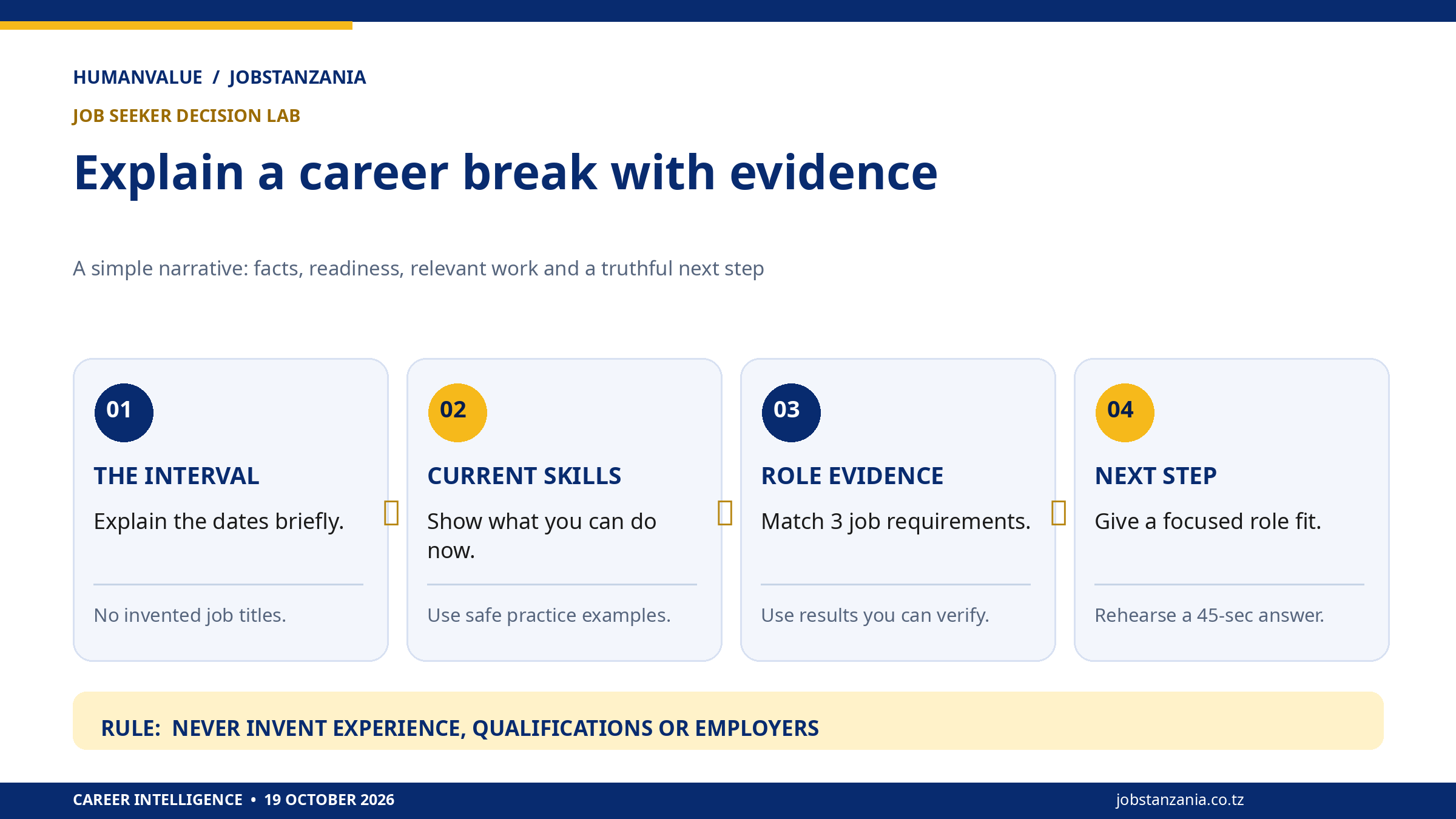
Option A: Briefly label a substantial break. A dated line can say, “2024–2025 | Planned career break for family responsibilities; resumed professional development and active job search in 2026.” Only include details you are comfortable sharing. A break label is not always necessary, particularly if a short gap does not confuse the employment chronology.
Option B: Show genuine independent work. If you kept books for paying clients or operated a registered or informal business, describe it accurately as self-employment or independent work. State the service and actual deliverables. Do not convert occasional family help into a fictitious full-time consultancy.
Option C: Present learning as learning. If you completed an Excel course, state the title, provider, completion date and practical exercise. If you merely watched tutorials, describe that as self-directed practice, not certification. The HumanValue Learning Center currently offers a Workplace Excel Essentials course and a CV & Application Pack Lab; choose the one that addresses a genuine skill or application weakness rather than buying courses to fill empty space.
A CV profile that shifts attention back to capability
Weak: “Hardworking lady seeking any job after being unemployed for a long time.” This gives the employer neither a target role nor a reason to interview you.
Stronger: “Accounts and administration professional with four years’ experience in invoice processing, customer records and monthly reconciliation. Recently refreshed Excel reporting skills through a simulated month-end close. Seeking an accounts assistant role where accuracy, confidentiality and timely reporting are essential.” Use the experience length only if it is true. The simulated exercise is explicitly described as practice, not employment.
Place relevant achievements near the top. If your previous work reduced reconciliation errors, state what you did and a verifiable result. If you cannot substantiate a number, describe the action without inventing a percentage. A career break is not permission to exaggerate, and a strong application does not need exaggerated claims.
Interview question: “What have you been doing since your last job?”
A useful answer takes about 30–45 seconds: acknowledge the interval, give a proportionate explanation, identify any meaningful preparation and connect to the role. For example: “I took time away from formal employment to support a family member. That responsibility is now managed, and I have been preparing to return to an accounts role. I refreshed my Excel and reporting practice and can show a sample reconciliation using non-confidential data. The responsibilities in this vacancy match the work I previously handled.”
If the reason was health-related, you can explain readiness without disclosing a diagnosis. If you were searching for work, say so; then describe your targeted applications, useful learning or relevant work. Avoid apologising for circumstances beyond your control. If a prospective employer asks an intrusive question unrelated to job requirements, consider seeking appropriate employment-rights guidance.
Build a fresh work sample without misrepresenting experience
For an administration role, draft meeting minutes from a fictional scenario, a clean spreadsheet tracker and a two-paragraph handover note. For sales, create a fictional customer follow-up log with an ethical response to a complaint. For HR, prepare an anonymised interview schedule and a candidate-consent checklist. For IT support, document a lab troubleshooting exercise. Label every sample “demonstration exercise” and remove names, employer data and private documents.
One page of credible work may be more useful than five pages of generic adjectives. The purpose is not to imply that a demonstration exercise is paid experience. It is to give a hiring manager a low-risk way to evaluate how you approach a relevant task today.
Your seven-day return-to-work sprint
- Day 1: Choose two related job titles and review three live advertisements.
- Day 2: Write the requirement–evidence–gap matrix.
- Day 3: Update your CV chronology and professional summary.
- Day 4: Complete one role-relevant practice task with fictional data.
- Day 5: Rehearse the 45-second career-break answer with a friend.
- Day 6: Apply to two genuinely suitable vacancies and track the exact requirements.
- Day 7: Review feedback, improve one weak skill and plan next week's applications. This is a suggested routine, not a promise of interviews within seven days.
If your applications remain unclear, HumanValue's CV & Application Pack Lab teaches a vacancy-to-application method and is publicly listed at TZS 40,000 at the time of this review. For ongoing opportunity alerts and career preparation, JobsTanzania Job Seeker Premium is another option. Check the current checkout terms before paying; ordinary local job applications remain free.
What employers can do differently
Recruiters should assess job-related evidence rather than automatically reject a dated CV. A structured question such as “Show us how you would reconcile this sample invoice ledger” is more informative than “Why were you at home?” Ask every candidate about availability and required hours consistently. Avoid requesting unnecessary medical or family information. A fair process improves candidate experience and protects the employer's hiring decisions.
The World Bank's 2026 Tanzania Economic Update, Making Jobs Work, notes barriers to better-quality employment, including skills and constraints faced by women. That broad labour-market context does not establish the reason any individual was unemployed. It reinforces the value of practical skills development and access to better opportunities.
Frequently asked questions
Should I put “unemployed” on my CV?
You do not have to create a separate job entry called “unemployed.” Keep your actual employment dates accurate. A short neutral explanation can help when the gap is long and likely to prompt questions.
Can I say I was freelancing when I only helped friends?
Describe the work honestly. “Occasional volunteer bookkeeping for a community group” is different from “full-time freelance accountant.” Keep evidence and obtain permission before naming any organisation.
Will Premium membership guarantee an interview?
No. It offers access to the benefits stated on the current product page, not an interview or job guarantee. Your role fit, application quality and employer selection process still matter.
The decision to make today
Pick one vacancy, build one credible evidence sample and rehearse one truthful explanation. A gap is a chapter of your career, not the only chapter. Explore current jobs in Tanzania, and use HumanValue career learning when a specific skill or application weakness needs work.
Editorial note: This article offers career preparation information, not individual legal or medical advice. Examples are illustrative and do not describe a real client.