


HumanValue Career Intelligence | Tanzania | 8 November 2026
A useful complaint log tells the next person what happened, what evidence exists, who owns the decision and when the customer will hear back. For a customer service applicant in Tanzania, a small fictional escalation portfolio can demonstrate judgement more clearly than writing “excellent communication skills” on a CV.
This guide provides an original practice exercise for delivery, retail and business-service teams. It is not a vacancy announcement or a promise of employment. The examples and timings are fictional planning choices, not industry benchmarks or legal deadlines.
1. Separate a request from an escalation
A request asks for something within the agent’s authority: checking an order or explaining a published return process. An escalation needs a different decision maker, specialist knowledge or urgent attention to a risk. Sending every difficult conversation to a manager creates a queue; keeping a serious issue without authority creates a different problem.
Write your team’s triggers before the busy period. Examples include a repeated failed delivery, an unresolved payment discrepancy or a commitment that the front-line agent cannot authorise. Safety concerns, suspected fraud and exposed personal information need the organisation’s designated urgent route. A routine spreadsheet must never replace that route.
2. Record seven fields that support a decision
| Field | What to record |
|---|---|
| Case reference | A unique internal number, without unnecessary customer identifiers |
| Customer impact | What the customer cannot do and why it matters |
| Confirmed facts | Order status, timestamps and authorised evidence |
| Unknowns | Questions still needing verification |
| Decision needed | The precise approval or technical answer |
| Owner | The person accountable for the next action |
| Next update | A specific agreed time and communication channel |
Keep a status field alongside these entries: new, checking, awaiting decision, customer updated or closed. “Sent to manager” describes movement, not resolution. A case remains open until the required outcome or documented next arrangement is confirmed.
3. Follow the evidence-to-action path
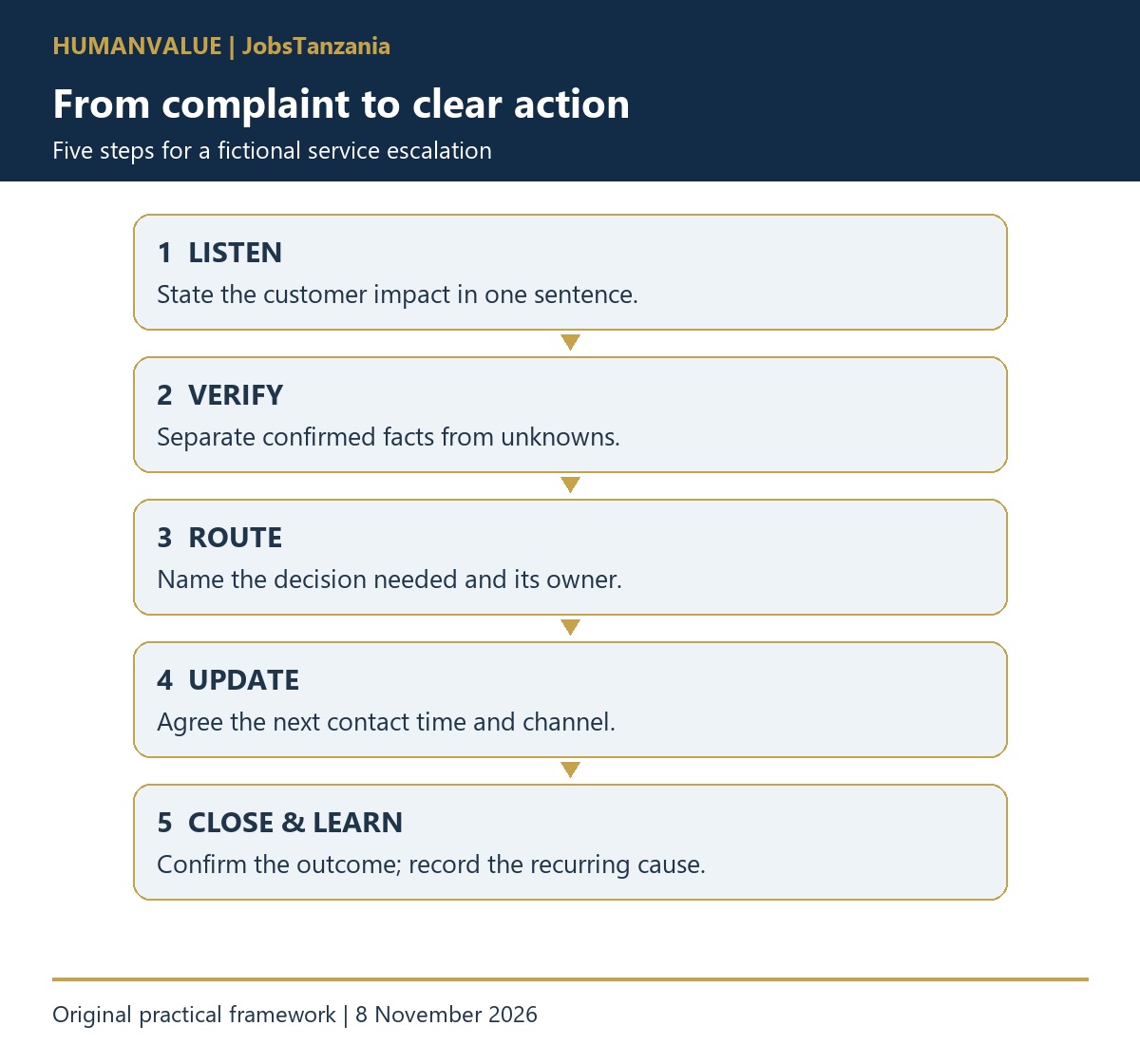
4. A fictional Dar es Salaam delivery case
A customer says a replacement part expected yesterday has not arrived. The tracking record says “attempted delivery”, but no signed delivery evidence is available. The customer needs the part for a planned maintenance visit. The agent should record the reported impact without declaring that the courier lied or promising a refund.
Practice response: “I can see the delivery attempt recorded, but I have not yet verified what happened. I am asking our dispatch owner to check the delivery evidence and available options. I will update you by the time we agree, even if the investigation is still open.”
This is model wording created for the exercise, not a customer testimonial. The internal escalation might request confirmation of the attempt, a realistic redelivery option and approval for any remedy outside the agent’s authority. Share only the details required for that task through approved systems.
5. Build a seven-day portfolio
On days one and two, create six fictional cases across delivery delay, wrong item and repeated contact. On day three, write a short customer response and an internal decision request for each. On day four, ask a peer to identify missing facts. On day five, revise the log. On day six, summarise recurring causes. On day seven, prepare a two-minute explanation of one difficult decision.
Use invented names and order references. Do not export your employer’s real customer records, screenshots or private conversations into a personal portfolio. Label every exercise as fictional. A reviewer should be able to see your reasoning without seeing anyone’s confidential information.
6. Measure follow-through, not just speed
For the exercise, count cases with a named owner, cases updated at the agreed time and cases reopened because the original issue remained unresolved. Explain the denominator and limitations. Six invented cases cannot prove a real service improvement or support a percentage claim on your CV.
For further reading, Atlassian’s incident-response handbook illustrates explicit responsibilities and communication during technical incidents. It is a reference from a different context, not a rule for Tanzanian customer service.
Your next step: Build one fictional escalation record today. Explore the HumanValue Learning Center for relevant learning and use the free ATS CV scanner to check how clearly your genuine skills are presented.