

Two different ways to find talent
A CV database gives an employer tools to search and contact relevant candidate profiles, while a recruitment agency typically provides a managed search, screening and shortlist service. Neither model is universally better. The appropriate choice depends on role complexity, internal HR capacity, urgency and budget.
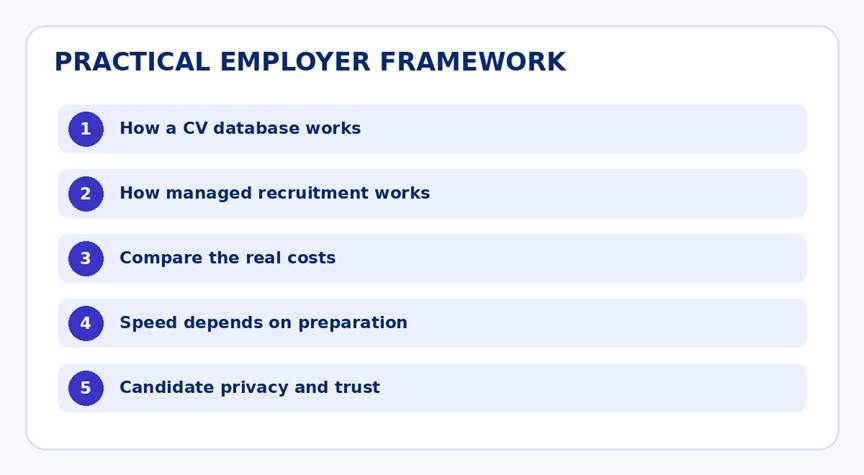
How a CV database works
A hiring team filters profiles by occupation, skills, experience, location or availability, then reviews matches and contacts suitable people. The team remains responsible for verifying qualifications, interviewing and making the employment decision. A good database should make data permissions, freshness and access rules clear.
How managed recruitment works
A recruitment partner can clarify requirements, source applicants, conduct initial screening, coordinate interviews and support offer management. For specialist roles, a recruiter may search beyond publicly available CVs. Service scope, guarantees and fees should be documented before engagement.
Compare the real costs
A database subscription doesn't cover the full cost of hiring. Add recruiter time, interviews, assessments, verification and vacancy downtime. Similarly, compare an agency fee with the work actually included. Ask for a written proposal instead of relying on an unsupported universal price comparison.
Speed depends on preparation
Access to many CVs does not automatically create a shortlist. Clear filters and a realistic job specification matter. Agencies also need timely feedback and an agreed decision-maker. Employers can improve either model by scheduling interviews in advance and setting response deadlines.
Candidate privacy and trust
CVs contain personal information. Tanzania’s Personal Data Protection Act establishes requirements for processing personal data. Employers should confirm lawful access, limit data use to legitimate recruitment purposes, control downloads and honour relevant candidate rights. Do not treat every uploaded CV as permission for unlimited redistribution.
Which method suits different roles?
For repeat hiring of common positions, a searchable talent pool may be efficient. For executive, confidential or scarce-skill appointments, managed search can add value. For volume recruitment, a combined approach may work best: advertise widely, use consent-based talent search and outsource selected screening steps.
A practical employer decision framework
Rate each vacancy on urgency, rarity of skills, number of positions, internal HR capacity and confidentiality. If urgency and complexity are high, compare a managed recruitment proposal. If internal capacity is strong and roles are recurring, test candidate search against a defined hiring outcome.
JobsTanzania options
Explore HumanValue Talent Bank for structured candidate discovery, JobsTanzania job advertisements for inbound applications and HumanValue HR services for a supported search. Verify live product terms and fees before making a commercial decision.
Frequently asked questions
Is a CV database the same as a recruitment agency?
No. A database supports employer-led search; an agency generally provides a managed service.
Does a CV database guarantee a hire?
No. Profile relevance, availability, screening and employer decisions determine outcomes.
What should employers ask about data protection?
Ask how candidate permission, access, retention and deletion requests are handled.
Official sources
World Bank Tanzania Economic Update:
Tanzania National Bureau of Statistics labour reports:
Employment and Labour Relations Act: