


Retention is a business performance issue
When a skilled employee leaves, the employer may incur vacancy time, replacement recruitment, onboarding costs and lost customer or operational knowledge. Tanzania’s current debate about productive and secure jobs makes retention a relevant management issue, but national turnover figures should not be invented or used without a defined dataset.
Measure turnover before prescribing solutions
A simple turnover rate is departures during a period divided by average headcount, multiplied by 100. Separate voluntary exits from involuntary exits, and analyse by department, tenure, location and job family. Small teams should avoid concluding a single departure.
Understand why people leave
Common organisational hypotheses include unclear expectations, poor supervision, limited progression, unpredictable scheduling, pay concerns, unsafe conditions and lack of recognition. These are questions to investigate locally, not claims that all Tanzanian employers share the same causes.
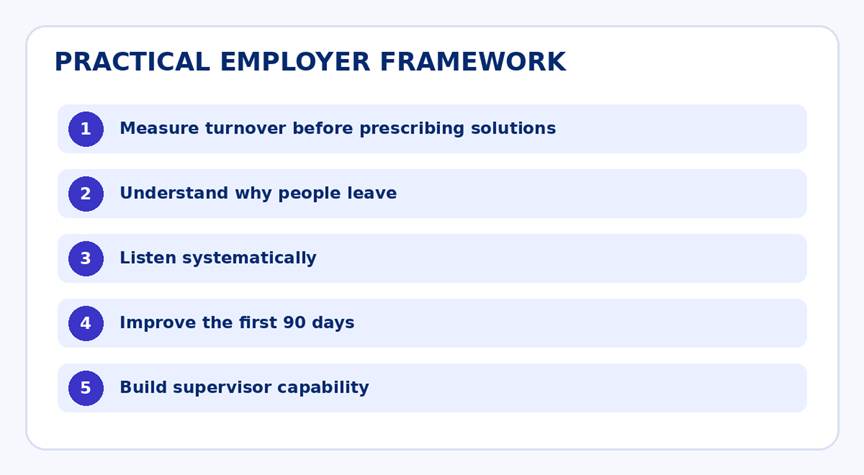
Listen systematically
Use confidential stay interviews, carefully designed exit interviews, manager check-ins and anonymised trend reviews. Ask what enables good work, which obstacles recur and what would improve the next six months. Communicate actions taken so staff can see that feedback matters.
Improve the first 90 days
A practical onboarding plan should include an accurate role briefing, essential tools, safety orientation, named supervisor, weekly check-ins and measurable milestones. Early exits may reveal a mismatch between the advertised job and actual conditions.
Build supervisor capability
Train line managers to set clear priorities, give specific feedback, handle concerns respectfully and identify workload problems. Monitor patterns by team without making unsupported accusations against individuals. Manager development is a practical retention investment.
Review progression and rewards
Map possible skill development, internal movement and promotion criteria. Assess compensation against role responsibilities and local conditions using reliable benchmarks. Avoid promising promotions or salary adjustments that the organisation cannot deliver.
Keep employment practices sound
Review contracts, working hours, leave, workplace safety and dispute procedures against applicable labour requirements. Tanzania’s Employment and Labour Relations Act provides a core framework, but specific legal questions need qualified advice.
Create a 30-60-90 day retention plan
First 30 days: measure exits and interview managers. By 60 days: pilot two improvements, such as onboarding and shift planning. By 90 days: compare early exits, employee feedback and service performance with the baseline. Record results and adjust.
HumanValue support
HumanValue HR services can help employers structure workforce diagnostics, recruitment support and manager capability initiatives. Learning Center programmes can support targeted development where relevant.
Frequently asked questions
What is employee turnover rate?
It is departures over a period divided by average headcount, multiplied by 100.
Is a high turnover rate always bad?
Not necessarily. Interpret it by role, tenure, business context and reasons for departure.
How quickly can retention improve?
Start with a 90-day pilot and evaluate results against a documented baseline.
Official sources
World Bank Tanzania Economic Update:
Tanzania National Bureau of Statistics labour reports:
Employment and Labour Relations Act: