


HumanValue Career Intelligence | Tanzania | Researched 8 November 2026
A good field enumerator records the respondent’s answer faithfully, follows the survey protocol and raises inconsistencies for the right review. The job is not to make every record look tidy. An unusual answer may be true; a missing answer may require a specific code; and an apparent contradiction may come from the questionnaire itself.
For Tanzanian jobseekers considering field research, monitoring or survey assignments, data-quality judgement is as important as confidence with a tablet. This guide explains the boundaries between collecting, checking and changing information. It provides an original fictional practice case rather than advertising a vacancy or claiming a certification.
Understand the instrument before judging an answer
Start with the approved questionnaire, field manual and definitions. A question about people who usually live in a household may use a different reference group from a question about people who slept there last night. A figure that appears inconsistent may therefore be correct under the survey definitions.
Learn the reference period, units, response codes and routing rules. “Not applicable”, “does not know”, refusal and a genuinely missing response should not be treated as interchangeable. Ask during training how each is recorded and when the supervisor must be consulted.
If a translated question is unclear, report the wording issue through the agreed channel. Do not quietly substitute a different question in each interview. In a multilingual field team, consistent approved interpretation helps keep the data comparable without putting words into the respondent’s mouth.
Know where each quality check belongs
The World Bank’s DIME data-quality assurance guidance treats questionnaire design, field management and frequent checks as complementary defences. Its high-frequency checks guidance describes checks for response consistency, enumerator patterns, programming issues and duplicates. These are project-level practices; a single enumerator should not independently redesign the research rules.
| Check | Purpose | Enumerator’s responsibility |
|---|---|---|
| During-interview clarification | Understand a response within the approved wording | Use neutral prompts permitted by the protocol |
| Pre-submission review | Identify missing fields or apparent contradictions | Review and flag; do not guess an answer |
| High-frequency checks | Find patterns across incoming records | Respond to documented feedback through the supervisor |
| Authorised back-check | Verify selected information independently | Follow the project’s assigned roles and respondent-contact rules |
| Data correction | Resolve a confirmed error with traceability | Apply only permitted corrections and retain the reason |
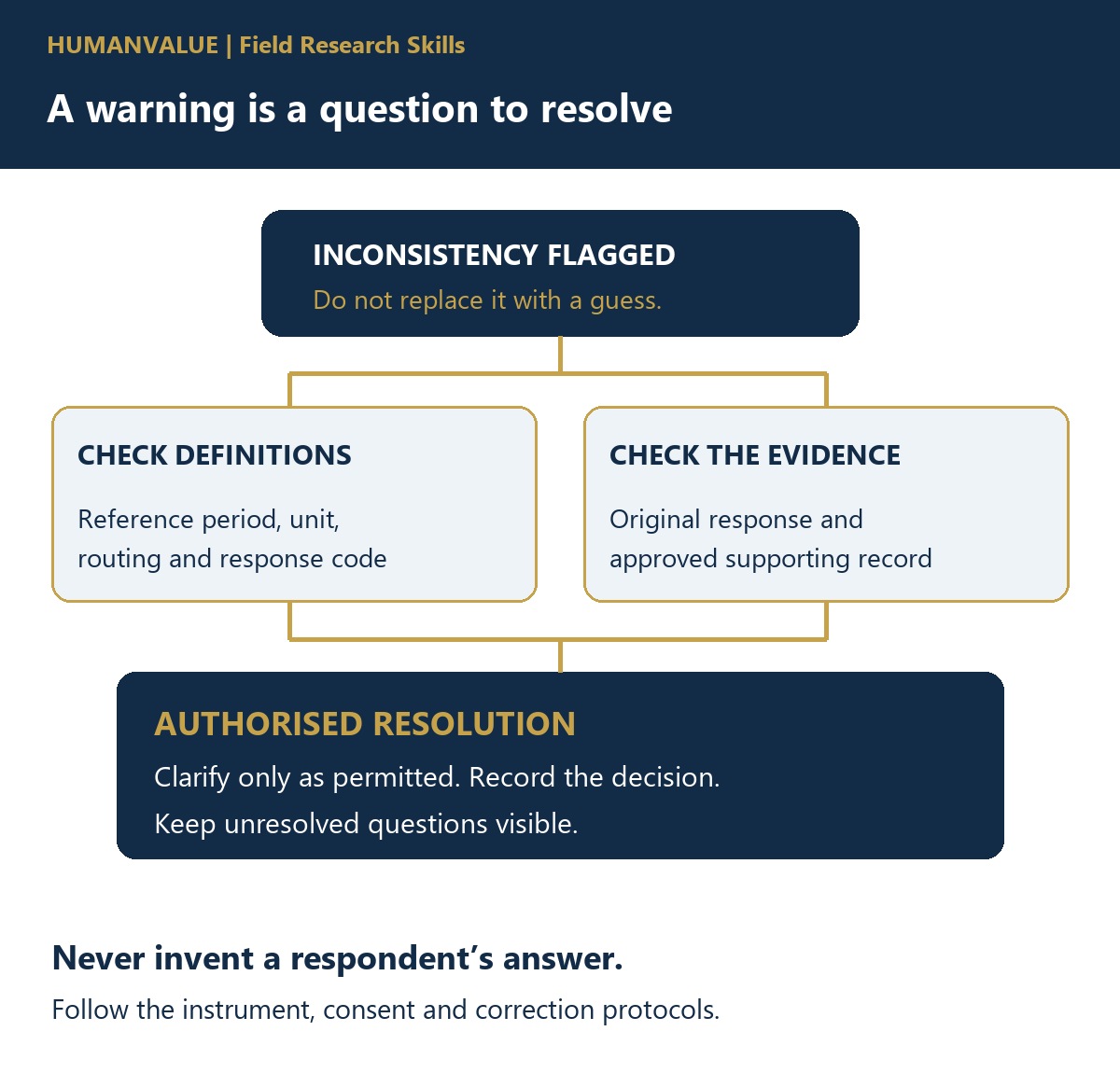
A software validation warning is a prompt to investigate. It is not proof that the respondent is wrong. Similarly, a record that passes every programmed check may still contain a misunderstood question or an incorrect unit.
Practise with a fictional household record
Use invented data for practice. Suppose a fictional instrument defines household membership for the exercise and contains a roster of five people. A summary field records six members. Another field records distance in kilometres, while a note says the respondent answered in metres. A third item is blank, and the exercise manual allows a refusal code.
The task is to identify the questions to resolve, not choose the most convenient numbers. The roster difference could come from an omitted member or a summary-entry error. The unit issue requires confirmation of the original response and the permitted conversion method. The blank cannot be assumed to mean refusal simply because a refusal code exists.
Fictional supervisor note: “Practice record H-021 has a roster total of five and a summary total of six. The distance note and field unit also differ. I have not changed either value. Please review the supplied evidence and advise the authorised clarification or correction process. The blank item has no recorded reason.”
Do not use real household names, phone numbers or locations in a public portfolio. A practice file should clearly state that all records are invented. It can demonstrate reasoning without exposing respondents or implying that you collected official statistics.
Use neutral clarification and respect the respondent
When the protocol permits clarification, explain the question without suggesting the desired answer. “You said six; may I check who is included under this definition?” is different from “It should be five, correct?” The latter can steer the response.
Consent, refusal, recontact and sensitive questions require the project’s approved procedures. Do not promise benefits, payment or absolute confidentiality beyond what the authorised information sheet actually says. Do not contact a respondent again merely because you would prefer a more complete record.
The World Bank’s field-data preparation guidance highlights advance protocols for quality feedback and data security. In practice, ask how devices, access, transmission and any lost-device incident should be handled before deployment. Do not send survey exports through a personal channel because it is convenient.
Respond to feedback without hiding the problem
A supervisor may flag a very short interview, repeated answers or an unusual pattern. Explain what happened and refer to the actual record. A pattern can indicate a training need, a routing problem or a genuine feature of the sample; it should be examined rather than treated automatically as misconduct.
Maintain a query log using project-approved identifiers. Separate open questions, authorised corrections and issues referred to the research team. Record the reason for a change and who approved it. Do not delete a difficult record or change timestamps to improve a performance measure.
Show employers how you think about quality
In an interview, describe a genuine situation where you noticed uncertainty, followed instructions and sought a resolution. If you are new to fieldwork, present the fictional case as a learning exercise and explain what remains to be learned in formal project training.
Ask a prospective employer about the instrument, training, supervision, language requirements, travel arrangements, device responsibilities and payment terms. Verify the actual vacancy and contract. A generic fieldwork title does not establish the duration of work, compensation or the qualifications required.
Questions new enumerators ask
Should I change an outlier to a typical value?
No. Check according to the protocol. An outlier may be genuine, and replacing it with a plausible number would distort the record.
Can I fill a blank from memory?
Follow the approved correction procedure and its evidence requirements. Do not assume that uncertain recollection is sufficient or that every blank has the same meaning.
Does a spreadsheet exercise qualify me for survey work?
It can demonstrate part of your preparation. It does not replace instrument-specific training, ethical procedures or the employer’s assessment of field readiness.
Build the next skill deliberately
For organising a fictional query log and practising clear summaries, review Workplace Excel Essentials in the HumanValue Learning Center. Match the resource to the gap; survey software and project protocols still require their own training.
To improve how you describe fields and definitions, read the HumanValue data-dictionary guide. For resolving a confirmed record error, use our Kiswahili guide to corrections with a clear history. The aim is reliable work that a supervisor can understand and verify.