


The 2026 international career market is shaped by overlapping forces: artificial intelligence, cybersecurity, ageing populations, infrastructure investment, the green transition, supply-chain change and tighter migration controls. Opportunity exists, but access is increasingly specific. Employers and governments are targeting defined skills, experience and language rather than offering broad “jobs abroad.”
This report converts current signals into a practical map for African professionals. It is not a vacancy list, salary survey or immigration guarantee. Use it to choose where to research, which evidence to build and which official rules to verify.
|
Key answer: The strongest cross-market signals sit in health, data and AI, cybersecurity, renewable energy, engineering, skilled trades, logistics and operational management. Access depends on licensing, employer demand, work authorisation, language and proof of results. |
What the global evidence says
The World Economic Forum's 2025 report, based on more than 1,000 employers representing over 14 million workers, identifies technological change, demographic shifts and the green transition among the major forces reshaping jobs through 2030. Employers expected 39% of core skills to change.
The US Bureau of Labor Statistics' updated 2025–2035 projections show strong growth for nurse practitioners at 41.0%, solar photovoltaic installers at 36.5%, data scientists at 34.6%, wind-turbine service technicians at 29.5%, medical and health services managers at 24.2% and information-security analysts at 21.0%. These are US projections and do not establish visa availability, but the occupation themes echo across other markets.
Canada's February 2026 Express Entry announcement continued targeted selection for strong French skills, healthcare and social services, and trades, while adding or emphasising specific categories including transport occupations and certain researchers and senior managers with Canadian experience. The details illustrate a broader point: policy increasingly rewards precise combinations of occupation, experience, language and location.
Opportunity cluster 1: health and care
Ageing populations and service demand support roles in nursing, advanced practice, allied health, mental health, health administration and selected care occupations. African professionals may bring valuable clinical and system experience, but regulated practice requires licence recognition, language evidence and country-specific assessment.
Build a licensing map before applying. Record the authority, qualification assessment, examination, supervised practice, language, document verification, cost and lead time. Employers may support some stages; they cannot waive the regulator's requirements.
Non-clinical opportunities also matter: health data, supply chain, quality, finance, programme management and digital health. These may travel more easily across borders, but still require sector understanding and privacy discipline.
Opportunity cluster 2: data, AI and software
Demand is moving from generic “tech talent” toward professionals who can connect technology to a business domain. Data scientists, software engineers, cloud specialists, product professionals and AI practitioners remain relevant, while finance, operations, HR and marketing roles increasingly require data and automation fluency.
A portfolio should show a defined problem, data source, method, controls, result and limitations. Employers want professionals who can assess AI output, protect data and explain trade-offs. Domain expertise differentiates candidates in a market where basic tool use is becoming common.
Remote delivery is possible for many roles, creating access without relocation. However, employer location policies, security, payment and worker-classification rules still apply. JobsTanzania International Opportunities should be used alongside employer and official verification.
Opportunity cluster 3: cybersecurity and digital trust
Cybersecurity demand spans security operations, governance, risk, cloud security, identity, audit, awareness and incident response. The BLS projects information-security analyst employment to grow 21.0% in the USA from 2025 to 2035.
Candidates need more than tool names. Build evidence through labs, risk assessments, incident exercises, secure configurations and policy implementation. Explain ethical boundaries and do not publish exploit details that create harm.
Experience with financial services, telecoms, infrastructure, manufacturing or government can be valuable because cyber risk is operational. International roles may impose clearance, residence or data-location restrictions, so read eligibility carefully.
Opportunity cluster 4: green energy and infrastructure
Solar, wind, grid, storage, energy efficiency, environmental management and resilient infrastructure are growing capability areas. BLS projections for solar installers and wind-turbine technicians illustrate the US demand signal, while African markets also offer major energy and infrastructure needs.
Roles range from technicians and engineers to project finance, procurement, environmental and social performance, construction management, data and community relations. Field roles may require local licences, safety credentials and physical presence. Programme and analytical roles may be regional or remote.
Build proof around project scale, safety, quality, schedule, cost, stakeholder management and measured energy or resource outcomes. Avoid unsupported carbon claims.
Opportunity cluster 5: engineering, trades and maintenance
Industrial maintenance, electrical, mechanical, construction, welding, machining and related trades remain important where infrastructure and manufacturing expand or retirements reduce supply. Canada continued a trades focus in 2026 category-based selection; the UK and European countries operate occupation and employer-specific routes; Gulf markets recruit for projects and operations.
Qualifications must be translated into the destination's terminology. Compile trade certificates, apprenticeship evidence, safety training and employment letters describing actual tasks. Test and licensing requirements can be decisive.
African plant, mining, energy and construction experience can be highly relevant when candidates show equipment, standards, site conditions, safety record and measurable reliability or project outcomes.
Opportunity cluster 6: logistics, operations and management
Supply-chain resilience has increased demand for planning, procurement, warehousing, fleet, trade compliance and operational leadership. The BLS projects US logisticians to grow 17.6% from 2025 to 2035. Canada identified transport occupations in its 2026 category changes.
International candidates should show systems, network scale, service level, cost, inventory, safety and stakeholder results. Senior managers need evidence of governance, transformation and people development, not only years of experience.
Middle Eastern and African regional markets may offer project and operational roles with relocation, while planning and analytics can support remote or hybrid delivery. Contract and package quality vary; apply a full relocation analysis.
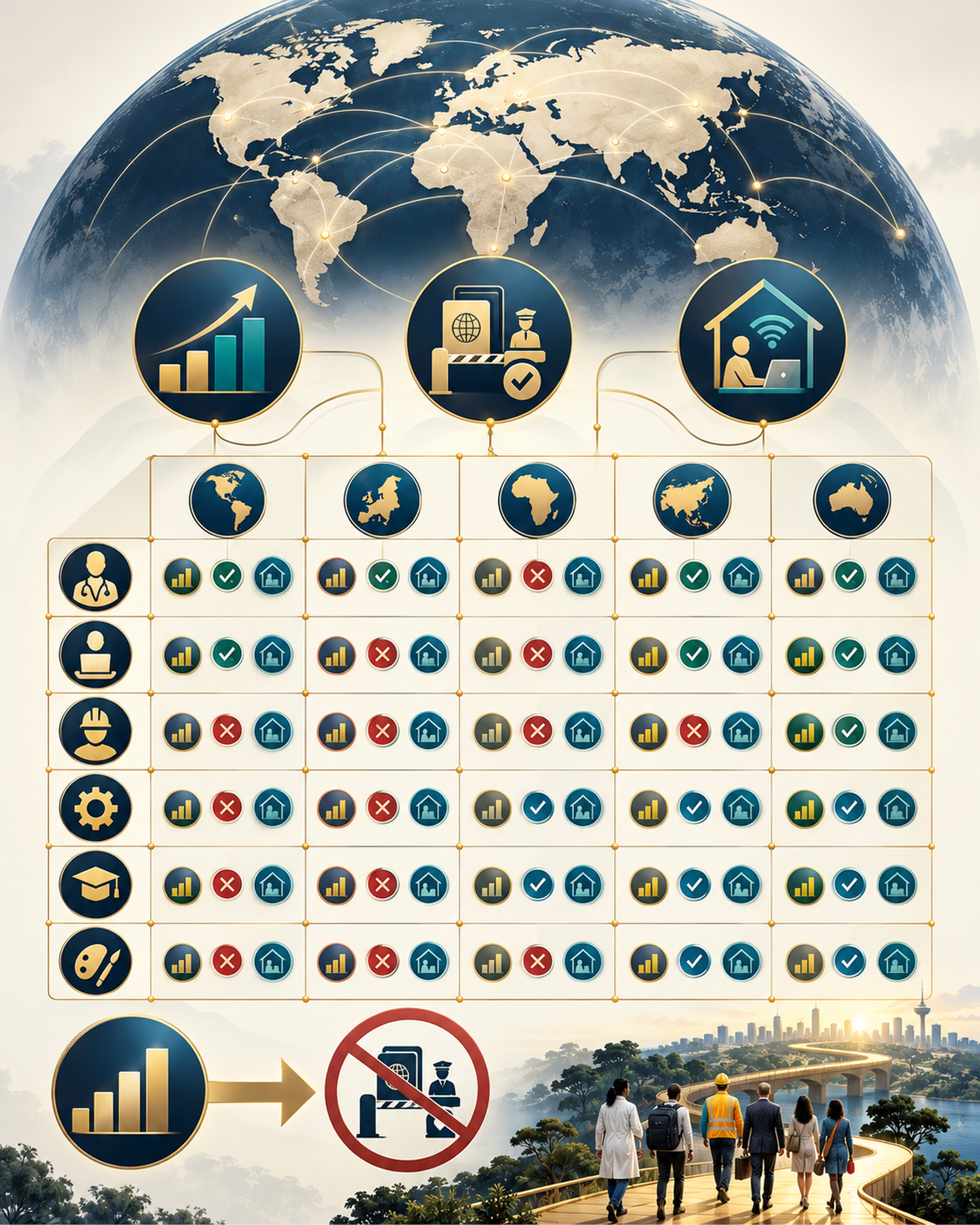
Regional access map
USA
Strong occupation growth does not equal easy sponsorship. Target employers and categories relevant to your exact role. Regulated health roles require licensing. Technology and specialist roles need differentiated evidence. Use official US sources for work-authorisation rules.
Canada
Monitor Express Entry, provincial and employer routes separately. French can create an advantage in relevant selection. Health, trades and transport are visible signals in 2026 policy, but programme criteria and invitation patterns can change.
United Kingdom
The Skilled Worker route requires an approved sponsor, certificate of sponsorship, eligible occupation and applicable salary. Build a sponsor-aware employer list and check current GOV.UK rules before each application.
European Union
The EU Blue Card applies in 25 Member States and generally requires a qualifying offer or contract of at least six months plus qualifications or recognised skills and country salary rules. National permits and labour-market needs differ; choose the country before tailoring.
Middle East
Projects, infrastructure, hospitality, aviation, health, energy and corporate services can create opportunity. Verify employer, contract, work-authorisation process, worker protections and total package. Do not pay for the promise of a role.
Convert the report into a 60-day decision
Select two occupation clusters and two markets. Collect 30 real vacancies and code them by capability, qualification, language, licence, location and employer. Score current evidence. Drop markets where the legal or professional gate is unrealistic in the near term.
Choose one priority gap and produce evidence. Update the CV, LinkedIn profile and portfolio around the target. Build a list of employers, recruiters and professional associations. Apply selectively and track conversion.
Use HumanValue CV Services for market-specific positioning, the Learning Center for targeted capability and International Opportunities for verified discovery.
How to read an opportunity signal without overreacting
Score each signal on four dimensions. Strength: is it supported by an official projection, immigration announcement or repeated vacancies? Specificity: does it apply to your exact occupation, level and location? Accessibility: can an international candidate meet licensing, language, sponsorship and experience gates? Durability: is demand structural or tied to a temporary project?
A high-growth occupation can still be inaccessible because licences take years or employers recruit locally. Conversely, a moderate-growth niche may be attractive when your experience is scarce and the employer can hire remotely. The score prevents headlines from replacing analysis.
Build a market evidence table with at least 30 vacancies collected over four to six weeks. Record employer, role, country, skills, licence, language, location policy, salary if disclosed and sponsorship wording. Count repeated requirements, but read the job descriptions; similar titles can contain different work.
Validate with people. Speak to practitioners, recruiters, professional bodies and diaspora members. Ask what employers struggle to assess, which qualifications transfer and why candidates fail. Treat anecdote as a question to test, not a statistic.
Set a review date. Policy, occupations and salary thresholds can change. This report is dated 26 September 2026; readers should recheck official sources when applying. A living opportunity plan records the date of every assumption and retires stale information. That discipline is more valuable than chasing each new “shortage jobs” list.
Keep separate confidence labels for confirmed facts, directional signals and personal hypotheses. When evidence conflicts, prefer the primary government, regulator or employer source and record the uncertainty. This prevents the report from becoming false precision.
|
CHOOSE A CLUSTER, BUILD THE EVIDENCE, TRACK THE MARKET |
|
TURN MARKET SIGNALS INTO A TALENT PIPELINE |
Frequently asked questions
Which global sector has the best opportunity in 2026?
There is no single winner. Health, data/AI, cyber, green energy, engineering/trades and logistics show strong signals, but access depends on role evidence, licensing, location and work authorisation.
Do BLS growth rates apply outside the USA?
No. They are US projections. They help identify themes, but candidates must use destination-specific labour and immigration sources.
Is remote work included in this report?
Yes, especially for software, data, cyber, finance operations and digital services. Remote eligibility still depends on employer policy, security and lawful contracting.
Does Canada's category list guarantee an invitation?
No. Candidates must meet programme and category requirements and invitation thresholds. Categories and rounds can change.
How should graduates use the report?
Choose one cluster, analyse entry-level vacancies, build a relevant project or internship, and avoid presenting senior occupation data as an immediate path without required experience.
How often will JobsTanzania update opportunity intelligence?
The growth strategy proposes a weekly “Global Opportunities for Africans” report and regular curated listings. Readers should still verify every source, deadline and eligibility condition at the time of application.
Research and Editorial Sources
Sources support market direction and factual claims. They do not create guarantees for an individual candidate, employer, visa or hiring outcome.
- World Economic Forum — The Future of Jobs Report 2025
- US Bureau of Labor Statistics — Fastest growing occupations, 2025–2035
- Government of Canada — 2026 Express Entry categories
- GOV.UK — Skilled Worker visa
- European Commission — EU Blue Card
- World Bank — Digital Africa
Build your next step with HumanValue
Choose the support that fits your needs. Paid support is optional and does not guarantee employment, interviews or immigration approval.
Editorial review: Research prepared 26 September 2026. Immigration, tax, employment, salary and licensing rules can change. Recheck the linked official sources before acting.