


A good maintenance coordinator can turn five competing requests into a safe, traceable work plan. When hiring for a Tanzanian office, campus, warehouse or commercial property, use a practical exercise to see how a candidate identifies risks, briefs technicians and confirms that work is complete. The fictional assessment below takes 45 minutes and can be run with a spreadsheet or on paper.
Define the work before advertising
Map the handovers among occupants, security, maintenance technicians, vendors and management. State who may authorise spending, close a floor, approve vendor access and confirm a repair. Specify which duties require a qualified technician and which belong to the coordinator. Advertise the actual sites, working pattern and escalation arrangements. Someone coordinating two Dar es Salaam buildings has a different job from someone arranging service visits across multiple regions.
Define what a good first month looks like in observable terms. For example, every urgent request has a timestamp and a named owner, recurring faults are linked, and every closed work order records how the repair was verified. Explain whether the role includes asset registers, preventive maintenance scheduling or invoice reconciliation. Those details let applicants present relevant examples.
Give every candidate the same five requests
| Fictional report | Evidence to look for |
|---|---|
| Water is pooling near an electrical cabinet | Escalates promptly, requests controlled access through the responsible team and avoids instructing anyone to inspect live equipment. |
| A stairwell light has failed | Checks the route, visibility and alternative access before deciding urgency. |
| A meeting room is warm before a visitor arrives | Offers a practical workaround and opens a service request with the location and symptoms. |
| A recurring door fault was reported twice | Links the reports, checks prior repairs and asks what would establish that the fault is resolved. |
| A vendor requests unscheduled access | Verifies the visit and uses the agreed security and approval process. |
Give candidates an invented site plan, a contact list and a one-page policy describing emergency escalation, authorisation limits and vendor access. Their job is to work from those instructions. Use fictional site details and ask for no customer records or documents from previous employers.
Run the 45-minute work sample
- 10 minutes for triage. Rank the requests and name any facts that could change the order.
- 15 minutes for the register. Capture a reference, time, location, description, priority, owner, next action and follow-up time for each request.
- 10 minutes for communication. Write one brief update to occupants and one vendor instruction with an access contact and a clear scope.
- 10 minutes for review. Explain how the highest-priority item was handled and how to verify the door repair before closing it.
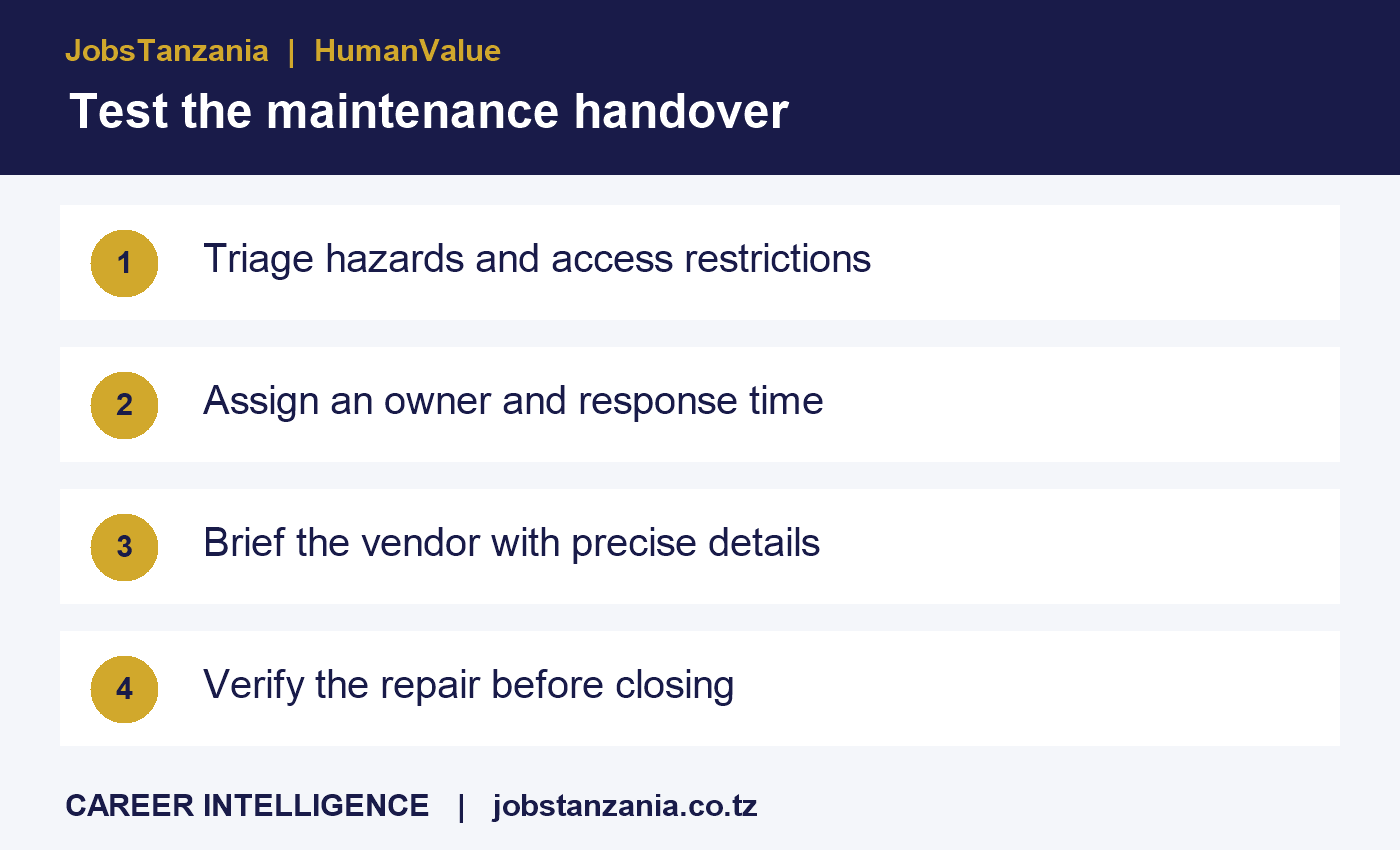
Score the decisions you can observe
| Measure | Points | Evidence |
|---|---|---|
| Safety triage | 30 | Escalation and access controls match the supplied instructions. |
| Work-order accuracy | 25 | Locations, symptoms, references and owners are traceable. |
| Communication | 20 | Messages contain one clear action and a realistic update time. |
| Vendor coordination | 15 | Scope, authorisation and site access are addressed. |
| Closure and follow-up | 10 | Completion evidence and repeat faults are recorded. |
Have two reviewers score independently and record one example for each score. For safety triage, agree on essential behaviours in advance. A candidate who describes a risky action should have the opportunity to explain their reasoning under the same rules applied to everyone. Give candidates the same time, instructions and opportunity to clarify. The suggested weights can be adjusted before the assessment to reflect the role.
Use the first month to test the handover in practice
Week one: Walk the property, check who holds each escalation responsibility and rehearse an urgent scenario. Week two: Assign supervised routine work orders and review the notes before closure. Week three: Introduce vendor scheduling and recurring defects. Week four: Sample ten records and discuss whether each one shows the original report, the response and the evidence of completion.
Review repeat faults and overdue work by priority. An average closing time can hide an urgent defect left unattended or several simple tickets that were closed quickly. Use the review to improve the handover, clarify authority or update the preventive maintenance list.
Frequently asked questions
Does the candidate need experience with our maintenance software?
List it as essential when the role requires immediate proficiency. A fictional spreadsheet can show the same underlying skills in recording, ownership and follow-up while your onboarding teaches the system.
What evidence supports closing a work order?
Agree on the evidence for the fault before assigning it. Examples include a technician’s completion note, a supervised function check or confirmation from the person who reported the fault. Record who verified it and when.
Can the same exercise be used for different properties?
Adapt the locations and escalation rules to the site. Preserve the role-relevant decisions and score all candidates for the same vacancy against the same instructions.
Prepare your vacancy and assessment
Write the escalation rules, run the exercise with your reviewers and tighten any ambiguous instructions. Then post the vacancy on JobsTanzania or speak with HumanValue HR Services about recruitment support. Share the sites, reporting lines and work-order responsibilities when making your enquiry.