


HumanValue Employer Intelligence | Tanzania | Researched 8 November 2026
Hire hotel reservations staff by assessing how they handle an enquiry, check the booking evidence, communicate unresolved terms and stay within their authority. A candidate’s warm manner is valuable, but it should sit alongside accurate records and commercial judgement. Use a realistic fictional booking case, a consistent interview and a clear induction plan to understand those skills before making an appointment.
This guide is for Tanzanian accommodation employers designing an ordinary recruitment process. It does not set hotel cancellation rules, guest rights or employment-law requirements. Its case and scorecard are original, proposed assessment material to adapt and pilot for the actual job. They are not a validated certification or a guarantee of performance.
1. Start with the property’s actual workflow
A city hotel handling business arrivals may need different experience from a lodge coordinating several travel arrangements. The role may cover enquiries only, confirmed bookings, amendments, guest communication or a mix of these. Clarify which channels, systems and departments the employee will use and what decisions need a supervisor.
Write down the work that must be performed competently from the start and the work you will teach. If your vacancy requires specific system experience, explain why. Do not advertise a support position and then test applicants as though they will independently manage revenue, refunds and every operational exception.
| Area | Employer decision | Selection implication |
|---|---|---|
| Booking channels | Which enquiries and confirmed records does the role handle? | Choose a case reflecting those channels |
| Commercial authority | Who approves rate exceptions, refunds or upgrades? | Assess recognition of limits, not unsupported promises |
| System competence | What knowledge is essential on entry and what training is provided? | Use a permitted demonstration or fictional record exercise |
| Guest communication | What language and written tasks are genuinely required? | Assess relevant messages against clear criteria |
| Working arrangements | What shifts, reporting line and handovers apply? | Describe the actual arrangements to candidates |
2. Use a fictional case that tests more than typing speed
Prepare an invented booking request, a practice reservation record and a short property procedure. State what the candidate may decide, which information is available and who receives an escalation. Include no real guest names, contact details, payment information or confidential hotel prices.
For the exercise, booking H-031 covers a standard room for two nights. An invented guest asks to arrive one day earlier and retain the same rate. The additional night’s availability has not been confirmed, and the practice procedure requires a supervisor to approve a rate exception. The applicant must identify what can be checked, what needs approval and what can honestly be communicated now.
Give every candidate the same materials and access to the same tools. Explain the format and arrange appropriate participation through your recruitment process. Pilot a proposed 35-minute timing rather than assuming it is sufficient. A realistic task should be proportionate; applicants should not be processing your real pending bookings.
The US Office of Personnel Management’s work-sample guidance describes assessing activities resembling job tasks. Use that methodological principle to match the exercise to your role. It does not replace the employer’s responsibility to follow applicable local hiring requirements.
3. Request three outputs
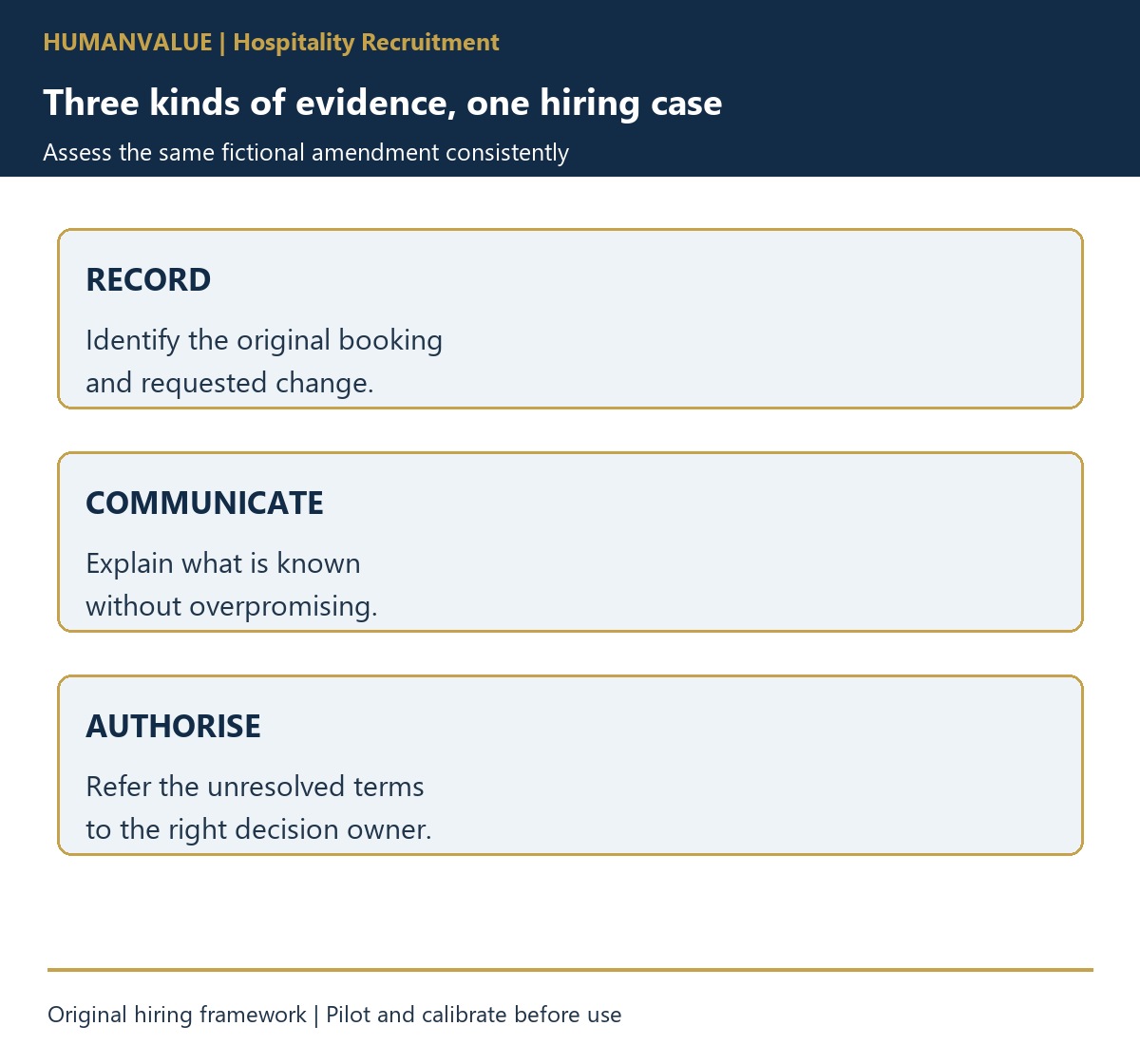
First, ask for a discrepancy-and-questions note. Second, request a brief guest response. Third, ask for an internal handover to the reservations supervisor. This combination shows whether the person can distinguish an enquiry from an approved change and whether the next colleague can see what remains unresolved.
Illustrative response, not a real hotel message: “Thank you for your request to arrive a day earlier. We are checking availability and the applicable terms for the additional night. We will update you at the agreed time once the reservation team has reviewed the request.”
Do not reward the candidate simply for using those exact words. Look for an accurate explanation, respectful tone and an update the exercise allows. A response promising the original rate before approval should be discussed as an authority issue, even if its writing is polished.
4. Score the booking decision trail
| Criterion | Points | Evidence to record |
|---|---|---|
| Record checking | 25 | Correct reference, original dates and requested amendment are identified |
| Availability and terms | 25 | Unverified extra night and unresolved rate are kept explicit |
| Guest communication | 20 | Clear response without a premature confirmation |
| Approval judgement | 20 | Supervisor decision is requested where required |
| Handover | 10 | Owner, next action and update time can be followed |
Prepare an answer guide listing the material issues and acceptable approaches. Have reviewers note evidence independently before discussing scores. A candidate may use a different sequence and still demonstrate sound judgement. Do not confuse a preferred wording with the underlying competence you intended to assess.
5. Ask interview questions about ownership
Use a consistent core of questions. Ask candidates to describe a booking change or guest-service issue they genuinely handled: what information they checked, what they could decide, whom they involved and how they confirmed the outcome. Follow up neutrally to distinguish personal actions from a broader team result.
OPM’s structured-interview guidance explains using predetermined questions and common rating standards. For your panel, agree what evidence supports each rating before interviews begin. Keep notes relevant to the role and avoid requesting confidential guest records from a previous employer.
6. Check the gaps before appointment
Compare the exercise, interview and required background. If someone communicates well but misses an unresolved rate, discuss the evidence and training need. If they claim proficiency in a named system, verify it through an appropriate authorised process rather than assuming a screenshot proves competence.
Conduct relevant verification consistently and with appropriate permissions. Explain the actual shifts, reporting arrangements and role expectations. Do not use an assessment score to conceal a requirement that was never communicated. Document the reasons for the selection through your normal process.
7. Make induction specific
Introduce the property’s approved enquiry, booking, amendment and escalation procedures. Show how linked services are coordinated and how unresolved items move between shifts. Start with supervised tasks, then review accuracy and authority use before expanding responsibility.
For learning support, the HumanValue booking-mismatch guide offers a fictional comparison exercise. The Microsoft 365 Collaborative Workplace course may support approved communication and task coordination where its contents fit the role. It is not property-management-system training.
8. Questions employers often ask
Should system speed decide the hire?
Assess the actual job requirements. Speed matters in some tasks, but a fast incorrect amendment can create avoidable problems. Examine accuracy, judgement and the training available alongside speed.
Can we use a live guest complaint?
Use a fictionalised case with invented records. Keep sensitive guest information out of candidate materials and avoid asking applicants to perform real unpaid service work.
Does the scorecard guarantee a good appointment?
No. It is one proposed evidence tool. Role design, relevant verification, supervision and induction still matter, and the assessment needs calibration for your property.
9. Give HumanValue a clear recruitment brief
Bring the role’s booking channels, system requirements, authority limits, shifts and service expectations when discussing HumanValue recruitment support. We can discuss sourcing, screening and relevant assessment deliverables, with responsibilities, timing and fees agreed before work begins. If your team manages selection internally, post the vacancy on JobsTanzania with the actual requirements.
Editorial contact: Emily Sebashahu
HR Services & Recruitment Director, HumanValue Consulting Limited.
Follow Emily on LinkedIn for HR and recruitment insights.