
Quick answer
A strong cover letter for a Tanzanian job application is not a second CV. It is a one-page business case connecting the employer's most important requirements to two or three verified examples from your experience. Start with the exact role, show evidence with results, explain why the organisation or sector matters to you, and close with a clear invitation to discuss your fit. Never copy a template without replacing every bracketed field and checking that the letter matches the vacancy.
Key facts
· Tailor the letter to one vacancy and use the employer's terminology where accurate.
· Keep the argument focused: role, evidence, motivation and next step.
· Use achievements you can explain and defend in an interview.
· Keep the main letter to one page unless the employer requests otherwise.
· Check names, job title, advert reference, dates, attachments and file names before sending.
· Treat the letter as a writing sample: concise, accurate and professional.
Why a cover letter matters in Tanzania
A CV records your career history. A cover letter interprets that history for one hiring decision. The employer should not need to guess which requirement you meet, why your experience is relevant or what contribution you could make. The letter makes that connection in a controlled, readable way.
Local career guidance consistently recommends a formal structure, a role-specific opening, evidence linked to job requirements and a concise close. The strongest point is not the format alone. It is the quality of the match between the vacancy and the applicant's proof. A polished letter with generic claims remains weak; a short letter with relevant evidence is usually more useful to the reader.
Before drafting, also align the letter with your CV. Use the JobsTanzania guide on the best CV format for Tanzania in 2026 to check consistency across dates, titles, achievements and presentation.
The JD-to-evidence method
Use the job description as a decision document, not as text to copy. Read it twice. On the first pass, understand the business need. On the second, mark the requirements that appear essential, repeated or connected to measurable outcomes.
1. Capture the target: Record the exact role title, employer, location, reporting context, advert reference and deadline.
2. Select three priorities: Choose the three requirements most likely to influence screening. Separate mandatory requirements from preferences.
3. Build an evidence bank: For each priority, write one example using context, action and result. If no result is measurable, state the scale, quality, speed, risk reduction or stakeholder outcome honestly.
4. Draft the argument: Open with fit, use the middle to prove value, and close with a direct next step.
5. Run a trust check: Remove unsupported claims, incorrect company references, copied phrases and information that conflicts with the CV.
Visual: from job description to stronger cover letter
|
JD SNAPSHOT |
BEFORE: GENERIC |
AFTER: TAILORED |
|
Sales Officer |
I am hard-working and passionate. I believe I can perform the advertised duties. I have attached my CV and hope to hear from you. |
I am applying for the Sales Officer role. In my current territory, I built a disciplined follow-up routine, kept pipeline records current and coordinated pending deliveries with operations. I would bring the same account visibility and customer follow-through to your team. |
Why the “after” version is stronger: it names the target role, mirrors the real work in the job description and gives credible contribution signals without inventing results. Replace the illustrative wording with your own evidence before use.
A practical one-page structure
|
Section |
What it must achieve |
|
Header |
Your full name, professional email, phone number, location, date, recipient, organisation and subject/reference. |
|
Opening |
Name the role and give one relevant reason the reader should continue. A concise achievement, specialist capability or sector experience works better than a generic statement. |
|
Evidence paragraph |
Connect two or three requirements to evidence. Use specific verbs and verified outcomes. Avoid listing every duty. |
|
Motivation paragraph |
Show why this employer, function or sector is a logical target. Keep it factual and avoid praise that could apply to any organisation. |
|
Close |
Thank the reader, state availability and invite a discussion. Mention attachments only if useful. |
Six ready-to-edit role templates
The templates below are starting structures, not finished applications. Replace every bracketed item, delete any claim you cannot support, and match the tone to the vacancy. Separate editable Word files are included in this pack.
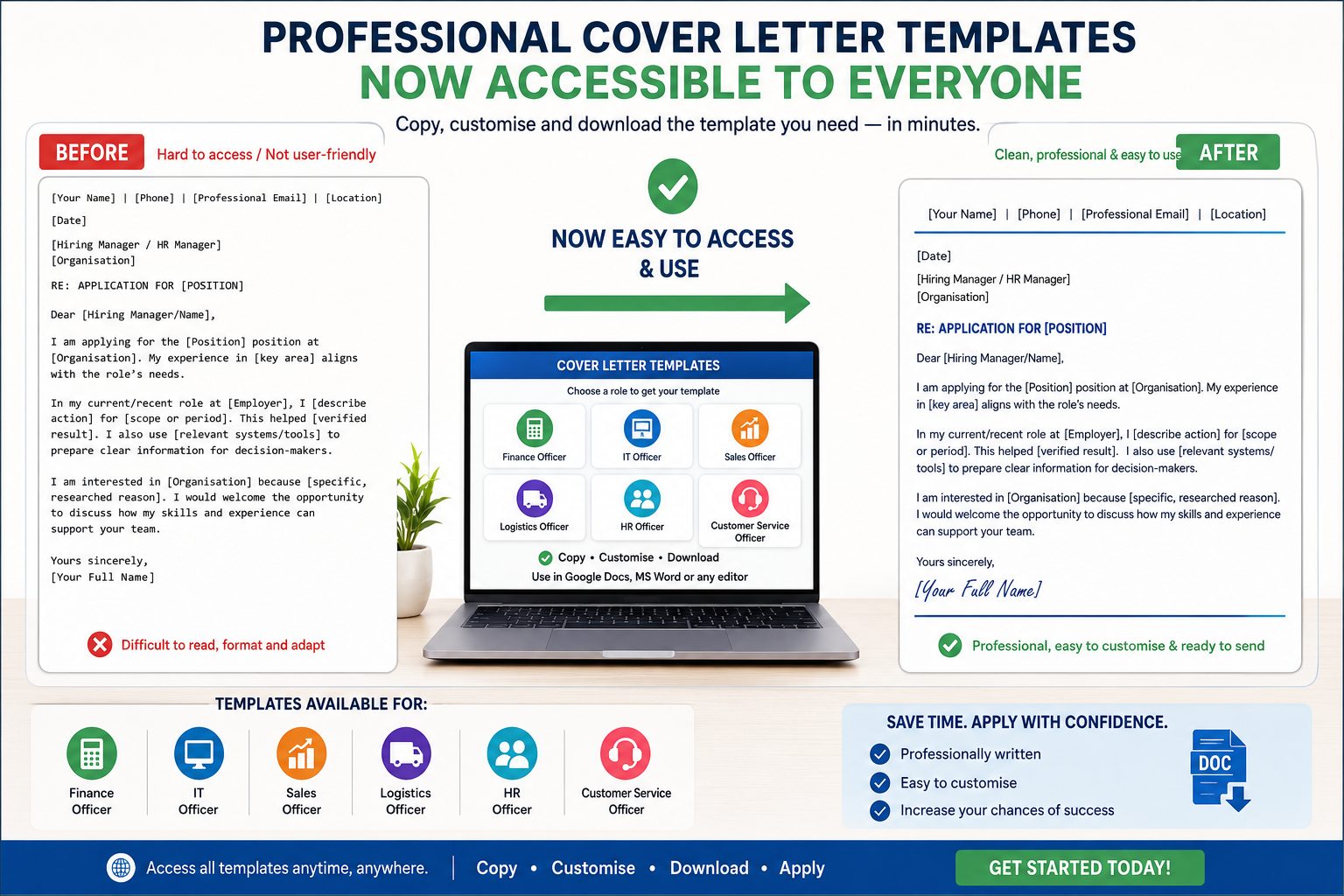
Ready to make your application stand out? Access the cover letter templates here and get a bonus branded PowerPoint template designed to help you communicate your value clearly and professionally for your specific role. Whether you’re applying for Finance, IT, Sales, Logistics, HR, or Customer Service positions, these ready-to-customise templates help you present your skills with confidence, save time, and make a stronger first impression.
Common mistakes and better alternatives
|
Weak practice |
Stronger alternative |
|
Repeating the CV |
Select only the evidence that proves fit for this vacancy. |
|
Using unsupported adjectives |
Replace “excellent” and “hard-working” with an example. |
|
Copying the employer’s requirements |
Explain where you have applied the relevant capability. |
|
Wrong company or role name |
Use a final identity check before export. |
|
Long biography |
Keep the argument focused on the employer’s decision. |
|
AI-generated claims you cannot defend |
Verify every statement and rewrite it in your natural professional voice. |
|
Sensitive personal details |
Include only information relevant to the application and requested by the employer. |
Final application checklist
· Exact role title and advert reference are correct.
· Recipient and organisation names are correct.
· The opening gives a relevant reason to continue reading.
· Every claim is true and consistent with the CV.
· At least one example shows action and outcome.
· The letter fits on one page when exported separately.
· Spelling, punctuation and file names are professional.
· Requested attachments are included in the stated format.
· Email subject follows the vacancy instructions.
· Contact details work and the phone is reachable.
Frequently asked questions
Should I send a cover letter if it is optional?
Send one when it adds relevant evidence or explains fit that the CV cannot show. Do not attach a generic letter simply to increase document volume.
Can I use the same template for every job?
Use the same structure, but rewrite the opening, evidence and motivation for each vacancy. The job description should determine which examples you include.
Should the letter be in English or Swahili?
Follow the language of the advert and the employer’s instructions. When the role requires formal English communication, the letter may also be assessed as a writing sample.
How long should it be?
Aim for one focused page unless the employer requests a different format. Remove repetition before reducing the font to an uncomfortable size.
What if I do not have measurable achievements?
Use honest evidence of scope, quality, speed, responsibility, stakeholder coordination or problem resolution. Do not invent percentages or financial results.
Can I use artificial intelligence to draft it?
Yes, as a drafting aid. You remain responsible for accuracy, privacy, tone and originality. Remove unsupported claims and make sure you can discuss every example in an interview.
What should I send to JobsTanzania for help?
Send your current CV, the exact job description and any existing cover letter or application instructions. Remove unnecessary sensitive information before sharing.