


A person who has managed a market stall, recorded stock for a family shop or organised deliveries for a small business may have useful experience even without a formal job title. The challenge is to describe that experience truthfully, with dates, tasks and results that a recruiter can evaluate. A credible CV does not turn informal work into invented corporate employment. It translates real responsibilities into evidence relevant to a real vacancy.
This matters in Tanzania because employability and productive work are wider than salaried office jobs. The ILO Tanzania Decent Work Country Programme 2025/26–2029/30 identifies MSME productivity, youth employability, skills development and formalisation as priorities. That policy context does not guarantee a job, but it reinforces why employers should recognise demonstrated capability while still checking qualifications and references.
Start by separating work experience from job title
Imagine Neema helped run a family stationery shop in Morogoro for two years. She handled payments, reconciled daily sales, updated stock lists and responded to customer complaints. Calling herself a “Senior Finance Manager” would mislead the employer. Calling herself “Retail Operations Assistant, family business” is more transparent. Her duties can still demonstrate customer service, recordkeeping, basic numeracy and reliability.
A recruiter needs to know who benefited from the work, how often it happened and what level of responsibility Neema held. She should write the business name where appropriate, the location, dates and a short disclosure such as “family-owned enterprise” if this helps explain the arrangement. If she was self-employed, “Self-employed Retail Trader” is more accurate than claiming a position in a company she did not join.
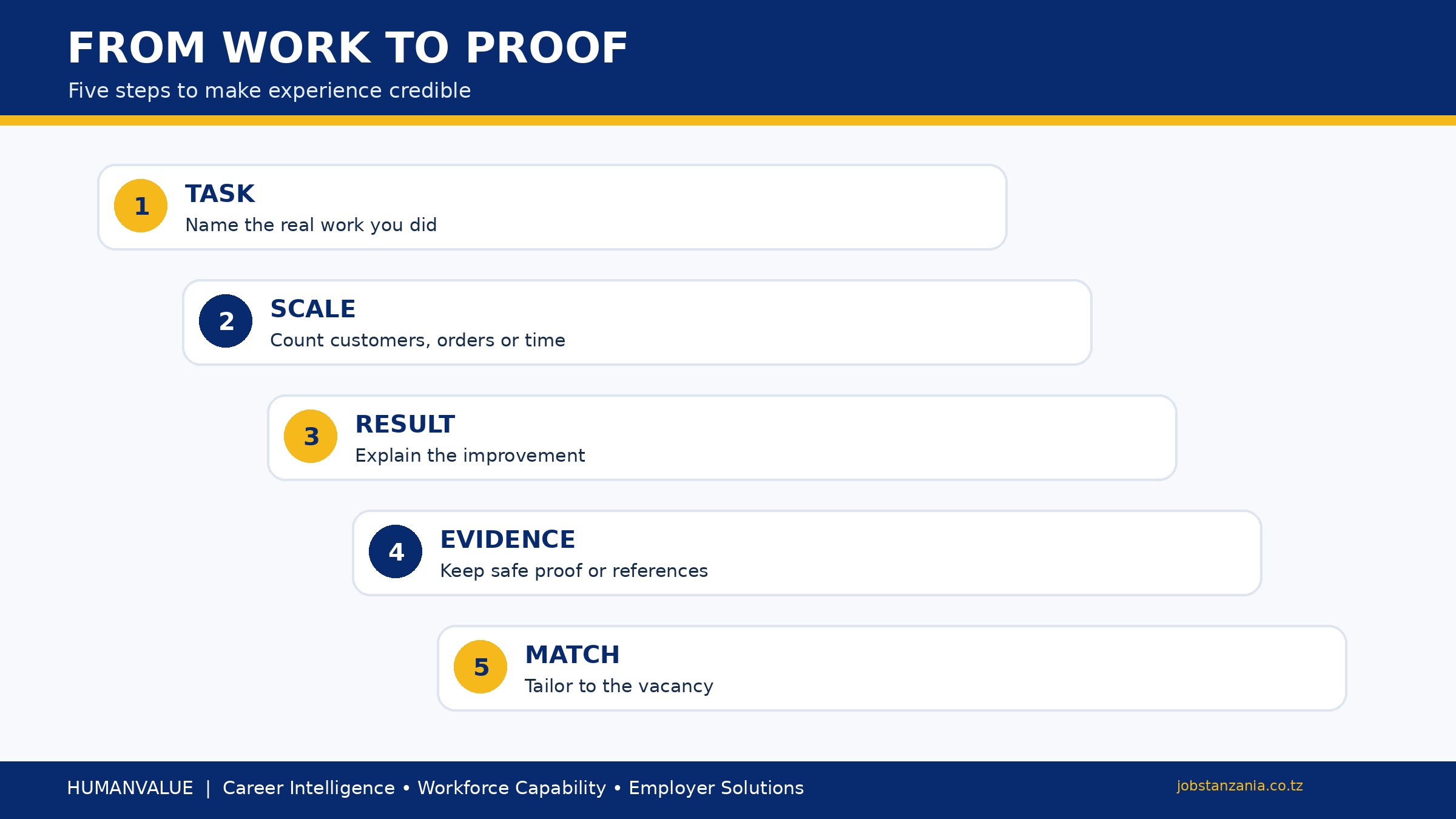
Convert duties into evidence using the TASK method
The weak statement “helped in shop” gives almost no information. A stronger statement says: “Maintained a weekly stock register for approximately 80 product lines and reconciled cash and mobile-money sales at close of business.” This is useful only if the numbers and duties are true. If records are missing, omit exact figures rather than inventing them.
For a logistics application, another example might read: “Coordinated deliveries with three local riders, confirmed customer addresses and recorded delivery exceptions.” For hospitality: “Handled guest enquiries, maintained room-preparation checklists and escalated service issues to the supervisor.” Each sentence identifies an action and a business process. Results such as reduced errors or faster service should be stated only where they can be reasonably supported.
A practical writing formula is action + scope + method + outcome. For example, “Tracked daily sales in a spreadsheet, compared stock counts every Friday and identified repeated shortages before new purchases.” It is better than a vague adjective such as “hardworking.”
Build a proof folder before applying
Employers may ask how the work can be verified. Suitable evidence can include a supervisor or business-owner reference, nonconfidential work samples, training certificates, redacted inventory templates or a short description of a completed project. Never upload customers' telephone numbers, payment records, account credentials or other confidential information to an open portfolio.
Create one folder with a one-page experience summary, a list of tools used, two or three examples you are allowed to share and contact details of references who have agreed to be contacted. If your experience includes cash handling, avoid presenting sensitive bank statements as public proof. Explain your process instead. An employer can arrange appropriate checks later.
Match the evidence to the job you actually want
An office administrator vacancy might require scheduling, document handling, Excel and communication. A candidate who has operated a kiosk can select evidence of customer records, ordering and reconciliation. A warehouse assistant vacancy might prioritise stock counts, goods receiving, safety and teamwork. The same experience can be described differently without changing the underlying facts.
Read the vacancy in full. Underline essential criteria and identify which ones you meet. Distinguish a skill you already have from one you can learn. If a role legally requires a professional licence or formal qualification, practical experience alone may not substitute for it. The HumanValue CV & Application Pack Lab teaches a vacancy-to-application method with a match matrix and evidence bank; it is relevant when your experience is real but your presentation is unclear.
A sample CV entry that can survive an interview
Retail Operations Assistant | Family-owned shop, Morogoro | January 2024–September 2026. Supported daily retail operations, handled customer enquiries and maintained stock and transaction records. Updated a weekly inventory spreadsheet, checked differences against physical stock and escalated discrepancies. Coordinated purchase requests with the owner and helped train a new assistant in customer-service routines.
This sample is illustrative, not a real person's record. Replace its dates, business type and duties with your own verifiable facts. During an interview, be ready to explain how you recorded stock, what errors occurred and what you learned. A detailed follow-up answer is often more persuasive than a polished sentence alone.
Address gaps and irregular work patterns without embarrassment
Many informal activities are seasonal. Someone may have worked in agriculture during harvest, sold goods intermittently or cared for family members while running a small service. Do not fabricate continuous full-time employment. Write “Seasonal Produce Trader, March–August 2025” or “Independent Catering Assignments, 2024–2026” if that is accurate. If you completed occasional projects, group them under “Selected Projects” with clear dates.
A CV can show both paid and unpaid experience when the distinction is made clear. Volunteering at a school or community group may demonstrate organisation and communication, but it should not be disguised as paid employment. Use consistent dates across the CV, application form and interview.
Prepare three interview stories
Employers often ask about a difficult customer, an error and a deadline. Prepare a short situation–action–result answer for each. For example: “A supplier delivery arrived with missing items. I compared the delivery note with the order, photographed the discrepancy with permission and contacted the supplier before accepting the balance.” The point is not dramatic storytelling. It is to demonstrate judgement, responsibility and evidence.
Practise explaining the tools you used. If you claim Excel, show a simple formula or stock sheet. If you claim customer service, describe a complaint and how you handled it. If you claim supervision, explain who you supervised and what authority you had.
A realistic seven-day application plan
On day one, choose two job families. On day two, list real tasks and dates. On day three, turn five tasks into measurable or observable CV statements. On day four, ask two potential references for permission. On day five, compare one actual vacancy against your skills. On day six, complete your CV and application message. On day seven, review the submission, record its date and prepare for interview questions.
You can browse JobsTanzania vacancies before deciding where to apply. If you want additional alerts, CV positioning and career guidance, Job Seeker Premium offers those support features; ordinary local job applications remain free. Check the live checkout terms before purchasing, and remember that paid support cannot guarantee a job.
Frequently asked questions
Can I include family-business experience on a professional CV?
Yes, when it is real, relevant and accurately labelled. Explain the work performed, dates and who can verify it. Avoid invented company titles or fabricated performance numbers.
What if I have no formal payslips?
Payslips are not the only possible evidence of experience. Describe duties clearly and discuss appropriate alternative verification with the employer. Never manufacture documents or expose confidential records.
Should I put a photo or identity number on my CV?
Follow the employer's genuine requirements and applicable privacy rules. Avoid including sensitive identity information unless necessary and requested through a trustworthy channel.
Can a course replace years of experience?
A course can demonstrate new learning but should not be presented as equivalent to work experience. Combine training with practical exercises and honest work history.
The next step
Choose one vacancy today and rewrite three CV bullets using action, scope and evidence. A good CV makes your actual value visible without exaggeration. When you need a structured workbench, explore the HumanValue Learning Center and its application resources.