


HumanValue Employer Intelligence | Tanzania | 8 November 2026
Before interviewing candidates, ask every panel member to score the same fictional answer independently. Compare the reasons behind the scores, revise unclear standards and agree how evidence will be recorded. This short calibration exercise helps an interview scorecard become a usable decision tool rather than a form completed after the panel has already chosen its favourite.
For a growing Tanzanian business, the practical problem is familiar: operations wants speed, the hiring manager wants experience and HR wants a process that can be explained. A shared scorecard starts by translating those preferences into job-related evidence. This article offers an original workshop format; it is not a legal compliance certification.
1. Define the work before the questions
Choose three or four essential tasks from the actual role. For an order administrator, these might be identifying an incomplete order, explaining a delay and maintaining an accurate record. Ask the manager what acceptable performance looks like during the first month and which errors create material operational risk.
Avoid turning every preference into an essential requirement. Distinguish a skill needed on day one from a system that can be taught. Check whether a language requirement is necessary for the work, and assess the language actually needed. Accent, confidence and familiarity with the panel are not substitutes for evidence.
2. Create anchors that describe observable behaviour
| Score | Evidence in the answer |
|---|---|
| 1 | Acts without checking key missing information |
| 2 | Notices a gap but gives no clear next action |
| 3 | Checks the gap, identifies an owner and records the next step |
| 4 | Also explains customer impact and a realistic update plan |
| 5 | Also anticipates a relevant failure point and proposes a proportionate control |
These anchors are examples to adapt, not validated cutoffs. The strongest answer should remain realistic for the job level. An entry-level applicant should not need executive authority to earn a good score. Specify what follow-up questions interviewers may use so that one candidate is not coached while another receives none.
3. Run a 25-minute calibration workshop
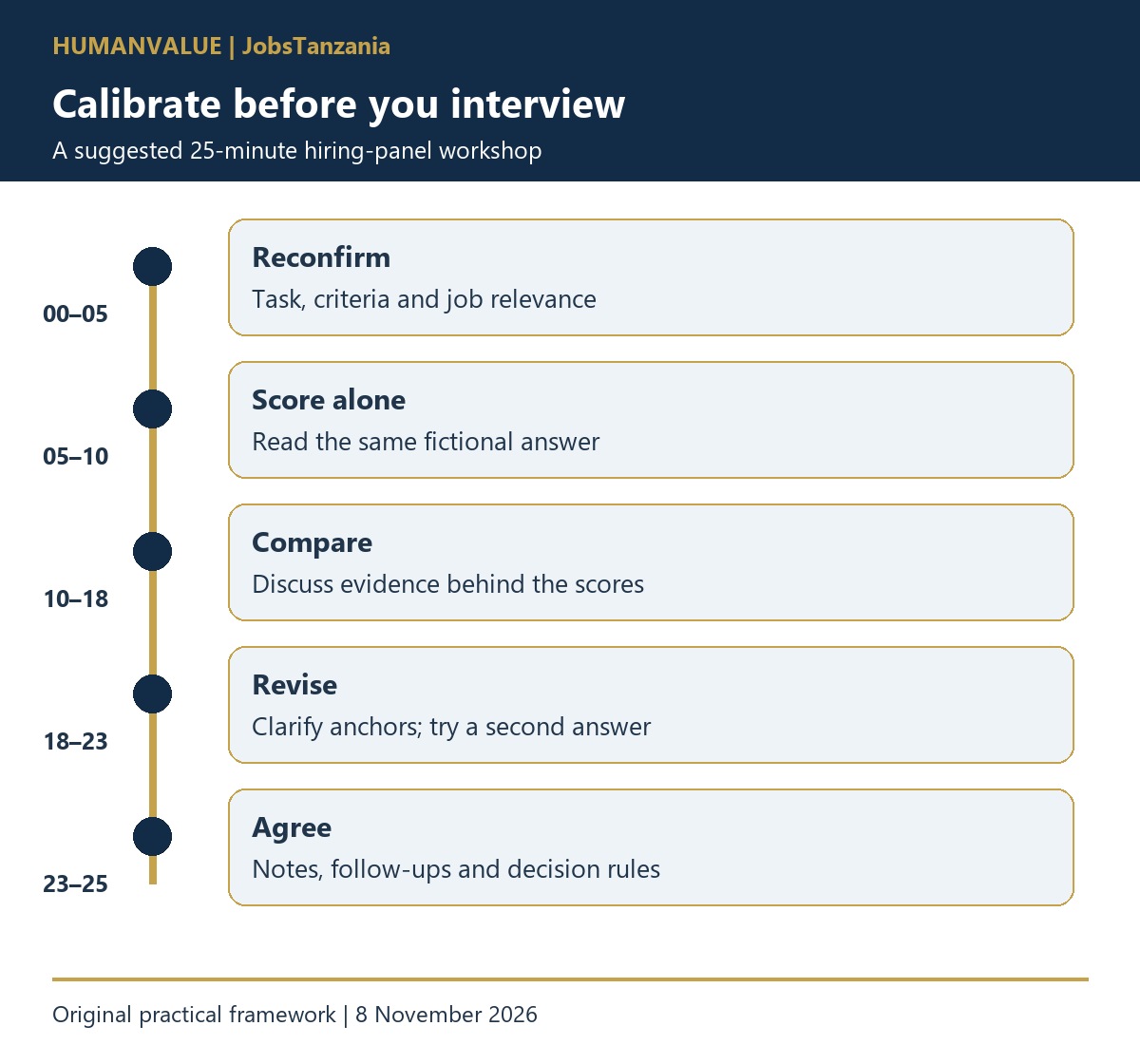
If one interviewer gives a 2 and another gives a 4, do not average immediately. One may be scoring presentation while the other scores judgement. Ask each to point to the behaviour in the answer and the matching anchor. Record what changed in the rubric before candidates are assessed.
4. Use a realistic fictional answer
Calibration example: “I would confirm which item or address detail is missing, check the order record, contact the responsible person and tell the customer when we can give the next update. I would record the action so the next colleague does not start again.”
This is invented teaching material, not a quotation from an applicant. Under the illustrative rubric it contains evidence for checking, ownership, recording and communication. The panel should discuss whether the update is sufficiently concrete before assigning a score. A real answer may be expressed differently and still demonstrate the same competence.
5. Score independently before discussing
During interviews, use the same core questions and relevant scoring standards for all candidates. Record factual notes and score promptly. Panel members should complete their first assessment before hearing the most senior person’s opinion. If a score changes after discussion, retain the reason and the evidence that justified the change.
The US Office of Personnel Management’s structured-interview guidance describes consistent questions and assessment standards. It is a useful methodological source, not Tanzanian employment law.
During interviews, panel members should independently assess candidates using a consistent, job-related scorecard covering qualifications, experience, technical competence and relevant skills. Scores must be evidence-based, free from discrimination and documented before panel discussions, with reasons recorded for any changes. This approach supports Tanzania's Employment and Labour Relations Act, Cap. 366, Section 7, and the Employment and Labour Relations (Code of Good Practice) Rules, 2007, Rule 34, which require fair, non-discriminatory selection criteria and encourage multi-person interviews. Independent scoring is a recommended practice, not an express statutory requirement.
6. Keep a decision record that can be explained
Use one page to record the criteria, evidence, unresolved questions and final reason. Avoid unnecessary personal observations. A comment such as “not a culture fit” gives little operational explanation; “did not identify the missing delivery address after the same follow-up used with other applicants” is more specific.
Keep candidate records in approved systems with access limited to the hiring team. Use fictional material in training. Make arrangements for candidates who need an accessible assessment, and review the assessment for job relevance before use.
7. Improve the rubric after the hiring cycle
Compare the interview evidence with the actual work and induction needs. A small recruitment exercise cannot establish statistical validity, but it can expose unclear questions, inconsistent instructions or a task that measured the wrong thing. Improve those features before the next cycle; do not quietly change standards halfway through a live process.
Next step: Choose one role and calibrate one question before inviting candidates. Explore HumanValue Talent Bank for sourcing and HumanValue HR services for support with a role-specific recruitment process. Agree the scope and fee before commissioning work.
8. A practical starting point with HumanValue
If you ask HumanValue to strengthen a hiring process, start with the decisions your managers need to make: what the role must deliver, what evidence will demonstrate readiness and who owns the final selection. We can discuss a scope covering role clarification, candidate sourcing, structured assessment and recruitment support. Agree the deliverables, responsibilities, timeline and fee before work begins. A larger CV pile is useful only when it helps you reach a clearer, defensible shortlist.
Editorial contact: Emily Sebashahu
HR Services & Recruitment Director
HumanValue Consulting Limited
Follow Emily Sebashahu on LinkedIn for HR and recruitment insights. For an organisation-specific discussion, explore HumanValue HR services.