


Ireland's Critical Skills Employment Permit can offer a genuine route for a suitably qualified professional from Tanzania or elsewhere in Africa to work for an Irish employer. But the pathway begins with a real, eligible job offer, not with payment to an agent or registration for a generic overseas job list. The employer must be genuine, the occupation and salary must meet the current rules, the applicant must have the relevant qualifications or experience, and immigration permission remains a separate step.
This guide is for African engineers, healthcare professionals, ICT specialists, selected finance and business professionals, construction specialists and other applicants who want to distinguish an actual Irish employment route from social-media promises. It draws on the Irish Department of Enterprise, Tourism and Employment's Critical Skills Employment Permit guidance and the Critical Skills Occupations List, updated in May 2026.
What makes this route different?
The permit is designed for certain occupations where Ireland identifies strategic skills needs. For eligible Critical Skills roles, the normal Labour Market Needs Test is not required. That does not mean the employer can skip other checks or that every professional in the named sector qualifies. Eligibility depends on the specific occupation, duties, qualification, remuneration and offer.
The official guidance requires a job offer of at least two years for an eligible occupation. It also describes an employer-employee balance rule and certain exceptions. The permit is not a substitute for a visa where one is required, nor does holding an employment permit automatically give a person residence permission. An applicant should read the Irish Immigration Service requirements alongside the employment permit guidance.
Step 1: Check the actual occupation, not a broad job title
A job called “IT specialist” may cover different work. A software developer, network professional, information-security specialist and technical support assistant do not necessarily fit the same occupation code or skill requirements. Likewise, the fact that some construction or healthcare roles are eligible does not mean every construction or healthcare position qualifies.
Ireland's official Critical Skills Occupations List became effective in its revised form on 13 May 2026. It identifies occupations and, in some cases, specific skills within a broader occupation category. For example, Ireland announced additions including construction planners/schedulers, geospatial surveyors, agronomists and certain healthcare and intellectual-property roles. These changes were part of a wider 2026 review and should not be confused with a list of open vacancies. See the May 2026 government announcement.
For each target job, record the occupation description, required specialism, qualification and duties. Compare those details with the actual advertisement. If the job title sounds similar but the duties do not match, do not assume eligibility. This occupation-first approach is more reliable than applying to every listing with “Ireland sponsorship” in the headline.
Step 2: Understand the 2026 salary and qualification rules
Ireland changed minimum annual remuneration thresholds from 1 March 2026. The official government roadmap explains the increase and the special treatment of some recent graduates and public-sector roles. The live Critical Skills permit page currently presents a standard relevant-degree threshold of €40,904, a recent-graduate threshold of €36,848 for qualifying applicants and a higher remuneration route above €68,911 for other eligible occupations, subject to its stated conditions.
Publication verification note: Another official remuneration table displays a slightly different standard CSEP figure, €40,909. Because government pages are not perfectly aligned, applicants and editors should check the operative legislation, current online permit guidance and application requirements before treating either figure as definitive. Do not use this article as a final salary eligibility determination.
The salary is not a guaranteed market wage, and a higher salary does not make an ineligible occupation eligible. Compare the offer with the relevant threshold, role classification, employment conditions and living costs. An applicant should also check what components of remuneration are permitted to count. A vague offer promising “€4,000 monthly including bonuses and accommodation” is not enough to establish compliance.
Step 3: Verify the employer and offer before paying anyone
A credible offer identifies the legal employer, location, role, working hours, annual remuneration, start date and contractual conditions. The Irish department states that a prospective employer must be genuinely based and trading in Ireland and registered with relevant authorities. Search the company's official website and company registration information, and contact the employer through independently obtained channels. Do not rely solely on a recruiter's WhatsApp profile or a letterhead image.
Ask who will submit the permit application, who is responsible for the fee, whether the role is conditional on approval and what happens if permission is refused. The department's employment permit fees page lists a €1,000 fee for a Critical Skills permit of up to 24 months, subject to current rules and exemptions. That is a government permit fee, not an authorisation for an intermediary to demand an invented placement charge.
Beware of pressure tactics: “pay today to reserve an Ireland slot”, “no interview or employer required”, “guaranteed approval” and “visa first, employer later”. A legitimate process may involve costs, but costs must be explained, receipted and connected to an authentic service. No consultant can guarantee an Irish immigration decision.
Step 4: Build a professional evidence file
An African applicant should prepare an accurate CV tailored to the role, qualification records, evidence of relevant experience, a consistent employment history and documents requested by the employer or authorities. Regulated professions may require recognition or registration with a relevant Irish professional body. A nurse, for example, should not assume that a job offer alone permits clinical practice without meeting the professional regulator's requirements.
A good application answers three questions quickly: What problem can I solve? What evidence proves it? Why does that evidence fit this specific employer and occupation? A software professional may present an authorised project summary describing the system, responsibilities, controls and outcome. An engineer may show project types, relevant standards and professional registration. A finance professional may show qualifications and responsibilities without disclosing a former employer's confidential figures.
HumanValue's Learning Center can support transferable professional skills, while the CV & Application Pack Lab provides a structured method for matching vacancy requirements with application evidence. These services prepare the candidate's presentation; they do not provide an Irish employer, permit or visa.
Step 5: Understand the sequence and timing
A practical sequence is: identify an eligible role, secure a genuine two-year offer, verify occupation and remuneration, prepare evidence, submit the employment permit application through the official process, and then complete any required entry-visa and immigration-registration steps. The department states that permit applications should generally be received at least 12 weeks before the proposed employment start date. Processing queues change, so use its current processing dates page, not a promise from a social-media agent.
As of 16 October 2026, the official processing update stated that Critical Skills applications received on 7 October 2026 were being processed. That is a dated administrative snapshot, not a guaranteed individual processing time. Delays can arise from incomplete evidence, employer issues or other checks. Candidates should not resign, book non-refundable travel or make irreversible financial commitments solely on an informal expectation of approval.
Example: two candidates, two very different prospects
Consider fictional applicant A, a Tanzanian geospatial professional with relevant education, documented project work and a two-year offer from an identifiable Irish employer. The role's duties appear to align with a listed occupation. This applicant has a reasonable basis to proceed to detailed official eligibility checks, including remuneration and qualification review.
Fictional applicant B has a generic “warehouse assistant” offer sent by an unknown agent, with no named employer and a request for a large upfront payment. The agent says the Critical Skills route is guaranteed because Ireland “needs workers”. This applicant has not established occupation eligibility, employer legitimacy or a credible offer. The sensible next step is verification, not payment. These examples illustrate decision quality, not predicted outcomes.
What about family and longer-term residence?
The Critical Skills route includes certain family and later immigration-permission features, subject to the relevant Irish authorities and individual conditions. These should be checked through the Irish Immigration Service rather than interpreted as automatic benefits. Employment permits, entry visas, residence registration and permission to change employment are different legal questions. The precise timing and entitlements depend on the applicable rules and the person's circumstances.
How JobsTanzania can help without overpromising
Use the Global Career Intelligence archive to compare countries and understand requirements. The International Opportunities section can help you explore available career preparation pathways, but it should never be mistaken for the Irish government's permit system or proof that a particular employer is recruiting. Check every vacancy at its original employer source.
If you are still choosing a market, a HumanValue international career-readiness assessment may help organise your qualification, experience, CV and budget questions, subject to the current service scope shown at checkout. It cannot determine immigration eligibility or guarantee placement. A strong decision may be to strengthen your experience in Tanzania before committing to a costly overseas search.
Frequently asked questions
Can I apply for an Irish Critical Skills permit without a job offer?
No. The route described here requires an eligible offer from a genuine employer. A profile on a job board or a paid assessment is not a substitute for that offer.
Are all engineering, nursing or IT jobs eligible?
No. Check the precise occupation and duties, qualifications, remuneration and any regulator requirements. A broad industry label is insufficient.
Is an employment permit the same as a visa?
No. Applicants who need a visa must meet the relevant entry requirements, and residence registration is a separate matter.
Does the €1,000 government fee cover all relocation costs?
No. Applicants may face separate visa, documentation, travel, housing and professional-registration costs. Budget them individually and verify each charge.
Does HumanValue guarantee an Irish job or visa?
No. HumanValue's relevant offerings are career guidance, preparation and assessment services. Hiring and immigration decisions remain with employers and competent Irish authorities.
Final decision: verify the route before you invest
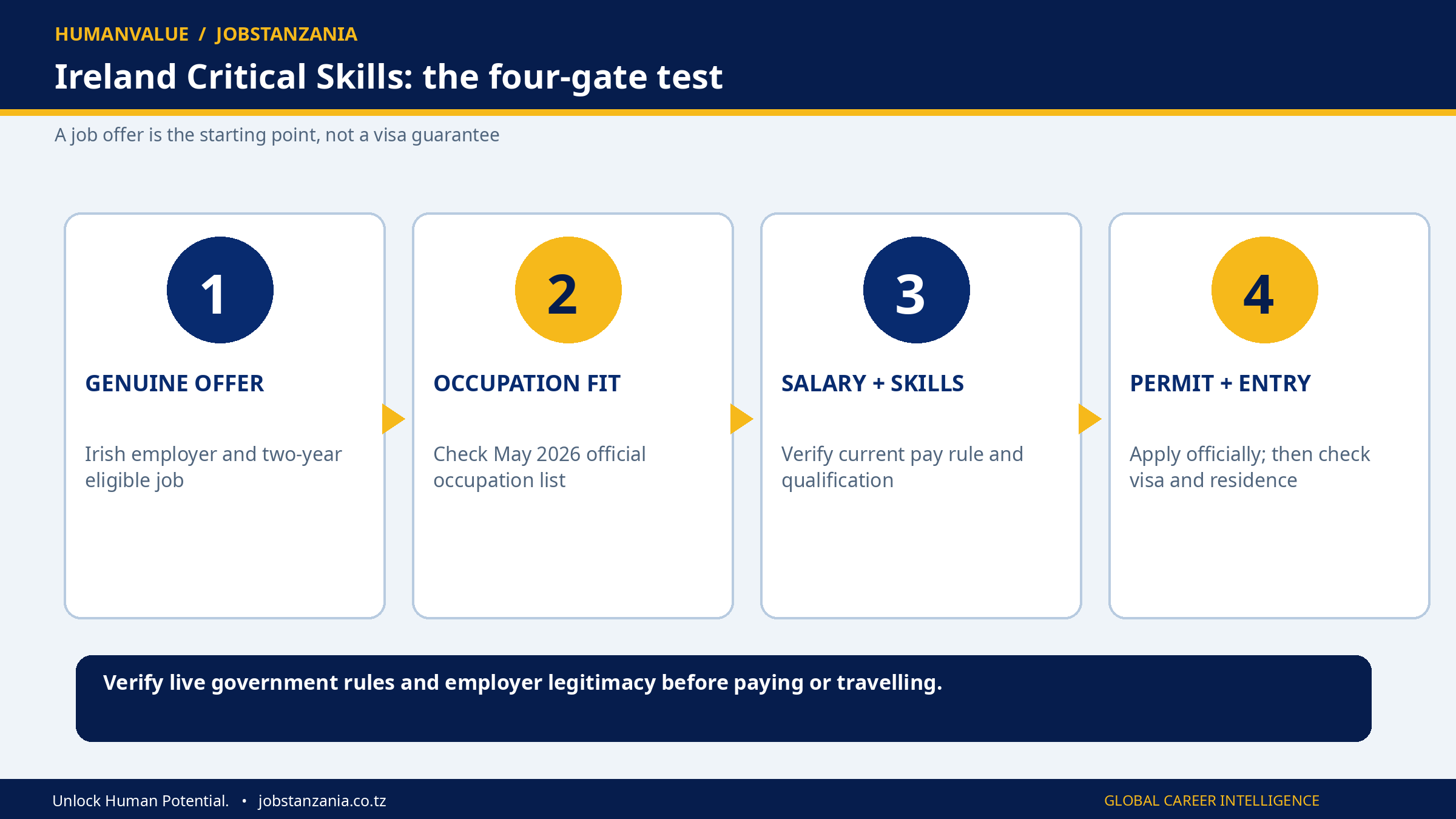
Ireland may be a relevant market for African professionals whose specific skills match an eligible occupation and a genuine employer need. The strongest strategy is to test occupation fit, employer legitimacy, remuneration, evidence and immigration requirements in that order. Start with the Irish government Critical Skills guidance, then use JobsTanzania International Opportunities and the HumanValue Learning Center for appropriately scoped career preparation.
Editorial note: Immigration information is general, dated 18 October 2026, and not legal advice. Rules and fees can change. The Irish government and qualified advisers are the authoritative sources for individual cases.