


JobsTanzania Employer Recruitment Intelligence | Tanzania | 22 October 2026
Quick answer: A Tanzanian factory should recruit a shift supervisor against the outcomes of the shift, not the most impressive job title on a CV. Define the line's safety, quality, output, attendance and handover requirements; assess candidates with the same practical scenario; verify experience and references; and give the selected person a documented 90-day operating plan. This approach creates a more defensible shortlist and a clearer starting point for performance management.
Manufacturers in Dar es Salaam, Kibaha, Mwanza, Arusha and other industrial centres face a recurring recruitment dilemma. A strong machine operator may know the process but struggle to supervise people. A polished manager may speak confidently about KPIs without understanding downtime, rework or shift escalation. The employer needs both operational judgement and the ability to coordinate people safely. The answer is a role-specific selection system, not a longer list of generic interview questions.
1. Write the supervisor's operating contract before posting
Begin with the production reality: number of shifts, line or plant type, team size, equipment complexity, maintenance interface, product quality requirements, overtime patterns and the authority the supervisor will actually hold. A person who oversees a ten-person packaging line has a different span of control from a multi-line production supervisor coordinating contractors and maintenance technicians.
Turn that context into five measurable outcomes: safe work, planned output, acceptable quality, reliable handovers and fair people management. Record what evidence will demonstrate each. For example, the employer may need a candidate who can respond to a stoppage, protect an unsafe area, report a recurring defect, update a production log and explain a shift plan to operators. A generic “minimum five years' experience” does not prove those abilities.
Tanzania's Occupational Safety and Health Authority is responsible for enforcing the Occupational Health and Safety Act, Cap. 297 R.E. 2023. A recruitment assessment should therefore include realistic hazard recognition and escalation, without pretending that a short interview substitutes for site-specific safety induction or legal compliance.
2. Separate non-negotiables from preferences
An effective job brief has three columns. Essential: experience relevant to the actual production process, ability to read and complete shift records, credible safety judgement and the required legal qualifications. Trainable: the company's ERP screens, a particular reporting template or a new brand of equipment. Desirable: experience with a second product line, improvement projects or multilingual team communication.
This distinction prevents the employer from excluding a capable applicant for a minor software difference while overlooking a major safety or supervisory gap. It also makes the advertisement more accurate. If the employer needs a supervisor for a continuous-process plant, state that context; if it is a packaging and dispatch operation, do not use a broad “plant manager” label that attracts mismatched senior applicants.
Before advertising, agree the salary band internally, the shift allowance or overtime approach, reporting line, location and interview timetable. The JobsTanzania employer pricing page offers single-vacancy and subscription options, but publishing a vacancy is only one stage of the hiring process. A good brief improves both applicant quality and interview decisions.
3. A weighted scorecard that tests the actual work
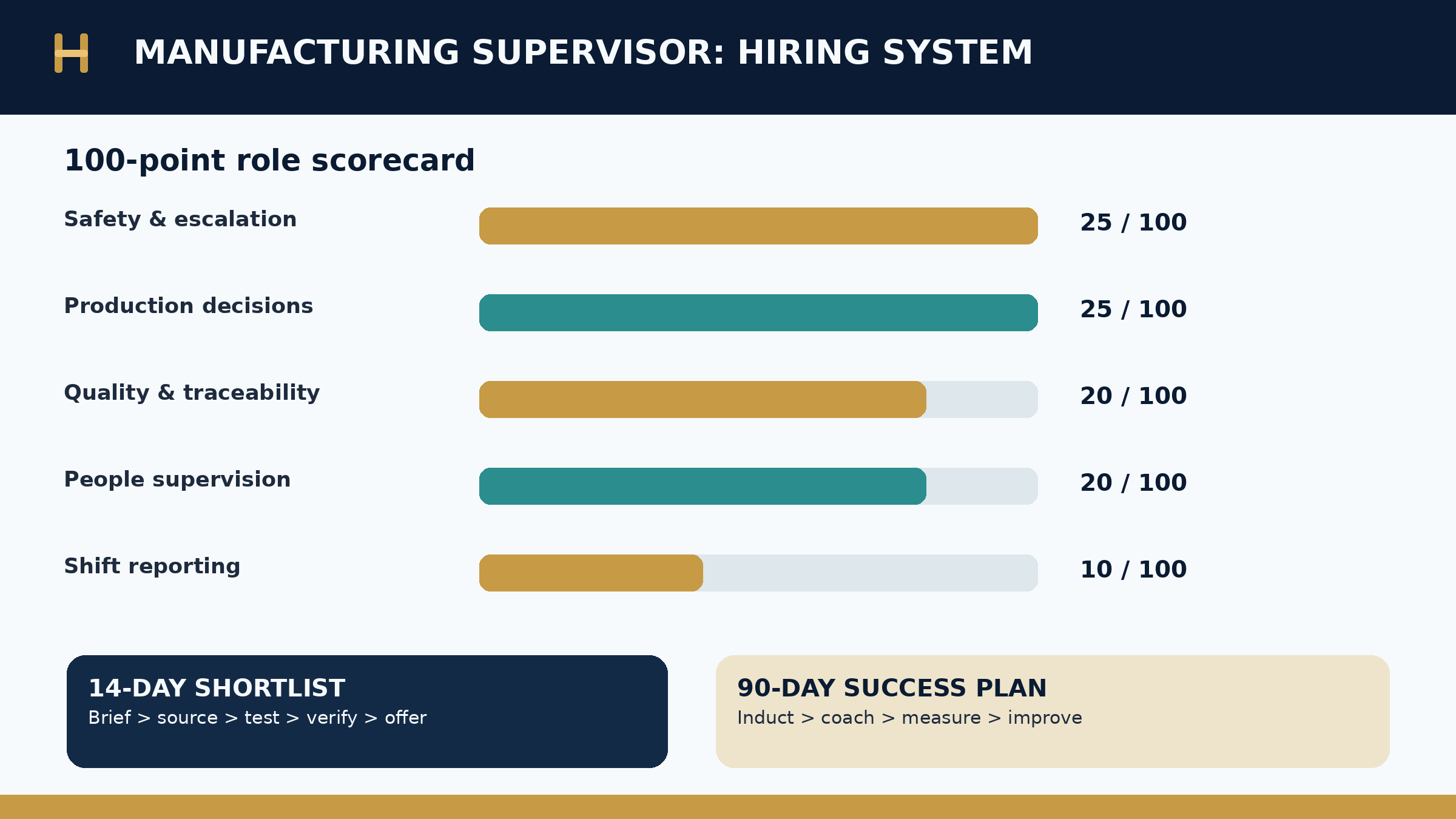
Use the same 100-point structure for every shortlisted candidate, with written behavioural anchors:
- Safety and escalation, 25 points: identifies a credible hazard, stops or isolates work within authority, records the event and calls the correct responsible person.
- Production planning and problem-solving, 25 points: prioritises output, staffing and downtime without sacrificing quality or safety.
- Quality and traceability, 20 points: recognises a defect, contains suspect output, follows batch or lot records and explains the handover.
- People supervision, 20 points: allocates work fairly, gives feedback, manages conflict and knows when to involve HR.
- Data and shift reporting, 10 points: produces accurate totals, explains variance and leaves a usable handover.
These weights are an illustrative HumanValue editorial framework, not a statutory standard or a validated psychological test. Adjust them to the role after a job analysis. A food processor might put more emphasis on hygiene and traceability; a heavy engineering plant may require specific technical competence and higher safety weight. Use a minimum safety threshold as well as a total score, so excellent production answers cannot compensate for dangerous decisions.
For each score, require the assessor to write the candidate's actual evidence, not “good attitude” or “looks like a leader.” A panel can disagree about an answer, but it should be able to point to the same observed behaviour. Keep the notes secure and relevant to recruitment.
4. Run a 35-minute work-sample assessment
Present a fictional shift scenario: a packaging line is scheduled to produce 2,400 units; a key machine stops for 35 minutes; quality identifies 60 units needing inspection; two operators are absent; and the next shift starts in 50 minutes. Ask the candidate to prepare a priority list, a short verbal briefing and a five-line handover. The numbers are invented for assessment and do not represent a real factory's performance.
A strong response first protects people and product quality, confirms facts, escalates the stoppage, updates the production forecast and assigns accountable follow-up. A weak response may promise to “push the team harder” without explaining safety or the cause of the stoppage. The panel should score the reasoning, not merely the arithmetic or presentation confidence.
Do not use the assessment to obtain unpaid productive labour. Keep it brief, simulated and the same for all candidates. Provide reasonable access accommodations and do not ask for confidential information from former employers. A practical test should reveal job competence without creating exploitation or unnecessary personal-data collection.
5. A 14-day hiring workflow with named owners
Days 1–2: define and approve. Operations and HR confirm the role outcomes, location, salary budget, selection criteria and decision owner. Build the work sample and agree score anchors before seeing applicants.
Days 3–5: source. Advertise through an appropriate channel and search existing talent with relevant filters. The live HumanValue Talent Bank advertises a one-time seven-day employer trial with anonymised previews and up to three unique candidate unlocks. Use it to inspect fit, not to assume every profile is independently verified.
Days 6–8: screen. Ask a short, consistent set of job-related questions about production type, shift supervision, safety responsibility, location, availability and evidence of results. Record why each applicant advances or does not. Do not make an AI-generated match score the sole decision-maker.
Days 9–11: assess. Run structured interviews and the same simulated stoppage scenario. Where technical tests are needed, use competent assessors and safe procedures. Score independently before discussing the candidates.
Days 12–13: verify. With appropriate notice and lawful basis, confirm qualifications, relevant employment dates, supervisory responsibilities and references. Separate verified facts from impressions. The Tanzania Personal Data Protection Commission explains that collecting, using and sharing candidate data carries legal obligations.
Day 14: decide and offer. Compare candidates with the original criteria, approve the offer and issue clear employment particulars. The timeline is a planning model, not a promised hiring turnaround; notice periods, verification and candidate availability can extend it.
6. Choosing the right JobsTanzania product for the vacancy
If the employer wants to test the market before advertising, start with anonymised Talent Bank search. The public page lists a seven-day trial and up to three candidate unlocks. For a dedicated search without a job advertisement, the page lists Talent Search at TZS 40,000 for 30 days, including up to 50 unique candidate unlocks. These are catalogue terms checked on 22 October 2026, not a promise that suitable supervisors are currently available.
If the employer needs to advertise, the pricing page currently lists a TZS 20,000 single vacancy, TZS 79,000 monthly employer plan and TZS 690,000 annual plan, with different Talent Bank unlock allowances and hiring-workflow features. Compare the exact current checkout terms. For difficult or confidential positions, HumanValue recruitment services can be contacted for a quoted, human-reviewed sourcing and assessment assignment; no unverified fixed recruitment fee is stated here.
The commercial decision should follow the hiring problem. A single vacancy may need a simple advertisement; a recurring factory staffing requirement may benefit from a subscription; a hard-to-find technical supervisor may justify assisted search. Do not buy a broad plan solely because it appears beside an article.
7. The first 90 days are part of the recruitment decision
A supervisor's selection is incomplete until the plant knows how to evaluate the appointment. Set a 90-day plan before the start date. Days 1–15: site induction, safety training, observation of current shift practices, equipment familiarisation and relationships with maintenance, quality and HR. Days 16–30: supervised ownership of shift plans and handovers, with weekly coaching.
Days 31–60: review real trends in downtime, defects, absenteeism, rework, near-miss reporting and unresolved handovers. Distinguish inherited system problems from individual performance. Days 61–90: agree an improvement experiment, document results and identify further support. Do not reward a fall in incident reporting if workers simply become afraid to report hazards.
Use a small dashboard with baseline, target, owner, source and review frequency. Avoid claiming a new hire caused every output change; demand, machine condition and staffing levels also affect results. The hiring scorecard and the 90-day plan should use compatible measures so that selection predicts the work the person will actually do.
8. Worked example: a Kibaha packaging plant
Fictional case study. A packaging plant has recurring handover errors and occasional short stoppages. Its old advert asked for a “dynamic production leader” with ten years' experience, without defining the line or shift authority. The plant redesigns the role around quality containment, shift logs, safe escalation and team coaching. The shortlist now includes a capable line leader who has only six years of relevant experience but strong evidence on the actual process.
The candidate completes the same simulated stoppage exercise as everyone else and demonstrates careful quality containment. Another applicant with a more senior title scores better on planning but poorly on hazard escalation. The plant investigates both candidates' evidence rather than selecting on seniority alone. No hiring outcome or productivity improvement is claimed; the example illustrates a defensible decision process.
Frequently asked questions
Can we hire a strong operator directly into supervision?
Possibly, if the person demonstrates the people, safety, reporting and decision skills required. Provide structured onboarding and do not assume technical excellence equals leadership competence.
Should we use the same scorecard for every factory role?
No. Keep the evidence-based method, but change weights and exercises to reflect the equipment, hazards, team size and operational requirements of each position.
Can we rely entirely on Talent Bank AI matching?
No. Profiles and matching support sourcing. Employers should independently confirm availability, qualifications, references and suitability and apply lawful data-handling practices.
What if no candidate meets the safety threshold?
Do not lower the critical standard to fill the shift. Reconsider the job design, training pipeline, interim supervision and sourcing strategy while maintaining safe operations.
Is 14 days a guaranteed recruitment period?
No. It is an illustrative operating cadence. Specialist skills, notice periods and verification may require more time.
Turn the vacancy into a qualified shortlist
Write your five shift outcomes and test the free Talent Bank trial against those criteria. If you need to advertise, compare employer plans; if you need a human-reviewed shortlist, request HumanValue recruitment support. Start with role evidence and keep the final decision with accountable people.
Research and editorial note (22 October 2026): OSHA's published enforcement remit, the Tanzania PDPC's guidance and JobsTanzania's live public product catalogue were checked. The scorecard, assessment scenario and 14/90-day plans are original practical frameworks, not legal mandates, employer case claims or verified performance results. Employment and safety requirements should be reviewed for the specific site.