


To prepare for monitoring and evaluation assistant jobs in Tanzania, build a small reporting sample that shows how you define an indicator, check a record and explain what the numbers cannot tell you. A dashboard is useful only when its source is understandable. This guide gives graduates, project assistants and field-data staff a practical fourteen-day portfolio plan using entirely fictional records. It is career guidance, not an announcement of a confirmed vacancy.
What does an M&E assistant contribute?
Monitoring and evaluation teams help a programme understand what has been delivered, whether information is credible and what needs investigation. An assistant might maintain an activity register, check submitted forms, follow up missing records, prepare summaries and organise supporting evidence. Responsibilities vary: a community project in Dodoma may use paper forms and Excel, while a larger organisation may use digital collection tools and a controlled reporting platform.
Do not confuse recording activity with proving impact. A workshop attendance total tells you about participation under a stated counting rule. It does not, on its own, show that incomes increased, health improved or a training programme caused a change. Candidates stand out when they can separate the observation, the interpretation and the evidence still missing.
Start with the vacancy, then choose your evidence
Read genuine advertisements for the role you want. Make a simple requirements matrix covering qualifications, Excel or analysis tools, field coordination, writing, languages, safeguarding and any sector-specific experience. An employer may require a relevant diploma or degree, but requirements differ. A practice project complements the qualifications specified; it does not replace an essential credential.
Choose one target role and identify two tasks you can demonstrate honestly. If you have been a project administrator, your strongest evidence might be a traceable activity register. If you have fieldwork experience, it might be a well-designed form and an exception log. Describe exactly what you did, including where a supervisor reviewed or approved the work.
Build a fictional youth-training register
Use an imaginary project offering three workplace-skills sessions in two fictional wards. Create invented participant IDs such as P001 to P030, session IDs, attendance dates, registration status and a completion field. Avoid real beneficiary names, phone numbers, identity documents or precise household locations. Mark the workbook prominently as a training simulation.
Prepare four tabs: raw attendance, participant register, data queries and summary. Keep the raw tab unchanged after the exercise begins. Record corrections separately, with a reason and a version date. Your reviewer should be able to trace a summary value back to the original fictional row and see why any record was excluded.
Write the indicator definition before counting
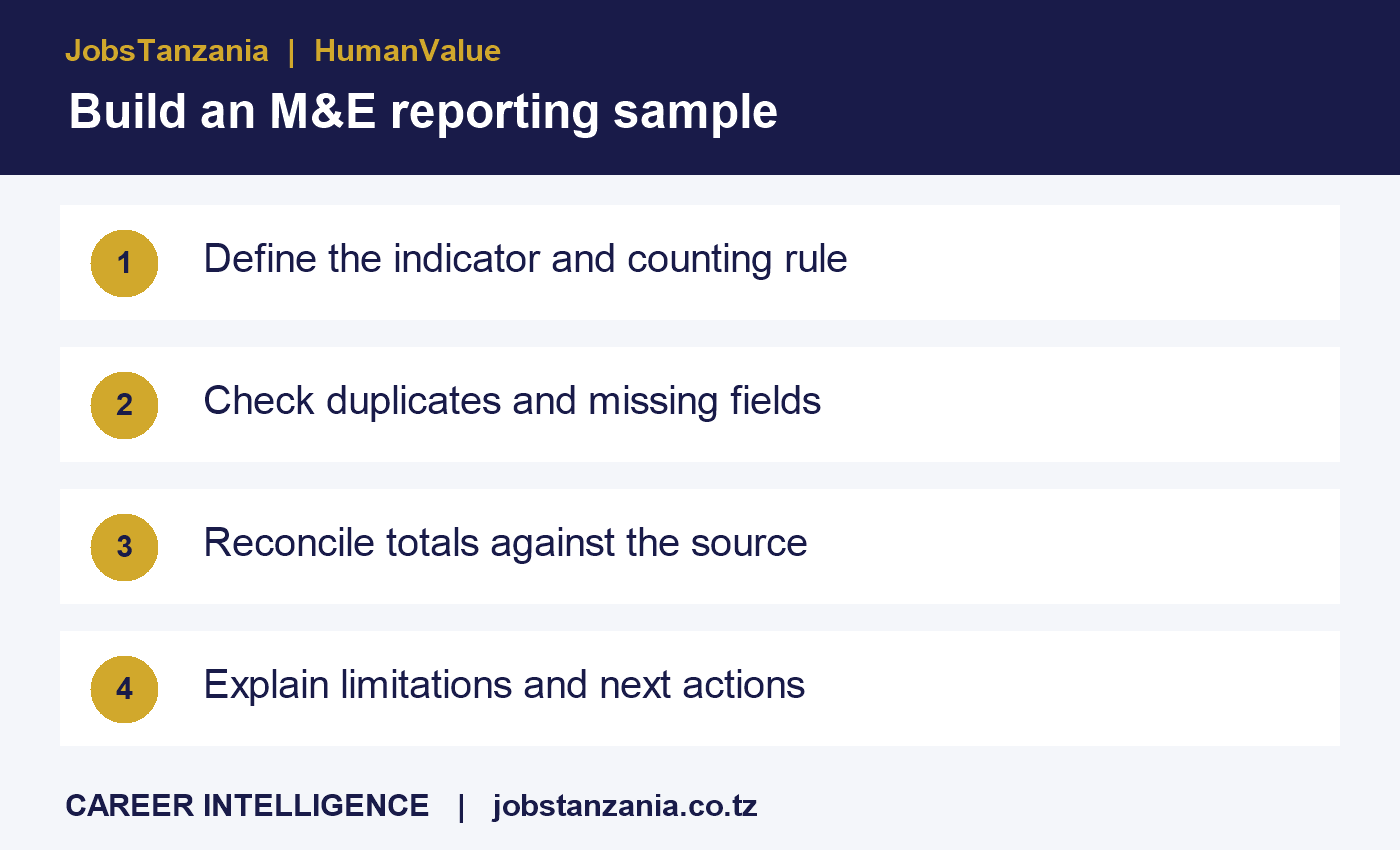
Define the practice indicator as “number of registered participants who attended at least two of the three sessions during the reporting period.” Specify the unit, reporting dates, source, inclusion rule and how repeated attendance is handled. One person attending three sessions is one participant under this indicator, not three participants. Session attendance and unique people are different measures.
| Indicator field | Example for the fictional exercise |
|---|---|
| Unit | Unique registered participant |
| Completion rule | At least two distinct sessions |
| Source | Session register checked against participant IDs |
| Reporting period | The dates stated in the workbook read-me |
| Unresolved records | Listed in the query log and disclosed in the summary |
Suppose the fictional register contains 30 registered participants and 24 meet the completion definition. The illustrative completion proportion is 24 divided by 30, or 80%. State the denominator and the definition next to the result. This is an invented training result, not a Tanzania employment statistic or evidence that a programme was effective.
Run five checks before you make a chart
Check whether the measure matches the question; whether records are protected from unsupported alteration; whether the detail is sufficient for the decision; whether the method is consistent; and whether the information arrives in time to be useful. These questions reflect established data-quality concepts. The U.S. Department of State monitoring and evaluation guidance discusses validity, integrity, precision, reliability and timeliness in its own programme context. Use it as a learning reference, not as a claim that every Tanzanian employer follows that framework.
For your sample, deliberately insert a duplicate attendance row, a missing participant ID, a session date outside the period and inconsistent spelling of a category. Write down what each issue could change. Do not quietly delete every awkward row until the chart looks clean. Preserve the original, explain the treatment and distinguish a confirmed correction from an unresolved query.
Use Excel to make the checking visible
Start with structured tables, clear column names and one data type per column. Use validation lists for agreed categories, conditional formatting for blanks and duplicate checks for repeated combinations of participant ID and session ID. A COUNTIFS calculation can help identify repeated records, while a pivot table can summarise attendance. Test each formula against a few manually checked cases.
Do not count an empty cell as zero automatically. “Not collected”, “not applicable” and a verified zero can mean different things. Add a short data dictionary that explains the allowed values. If you use Power BI or a collection platform, describe which parts you actually practised. A tutorial does not establish production experience with an organisation's reporting system.
Turn the result into a short decision memo
A useful one-page memo contains the question, period, source, calculation, limitations and proposed next action. In the fictional project, you might report that 24 of 30 registered participants met the stated attendance rule, while two records need follow-up. Explain whether those unresolved records could change the count. Recommend checking the relevant source rather than inventing a reason for absence.
Illustrative interview answer: “I would keep the original register, flag the repeated participant-session entry and confirm the counting rule before changing the summary. I would disclose unresolved records and explain whether they affect the indicator.”
This is a suggested practice response, not a quotation from a real worker. An interviewer may ask what you would do if a manager wants the report before all queries are closed. A careful answer separates an approved provisional report from a final result and makes the limitations visible. Never change a value simply to meet a target.
A fourteen-day preparation plan
- Days 1–2: choose a genuine target role and write a requirements matrix.
- Days 3–4: define the fictional project, indicator and data dictionary.
- Days 5–6: create the register and insert the four deliberate errors.
- Days 7–8: build validation checks and a documented query log.
- Days 9–10: calculate the indicator and manually verify a sample.
- Days 11–12: write a one-page summary and a limitations note.
- Days 13–14: rehearse a five-minute walkthrough and prepare an honest CV entry.
Keep the final portfolio compact: a read-me, the fictional workbook and a one-page memo are enough to begin. Your sample should be understandable without specialist software. Ask a mentor to change the counting rule or introduce another missing record; being able to explain the resulting change is stronger evidence than memorising one total.
Connect the portfolio to your next application
A truthful CV entry could say: “Independent M&E practice project: built a fictional 30-participant register, documented data queries and produced an indicator summary with stated counting rules.” Do not turn the fictional 80% into a claim that you improved a real programme. If you have genuine employment results, use only figures you can substantiate and information you are authorised to disclose.
Use the free JobsTanzania ATS CV scan to check whether your application presents relevant evidence clearly. For a specific spreadsheet gap, explore the HumanValue Workplace Excel Essentials course and review the current syllabus and price before enrolling. For structured application practice, compare the CV & Application Pack Lab. These are optional support services, not requirements to apply for jobs or guarantees of selection.
Frequently asked questions
Can a graduate apply without a previous M&E job title?
Some entry-level roles may accept relevant study, internships or transferable project experience; others require prior experience. Follow the actual vacancy requirements. A clearly labelled practice portfolio can help explain your skills without inventing employment.
Do I need Power BI, SPSS or a digital collection certificate?
Only treat a tool as essential when the employer specifies it. Learn the indicator and checking process first. Describe software skills at the level you can demonstrate, and distinguish classroom practice from live operational use.
Is the 80% completion result a benchmark?
No. It is a fictional calculation based on the example's counting rule. It is neither an acceptable-performance threshold nor a national statistic. Real targets and definitions belong to the relevant programme and approved reporting framework.
Can I publish forms from an internship?
Use invented records for a public portfolio. Actual programme information may contain confidential or personal data. Follow the organisation's authorisation, confidentiality and approved sharing procedures.
What should I do today?
Write one indicator definition, build ten fictional records and explain one discrepancy. Then expand the exercise and apply to a suitable verified vacancy through JobsTanzania. Which is harder for you: defining the denominator, checking duplicates or writing the limitations?
HumanValue Consulting Limited | JobsTanzania Career Intelligence. Published 7 November 2026. All scenarios, quantities, scripts and portfolio timings are original fictional training examples. The linked monitoring guidance is a methodological reference, not a statement of current funding, vacancies or a Tanzania-wide reporting requirement.