


JobsTanzania Global Career Intelligence | Netherlands, Europe and African professionals | 22 October 2026
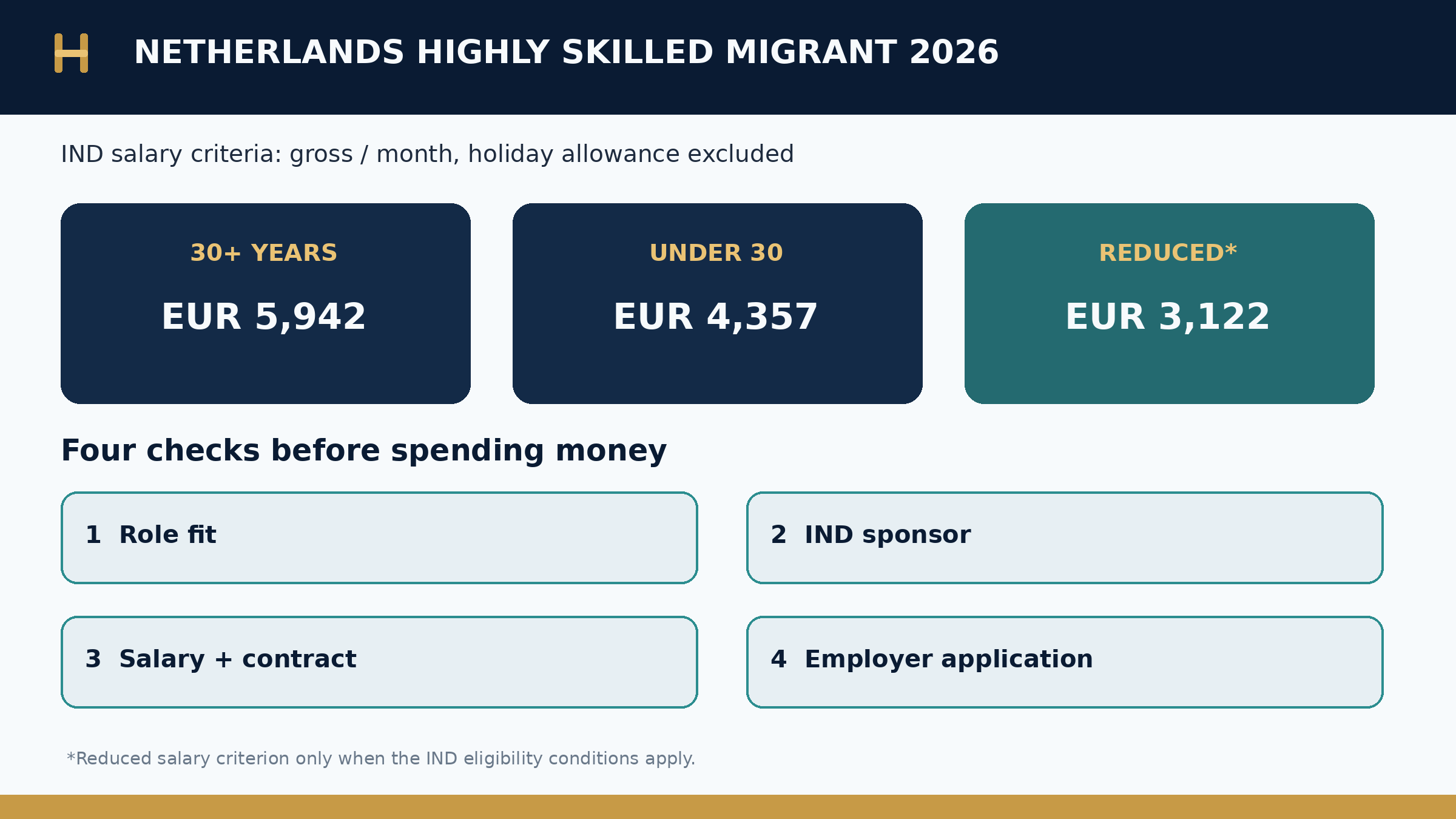
Quick answer: To use the Netherlands' highly skilled migrant route in 2026, an eligible non-EU professional normally needs a genuine Dutch employment contract, an employer recognised by the Dutch Immigration and Naturalisation Service (IND), a market-conform salary and the correct residence-permit application made by that employer. The IND's published 2026 gross monthly salary criteria are €5,942 for applicants aged 30 or over, €4,357 for those under 30, and €3,122 where the reduced criterion lawfully applies, excluding holiday allowance. None of these figures creates a job offer or guarantees a permit.
For an engineer in Dar es Salaam, a cybersecurity specialist in Nairobi or a finance systems professional in Accra, the route can look attractive because it is tied to specific employment rather than a general points lottery. But it has a clear gate: the employer must be recognised and willing to sponsor the actual position. A company appearing on a sponsor list is not evidence that it currently has a vacancy, will recruit abroad or will select a particular applicant.
1. Start with the official route, not an agency advertisement
The IND's highly skilled migrant page, updated 11 September 2026, explains that only an IND-recognised employer can apply for this residence permit. The employee must have an employment contract, meet the applicable income requirement and receive a salary consistent with the market for the job. Some regulated healthcare roles also require registration with the Dutch BIG register.
This is different from the Netherlands' EU Blue Card. The IND Blue Card page describes separate requirements, and an employer does not have to be a recognised sponsor for that route. A recruiter who uses “Blue Card,” “highly skilled migrant” and “job-search visa” interchangeably is not explaining the legal pathway accurately.
The Netherlands route is also distinct from a work permit in Germany, Malta, Italy or another European country. Immigration authorisation is country-specific. A European recruitment poster does not create Dutch sponsorship.
2. The 2026 salary thresholds and what counts
The IND's official required-amounts table gives the following 2026 criteria for first applications under the national highly skilled migrant scheme:
| Category | 2026 gross monthly salary criterion | Key caution |
|---|---|---|
| Applicant aged 30 or older | €5,942 | Market-conform salary also required |
| Applicant younger than 30 | €4,357 | Age and application circumstances matter |
| Reduced criterion, if legally eligible | €3,122 | Not a general discount for every graduate |
These amounts exclude holiday allowance. The IND says certain fixed allowances can count only if contractual and paid in the prescribed way, while holiday allowance, uncertain bonuses, tips and overtime payments do not count. The applicable figure is generally tied to the date and type of application; extensions and employer changes have specific rules. Recheck the IND table when an actual application is prepared, even if this article remains online.
Worked example: A fictional 31-year-old operations systems analyst is offered €5,800 gross per month plus a separately paid holiday allowance. That base amount is below the €5,942 general criterion for an initial application in 2026. The employer cannot repair the shortfall simply by pointing to an annual total that includes holiday allowance. If the contract instead specifies €6,100 gross base per month, the numerical salary test may be met, but the employer must still be recognised, the pay market-conform and the other conditions satisfied. This is an arithmetic illustration, not an IND decision.
3. Verify the recognised sponsor independently
The IND public register for work sponsors lists organisations recognised for work-related residence purposes. Its publicly displayed update date was 5 October 2026 when checked for this article on 22 October. Search the exact legal entity name, not merely a familiar trading name. Compare the registration details with the employer's official careers website and written correspondence.
Do not assume the following statements are equivalent: “We are a Dutch company,” “We have hired foreigners before,” “We use a payroll partner,” and “We are an IND-recognised sponsor for this route.” A real employer should be able to explain which entity will employ you, who will file the application and how the salary and contract comply.
A safe verification workflow has four steps. First, locate the employer's legal name in the IND register. Second, find the vacancy independently on the company's own careers page. Third, confirm that the recruiter communicates through a verifiable corporate channel. Fourth, ask whether the specific position is open to applicants needing the highly skilled migrant process. If the employer uses an agency or payroll company, establish the actual legal employer and sponsor relationship.
Being on the register is a necessary check for the usual route, not a job-availability signal. Avoid compiling a “list of companies guaranteed to sponsor Africans.” No such guarantee follows from registration.
4. Match the job to the market-conform salary rule
Salary is not just a minimum number. The IND states that the agreed salary must be in line with the market rate for comparable work. A fabricated “senior director” title attached to routine administrative tasks will not make a low-level job automatically eligible. Candidates should compare the role's duties, seniority, location and remuneration with credible Dutch employer advertisements.
Build a vacancy evidence table with job title, legal employer, sponsor-register check date, work location, key duties, contract type, base gross monthly salary if disclosed, and whether the employer mentions relocation or immigration support. Keep a separate field for assumptions. A vacancy that says “must already have the right to work in the Netherlands” should not be counted as a confirmed overseas-sponsorship lead.
For regulated work, verify licensing early. The IND specifically mentions BIG registration for certain individual healthcare professions. An African medical qualification, even when genuine and respected, may need separate recognition before the person can lawfully practise. The visa salary threshold does not override professional regulation.
5. What the employer does and what the applicant prepares
Under the national scheme, the recognised employer applies to the IND. The Dutch government explanation makes clear that the procedure is employer-led. Depending on nationality and circumstances, a provisional residence permit (MVV) may also be required; use the IND's individual requirements rather than assuming that every African passport has identical steps.
Applicants should prepare a consistent CV, qualification evidence, truthful employment history, references, passport information and any requested civil or professional documents. Avoid emailing scans of passports or certificates to unverified social-media contacts. Check the employer's secure document-submission method and keep a record of what was shared.
Ask the employer for the written salary structure, location, start-date conditions, probation and notice arrangements, relocation support if offered, and the point at which work may lawfully begin. A signed offer is not itself permission to enter or work. Do not resign or buy non-refundable flights merely because an intermediary promises a fast decision.
6. A four-gate decision map for African professionals
Gate A: occupational fit. Do your documented achievements match the actual Dutch vacancy? A systems analyst should show integrations, users supported, risk controls and outcomes, not only software names. An engineer should show the plant, equipment, standards, scale and evidence of responsibility.
Gate B: sponsor reality. Is the legal employer in the current IND register, and has it confirmed willingness to use the route for this vacancy? A LinkedIn job advertisement alone is not enough.
Gate C: salary and conditions. Does the contractual gross monthly pay meet the applicable 2026 criterion without counting excluded elements? Is it market-conform? Does the candidate meet any licensing or general conditions?
Gate D: safe application. Does the employer own the IND process, with verifiable communications and a clear document request? Are relocation costs and risks understood? If any gate is unresolved, record it as unresolved rather than treating interest as eligibility.
7. Worked example: a Tanzanian systems professional
Fictional planning example. Daniel has seven years of experience supporting finance and warehouse systems in Tanzania. He is 34 and targets an integration analyst role in Rotterdam. He sees a role advertised at €6,200 gross monthly base salary. He checks the exact legal employer in the IND register and discovers that the advert says only candidates with existing Dutch work authorisation may apply. The salary may exceed the general threshold, but the employer's vacancy policy means it is not a confirmed sponsorship opportunity.
Daniel instead researches another recognised employer whose career page explicitly invites international applicants for an integration role. He prepares a two-page case summary of an ERP interface project using anonymised, permission-safe information and asks the employer to clarify the immigration route. He does not claim the company will hire him. The difference is not optimism; it is verification before investment.
8. How HumanValue and JobsTanzania fit, and where they do not
The public JobsTanzania International Opportunities page lists multiple European and UAE programmes, a free register-interest route and an optional TZS 50,000 career/document-readiness assessment. As checked on 22 October 2026, the page did not show a Netherlands-specific programme. Therefore, this article is independent career intelligence, not an advertisement for a Dutch placement by HumanValue.
Candidates can still use the HumanValue Learning Center to close a verifiable technical gap, or the free ATS CV scanner to examine whether their CV explains the target vacancy. The scanner describes its output as keyword-coverage guidance, not a hiring prediction. The international assessment may help organise readiness for programmes in the catalogue; it does not constitute IND legal advice, Dutch sponsorship, a job offer or a visa decision.
For candidates comparing countries, keep separate folders for Dutch employer-led sponsorship and the specific European opportunities currently advertised. Do not send payment for a “Netherlands guarantee” on the strength of this article.
Frequently asked questions
Can I apply for the Dutch highly skilled migrant visa without an employer?
Not under the ordinary national highly skilled migrant process. An IND-recognised employer applies for the employee. Other Dutch residence routes have different rules.
Does a Dutch company on the IND sponsor register have to hire me?
No. Recognition indicates sponsor status, not a vacancy, recruitment commitment or selection decision.
Is €3,122 available to any African graduate under 30?
No. The reduced criterion has specific qualifying circumstances. Being young or having a degree alone does not automatically establish eligibility.
Does holiday allowance count toward the salary threshold?
The IND says holiday allowance is excluded. Check the contractual gross monthly salary and the current IND rules for other allowances.
Does the permit guarantee permanent residence?
No. A temporary employment residence permit is not an automatic permanent-residence grant. Check the applicable residence and continuity requirements independently.
Is the Netherlands currently a JobsTanzania partner placement destination?
No Netherlands-specific programme was visible on the public International Opportunities page at the time of this editorial check. Readers should not infer one from this independent guide.
Your next step: verify before you invest
Select three genuine Dutch vacancies, check each legal employer against the IND recognised-sponsor register, and calculate the salary criterion using the official 2026 table. Then build a truthful, role-specific evidence pack. For other advertised European destinations, explore JobsTanzania International Opportunities and read each programme's actual terms.
Immigration and editorial note (22 October 2026): Researched against the Dutch IND's official September 2026 route guidance, 2026 salary table and sponsor register updated 5 October 2026. Rules, salary amounts, company recognition and application procedures can change. This is general career information, not Dutch immigration legal advice or a promise of employment or a residence permit.