


Quick answer: New Zealand's Accredited Employer Work Visa (AEWV) is an employer-linked work visa for eligible people who have a genuine offer from an accredited employer for a qualifying job. For Tanzanian and other African professionals, the practical checks are employer accreditation, the employer's approved job-check process, a qualifying full-time offer, evidence of skills and experience, and any occupation-specific English or registration requirements. An attractive job advertisement, a CV or a paid “visa slot” does not by itself establish eligibility.
The official Immigration New Zealand AEWV page is the primary reference for this guide, reviewed 21 October 2026. Immigration rules can change, so confirm the live instructions before paying fees or making relocation commitments. This is general career information, not personalised immigration advice or an advertisement for a New Zealand vacancy.
Why the AEWV route matters to African applicants
A Tanzanian mechanical technician, Kenyan IT support specialist, Ghanaian chef or Ugandan healthcare worker may have transferable experience that interests an overseas employer. Yet New Zealand does not issue an AEWV merely because a profession appears in an online “skills shortage” post. The immigration decision is tied to an actual job, employer and applicant. Regulated occupations may also require local professional registration.
This distinction is especially important for people applying from outside New Zealand. The first task is not to pay an agent to “reserve a visa.” It is to establish that a genuine employer is recruiting for a role and can complete the required immigration steps. There may be no viable pathway for a candidate without an employer offer, regardless of qualifications.
Gate 1: Verify the employer, not just its logo
Immigration New Zealand maintains an official accredited employer list. Search the employer's legal name and check that the organisation you are communicating with is the same entity. Verify the recruitment contact through the company's independent website or telephone number, not only the address or WhatsApp number in a forwarded offer letter.
Accreditation is a necessary employer condition, but it does not mean the employer is hiring for your role today or that any individual agent is authorised to recruit for it. A business can be genuine while a scammer impersonates its HR team. Ask for a job description, work location, wage rate, expected hours and a normal interview process.
A warning sign is a person who refuses to identify the legal employer yet asks for money for “accreditation.” Immigration New Zealand publishes employer accreditation and job-check fees. Those are employer-side process charges, not evidence that a candidate should send an equivalent sum to a private intermediary.
Gate 2: Understand the job check and full-time offer
The employer normally needs an approved job check for the role and must send the applicant the appropriate online application link or job token. The official job-check process guidance describes advertising and other employer obligations, with exceptions and details depending on the job. The applicant cannot replace these steps with a general expression of interest.
The AEWV visa page states that the offer must generally be for at least 30 hours of work per week. A real offer should make the role, employer, location, remuneration and working conditions understandable. Check that the written conditions match what was discussed in interviews. Do not accept an arrangement where the employer's name, duties or pay changes after a deposit.
An employer's job check is not the same as a worker's approved visa. Immigration New Zealand decides the application after assessing the individual requirements. The official online application link should come through the appropriate process, not a random document-sharing website.
Gate 3: Prove skills with third-party evidence
The official AEWV rules generally require either at least two years of relevant work experience or an eligible qualification at NZQCF level 4 or higher, with stated exceptions and additional job-specific requirements. A bachelor's degree or higher can be treated differently for the relevance test, but that does not automatically meet the employer's own occupational requirements. Read the current AEWV eligibility instructions and employer qualification guidance.
A CV is not enough to prove experience. Immigration New Zealand describes evidence such as employment certificates, payslips, tax records and reference letters supported by other records. An applicant with informal work experience may need to examine whether credible independent evidence exists. Do not fabricate payslips, buy reference letters or ask someone to sign a statement about work they did not supervise.
For a technician, a strong evidence file might include a qualification certificate, employer records, duties and equipment handled, relevant safety training and proof of dates. For an IT professional, the file might include employment records and authorised project descriptions that explain responsibilities without disclosing confidential code or client data. For a chef, it may include kitchen roles, employer letters and relevant training. These examples illustrate documentation, not confirmed immigration eligibility.
Gate 4: Check the English-language rule introduced in 2026
Immigration New Zealand announced that from 1 June 2026, English-language requirements would extend to AEWV occupations classified at ANZSCO or NOL skill level 3, in addition to relevant level 4 and 5 roles. The official 25 May 2026 announcement explains the change and transitional exceptions. Applicants in skill levels 1 and 2 are treated differently under the current published visa guidance.
Do not assume that studying in English in Tanzania automatically proves compliance. The accepted evidence can depend on citizenship, qualifications, where and how long you studied, or approved language-test results. The job's occupational classification matters. A job title that sounds professional may map to a different skill level from the one you expect.
Some existing AEWV holders have transitional arrangements. These should not be used as a shortcut by a new applicant overseas. Check the exact circumstances on the current government page before interpreting an exception.
Gate 5: Understand fees, wage rules and duration
At the 21 October 2026 review, the official AEWV page displayed an applicant visa cost from NZD 1,540, with actual charges dependent on the application circumstances. This is a government-published starting amount, not a quotation from HumanValue or an all-inclusive relocation budget. Medical checks, police certificates, qualification assessments, flights and settlement costs may be separate.
New Zealand removed the old general AEWV median-wage threshold in 2025, but that did not abolish employer obligations to pay appropriately. Employers must meet applicable wage and market-rate rules, minimum wage requirements and the approved job conditions. Avoid outdated articles claiming that every applicant must earn the same fixed national immigration salary. Refer to Immigration New Zealand's rule-change explanation.
The visa page describes a possible stay of up to five years depending on the job, with shorter limits for some circumstances. “Up to five years” is not a promise to every applicant. Likewise, the possibility of a residence pathway is not a guarantee that the offered job qualifies for one.
A fictional comparison: two applicants, two different decisions
Candidate A: A Tanzanian industrial maintenance technician has a credible employer offer for a qualifying full-time position, the employer appears on the accreditation list, and the applicant has supported evidence of relevant work. The applicant still needs to check occupational classification, English, job-check documentation, health, character and any registration requirements. The evidence justifies further official eligibility review, not a guaranteed visa.
Candidate B: An applicant receives a message promising “New Zealand work visa, no interview, no employer details, pay deposit today.” The sender claims accreditation is included but supplies no legal company name or job token. This is not a credible basis for payment or relocation. The applicant should stop, verify the claim independently and report suspected fraud through appropriate channels.
Both examples are fictional. They do not describe an actual HumanValue placement or an active vacancy.
How to prepare an African professional application file
Create a role-specific CV with accurate dates and clear duties. Assemble qualifications, transcripts, professional registration evidence where applicable, third-party employment proof and identity documents only when the legitimate process requires them. Translate or authenticate documents as directed by the competent authority. Keep a record of which documents were provided to which employer and when.
Use a three-column readiness matrix: Requirement / Evidence available / Gap and next action. For instance, “two years relevant experience / two signed employment certificates and payroll records / confirm whether the occupation's employer-specific requirements add anything.” The matrix keeps you from paying for documents before knowing which are necessary.
The HumanValue Learning Center can support professional communication, CV presentation and workplace capability. Its CV & Application Pack Lab is a preparation resource, not an immigration credential. These services do not create an AEWV sponsor, job token or New Zealand visa.
Where JobsTanzania International Opportunities fits
The current JobsTanzania International Opportunities catalogue prominently describes Europe and UAE programmes and offers a TZS 50,000 career/document-readiness assessment. It does not establish that HumanValue currently has a New Zealand AEWV employer or vacancy. Readers exploring New Zealand should rely on official New Zealand sources and independently verified employers for that route.
A career assessment can help organise CV evidence, documentation gaps and a realistic preparation plan within its stated service scope. It is not an Immigration New Zealand decision, legal representation or a promise of placement. Do not buy an assessment expecting a visa or employer offer to be included.
Frequently asked questions
Can a Tanzanian citizen apply for an AEWV?
Potentially, yes, if the person meets the current visa and job requirements. Nationality alone does not establish eligibility. A genuine accredited employer offer is central to the process.
Can I apply without a job offer?
Not through the ordinary AEWV route described here. The applicant needs the relevant employer offer and application process. Explore other routes separately if you do not have an employer.
Is two years of experience always sufficient?
No. The minimum skills rule has alternatives and exceptions, while the employer's job requirements, occupational registration, English and other visa conditions may impose additional tests.
Do I pay an agent for an employer's job check?
Do not assume so. Check the official fee responsibilities and never send money to an unverified recruiter. Employer accreditation and job-check charges are not proof of a legitimate job offer.
Does an AEWV automatically lead to residence?
No. Residence pathways have separate criteria. Some employment may support a future application, but neither the visa nor a job title guarantees that outcome.
Make the next decision from verified evidence
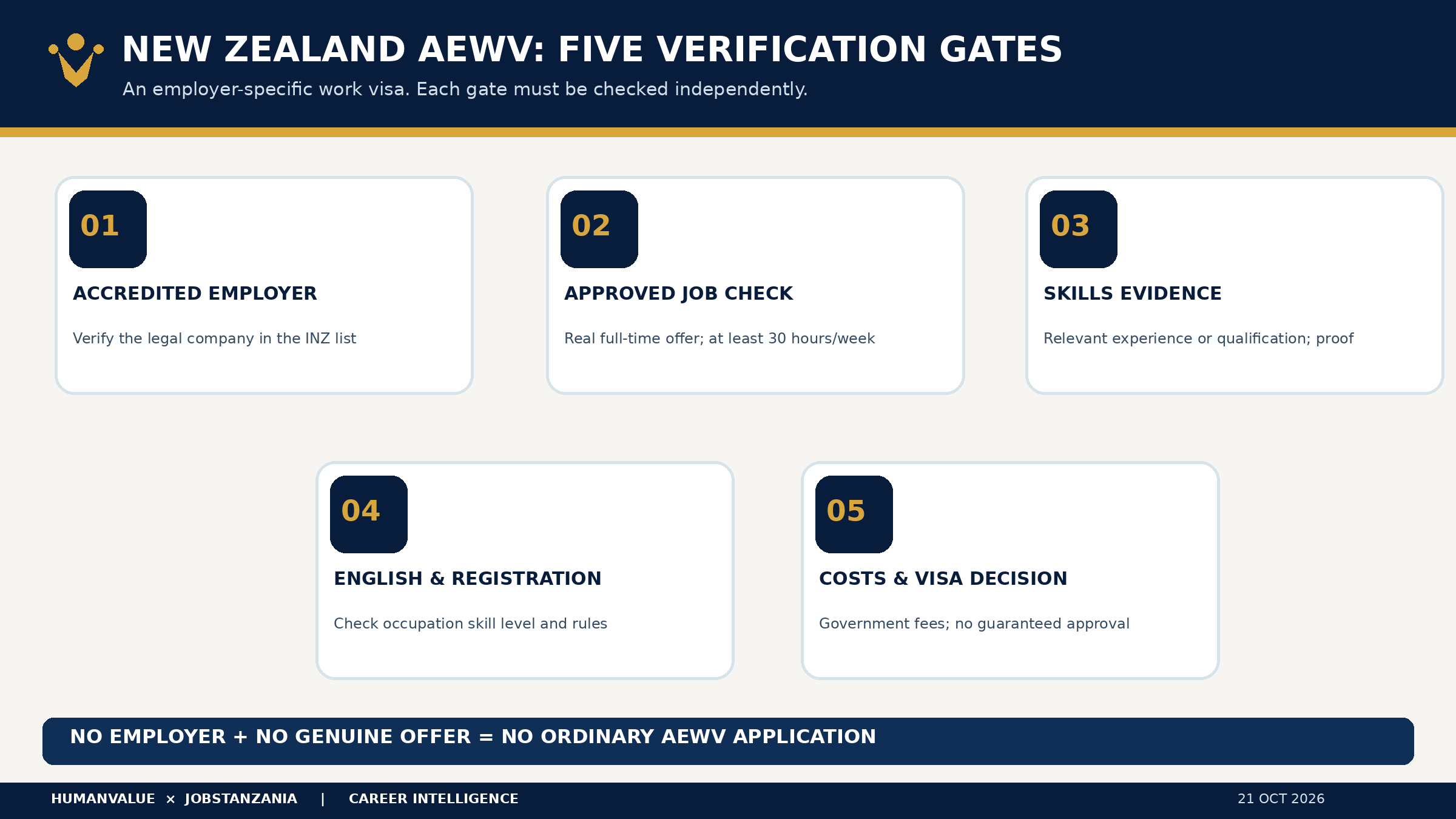
Before you spend money, complete the five-gate checklist: accredited employer, qualifying job and job check, skills evidence, language and registration, and real costs. Use Immigration New Zealand's AEWV page as your primary source. Use HumanValue's learning and career-readiness products only for the support they actually provide.
Research reviewed 21 October 2026. Immigration policy, fees, occupations and processing information can change. This is general information, not personalised immigration advice, a confirmed New Zealand vacancy or an employment guarantee.