
HumanValue Consulting Limited | Global Career Intelligence | Facts checked 23 October 2026
If you are preparing for PMP certification while working in Tanzania or elsewhere in Africa, check which exam your study materials describe. PMI updated its examination in July 2026. Another change arrives on 1 December: new restrictions will apply to providers of qualifying live training. These are separate milestones, and each affects a different preparation decision.
This guide explains the current requirements and offers an original portfolio exercise for professionals approaching multinational or US employers. PMP is a professional certification; it does not provide US work permission or guarantee a job.
1. What changed in the PMP exam?
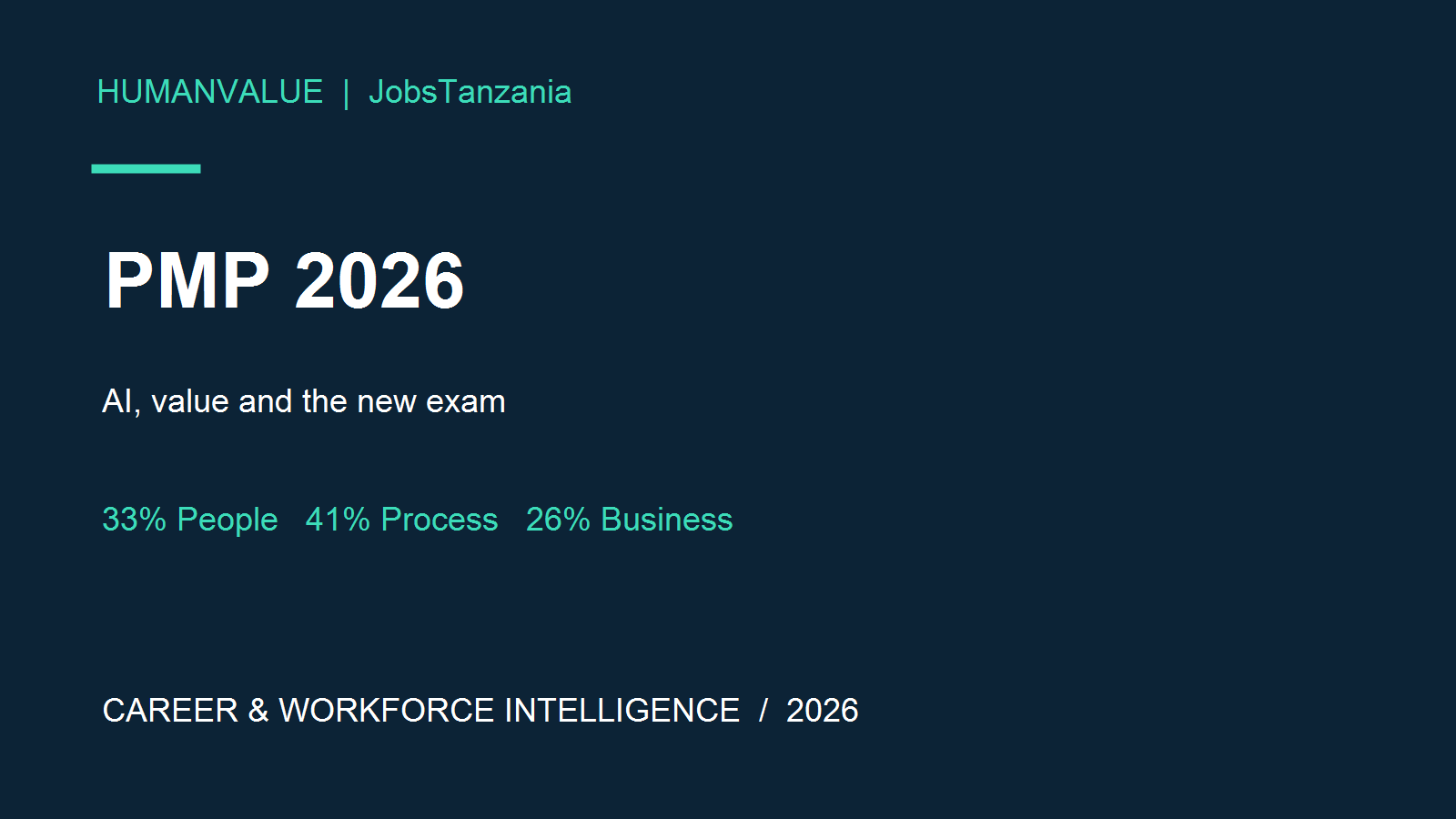
According to PMI's official exam update, the revised assessment gives greater attention to AI, sustainability, stakeholder engagement and business outcomes. The domain mix changed as follows:
| Domain | Previous | Current |
|---|---|---|
| People | 42% | 33% |
| Process | 50% | 41% |
| Business Environment | 8% | 26% |
The current certification page lists 180 questions and 240 minutes. Plan study and timed practice around this format. Do not mistake a smaller percentage for permission to skip a domain.
2. Check education and experience before buying training
PMI currently lists four education routes: a secondary-school qualification with five years of project-management experience; an associate degree or vocational diploma with four years; a bachelor's degree or higher with three years; or an eligible PMI GAC degree with two years. Experience must fall within the previous ten years. Overlapping projects cannot create additional calendar time.
Use PMI's eligibility guidance to confirm your route. A job title alone cannot establish what you actually managed. Prepare a private project log recording dates, responsibilities, decisions and outcomes. Ask a former supervisor whether they can verify your contribution before listing them in supporting records.
3. The 35-hour requirement and December deadline
PMI's training guidance requires 35 qualifying hours before application, with an active CAPM certification providing a waiver. From 1 December 2026, qualifying live instruction must come through a PMI Authorized Training Partner or an eligible accredited academic programme; a separate REP pathway applies in China. Self-paced courses may come from other organisations if they meet PMI's requirements, including an assessment and completion evidence.
Qualifying training completed before that date remains eligible under the rules applicable when it was completed. Retain certificates, dates, the syllabus and an hours breakdown. Buying a course before the deadline is different from completing it. Books and practice questions alone do not meet the training requirement.
4. Practise decisions about AI and value
For an original study exercise, imagine your team wants to use AI to summarise customer complaints. Write a one-page decision note: what problem are you solving, which data can be used, who reviews the output, and how will you detect errors? Add a fallback process if the summaries omit urgent complaints. This is editorial practice, not a sample PMI exam question.
For sustainability, compare two delivery options using cost, reliability, waste and stakeholder consequences. Explain the trade-off and the measure you would track after implementation. Practising a defensible decision is more useful than memorising fashionable terms without context.
5. Turn project work into an employer-readable portfolio
Consider a fictional African IT project manager who introduced a service-ticket system. A weak CV says “responsible for implementation.” A stronger account explains the baseline problem, team coordination, change decisions and verified result. For example: “Coordinated a three-department rollout and introduced weekly incident reviews; median resolution time moved from four days to three over the measured period.” The numbers are illustrative. Use your own records and avoid claiming that one intervention caused every improvement.
Build three short project summaries: one about delivery, one about stakeholder conflict and one about risk. Remove client names and confidential budgets unless disclosure is authorised. Explain your own contribution separately from the team's work. Certification can support credibility, but employers still assess role fit, experience and work eligibility.
6. A practical readiness plan
- Confirm your education route and non-overlapping experience.
- Audit training evidence and provider eligibility.
- Compare study materials with the current exam outline.
- Practise scenario decisions across all three domains.
- Use timed practice to identify gaps before booking.
- Prepare a truthful project portfolio for employer conversations.
Explore the HumanValue Learning Center for complementary workplace development and professional CV support to present project achievements clearly. HumanValue courses are not represented here as PMI-approved PMP training. Verify qualifying hours directly with PMI and the provider before payment.