


A credible quality assurance inspector application in Tanzania is built on evidence of how you check a specification, record a defect, protect a customer and communicate a corrective action. You do not need to invent factory experience to demonstrate those skills. A carefully labelled, fictional ten-sample inspection log, a simple defect-rate calculation and a reasoned root-cause discussion can give an employer something concrete to evaluate. This article shows how to build that portfolio and use it in an interview, without presenting a practice exercise as an actual company audit.
What does a quality inspector actually do?
A quality inspector compares a product, material or process against an approved requirement and records whether it conforms. In a food-packaging line, that might involve seal integrity, fill quantity, label information or visible damage. In a fabrication workshop it might involve dimensions, weld appearance or surface finish. The exact checks depend on the employer, product risk, applicable standard and approved procedure. A general job title does not authorise a candidate to claim expertise in regulated testing they have never performed.
The distinction between quality control and quality assurance is useful but not absolute in job advertisements. Quality control usually emphasises inspection and detection; quality assurance focuses on the system that prevents recurring defects. A strong junior applicant can explain both without pretending to be a certified auditor. Tanzania Bureau of Standards is an appropriate official starting point for checking applicable product standards, not a substitute for the employer's controlled specification.
Six decisions that separate an inspection from a guess
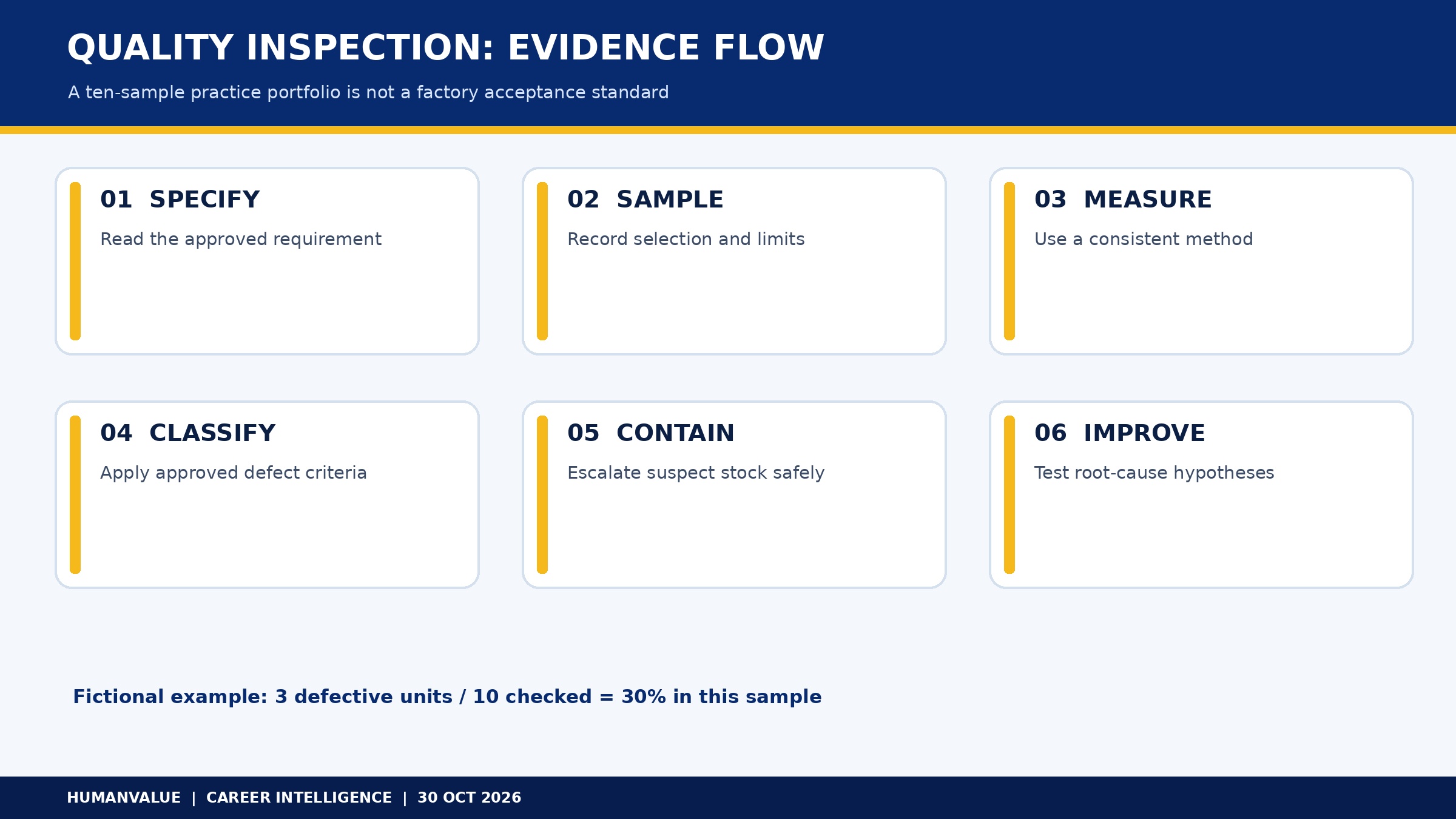
Define the requirement. Write down what the approved specification actually says. Do not decide that a product is defective merely because it looks different from your preference. Choose the sample. Explain how the units were selected and what your sample can and cannot establish. Ten practice items cannot establish an industrial acceptance-sampling plan.
Measure consistently. Record the tool, method and result, including units. Classify the finding. Separate critical safety issues from major functional issues and minor cosmetic issues only according to the approved company criteria. Contain the risk. Flag suspect items for supervisor review instead of independently releasing or destroying stock. Recommend improvement. Suggest a check that can test a cause, not an accusation about a worker. These six decisions form a useful interview narrative.
Build a ten-sample defect log using fictional data
Create a spreadsheet with columns for sample ID, product type, inspection point, specification reference, observed result, defect category, action, owner and review date. Use invented codes such as P01 to P10. Do not copy real customer names, proprietary product formulations, confidential quality records or photographs from a former employer.
Suppose ten fictional packages are inspected and two show an incomplete seal, one has a missing date code and seven pass. The observed sample defect proportion is 3 ÷ 10 = 30%. This number is deliberately exaggerated for learning. It is neither a national defect rate nor a statistically reliable estimate of a factory's production quality. If a single package has two findings, distinguish defective units from total defects to avoid misleading percentages.
A useful follow-up question is not 'how quickly can I reject the batch?' but 'what does the authorised sampling plan say, what risk does the defect create, and who can decide disposition?' The inspector documents evidence; release, rework or rejection authority follows company procedures. Show the decision boundary in your practice log.
Use the 5 Whys carefully, without blaming a colleague
A fictional packaging line experiences repeated incomplete seals. Why? The seal temperature may have been inconsistent. Why? A sensor reading may have drifted. Why? The sensor verification may not have been completed. Why? The maintenance schedule may not have assigned an owner. Why? The handover checklist may not have contained that step. This is a hypothesis chain, not a proven root cause. The next action is to examine maintenance records, machine readings and safe inspection results with authorised personnel.
Do not treat the first plausible story as a confirmed diagnosis. A 5 Whys exercise is strongest when it ends with evidence needed to test the theory and a way to confirm that corrective action worked. An operator's identity should never replace a causal investigation.
A fourteen-day portfolio plan
Days 1–3: Read five genuine quality inspector vacancies in food processing, manufacturing or logistics. Make a requirements matrix: product checks, record keeping, safety, basic Excel and any mandatory certification. Do not imply those five vacancies are currently open unless you can verify each listing.
Days 4–6: Design the ten-sample fictional log. Include one blank record, one correctly completed record and one deliberately incomplete record for error detection. Add data validation for defect categories and conditional formatting for missing fields.
Days 7–9: Write a one-page nonconformance report: finding, risk, immediate containment recommendation, evidence needed and responsible decision-maker. Prepare a separate 5 Whys hypothesis and a proposed verification step.
Days 10–12: Build a small dashboard with inspected units, defective units, open findings and closure status. Label the values as fictional training data. Avoid sophisticated charts that obscure a missing denominator.
Days 13–14: Rehearse a five-minute explanation, export a redacted PDF sample and write a two-sentence CV portfolio description. Ask a mentor to challenge your assumptions. Your evidence should be understandable without access to expensive enterprise software.
A realistic interview scenario
An interviewer says: 'The shift is behind schedule and your sample shows a seal defect. Production wants to release the pallet.' A weak answer is 'I would release it because the target is urgent' or 'I would shut down the factory myself.' A stronger answer is: 'I would record the observation against the approved specification, isolate or flag the affected stock according to procedure, notify the authorised supervisor and quality lead, and document the disposition decision. I would not alter results to meet the dispatch target.'
For a second question, explain what you would do if a measuring instrument appears out of calibration. Stop relying on the questionable measurement, identify affected checks and seek the approved verification process. You do not need to know a company's exact instrument model to demonstrate this judgement.
Turn the practice exercise into honest CV evidence
Use an entry such as: 'Independent quality-inspection practice project, October 2026: designed a ten-sample fictional defect register, documented three illustrative nonconformances and prepared a root-cause hypothesis with verification actions.' Do not write 'reduced factory defects by 30%' unless you actually achieved that result at work and can support it.
If your background is retail, laboratory support, warehouse receiving or hospitality, identify transferable habits such as careful counting, traceable records, customer safety and escalation. Match your application to the real vacancy rather than inserting every quality buzzword. The HumanValue Learning Center lists Workplace Excel Essentials at TZS 20,000 and CV & Application Pack Lab at TZS 40,000, checked 30 October 2026. Neither is a professional quality-inspector licence. Choose learning based on your actual gap, not a promise of employment.
Where safety and standards fit
A practice project must not involve unsafe machine access, live chemical testing or interference with production. Employers and workers should follow workplace safety requirements and approved procedures. Tanzania's Occupational Health and Safety Act establishes the statutory context for workplace safety, while TBS is the source for relevant national standards. A blog post cannot determine whether a particular product passes its legal requirements.
Frequently asked questions
Can a graduate apply without factory experience?
Some junior vacancies may allow it; others require specific training or experience. Read each genuine advertisement and present relevant coursework, internships and clearly labelled practice evidence.
Is a 30% defect result acceptable?
It is only a deliberately fictional training calculation. Actual acceptance depends on the applicable standard, sampling plan and product risk, not this article.
Do I need SAP or an ERP certificate?
Only if the specific role requires it. Show truthful familiarity with records and describe how you would learn the employer's approved system.
Does Premium guarantee an interview?
No. Job Seeker Premium is an optional 30-day support product listed at TZS 30,000 on 30 October 2026; ordinary applications remain free.
Your next practical step
Complete the ten-sample workbook, annotate the limitations and attach a short portfolio description to your role-specific CV. Search real vacancies on JobsTanzania. Use a course or optional Premium guidance only where it adds practical value. A credible inspector does not promise zero defects; they show how they detect, document and escalate risk.
Editorial sources and scope (30 October 2026): Tanzania Bureau of Standards; Occupational Health and Safety Act; HumanValue Learning Center. Practical cases are fictional. No vacancy or certification outcome is asserted.