


A reference check should answer a narrow hiring question: can an employer corroborate important claims about a candidate's work, responsibilities and job-related conduct? It should not become an informal investigation into private life, family circumstances or rumours. For Tanzanian employers, a reliable process combines clear candidate communication, genuine referees, consistent questions and careful handling of personal information.
This article provides a practical operating model for hiring managers and HR teams. It is not a substitute for legal advice about a disputed reference or a regulated role. Tanzania's Personal Data Protection Commission explains that the Personal Data Protection Act governs collection, processing, use, storage, disclosure and transfer of personal data. Reference checking therefore belongs inside the organisation's recruitment and data-governance process, not outside it.
Decide what actually needs verification
Before contacting anyone, separate critical requirements from nice-to-have details. A transport company may need to verify driving duties, vehicle classes, safety records and the period of employment. A finance team may need to corroborate accounting responsibilities, systems exposure and supervision. A hotel may care about shift reliability, guest service and handling escalated complaints.
Do not ask every referee the same irrelevant set of questions. Start from the job description and the evidence already collected at interview. If a role requires a licence, professional registration or other statutory condition, verify it with the responsible authority where appropriate rather than treating a referee's opinion as sufficient proof.
Tell the candidate how the check will work
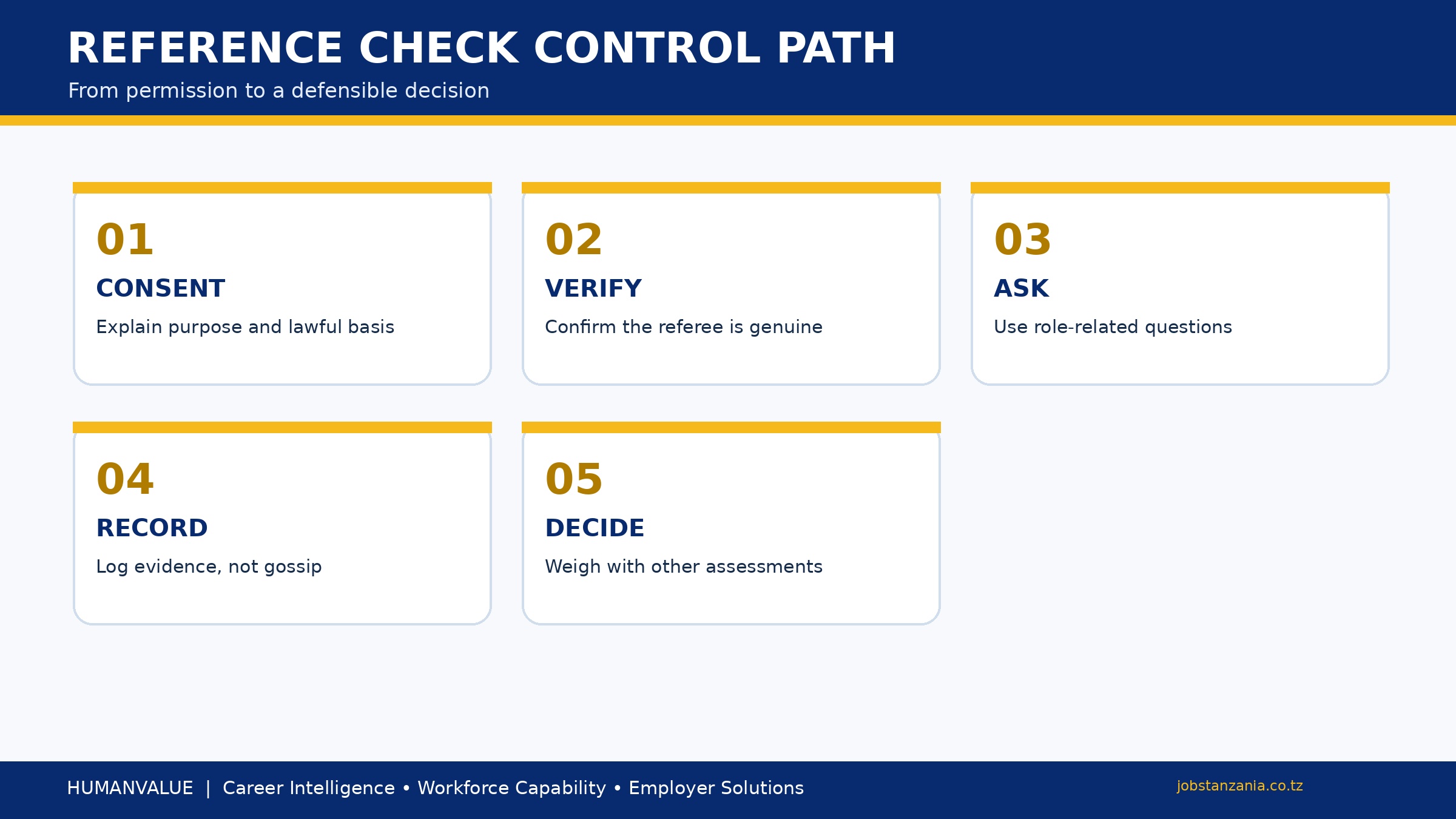
A candidate may still be employed and may not want a current supervisor contacted before a conditional offer. Explain who will be contacted, why, when and how the information will be used. Determine the lawful basis for processing personal data and document the candidate communication and any consent that is required. Consent is not the only possible lawful basis in all circumstances, so HR should not reduce data protection to a single checkbox.
Ask the candidate to identify suitable referees, their roles and professional contact channels. Where a current-employer reference could put employment at risk, consider a previous supervisor, project lead or other appropriate source, with safeguards. Do not surprise-call a current manager merely because their name appears on LinkedIn.
Verify the referee before asking sensitive questions
Fraudulent references can be created using personal email accounts or numbers controlled by friends. Where proportionate, check the referee's business affiliation through a published switchboard, professional directory or an independently established company contact. Do not assume every small business has a corporate email address. The goal is reasonable source confidence, not exclusion of candidates from smaller enterprises.
Record the referee's name, relationship to the candidate, how their identity was checked and the date of the conversation. If the source cannot be verified, label the result as unverified instead of silently treating it as fact. A candidate should have an appropriate opportunity to clarify material inconsistencies.
Ask structured questions that relate to the role
Begin with facts: employment period, job title, reporting relationship and main responsibilities. Then ask behavioural questions that the referee can answer from direct observation: “Can you describe an occasion when this person handled an urgent customer complaint?” or “What quality checks did they use before submitting monthly reports?”
Avoid questions about pregnancy, religion, ethnicity, medical history or unrelated family matters. Such questions create discrimination and privacy risks and rarely improve a hiring decision. Also avoid inviting broad statements such as “Is this person trustworthy?” without asking for observable job-related examples.
Use a reference scorecard without pretending it is objective truth
A simple record can contain the criterion, factual evidence, source confidence and follow-up needed. For example: “Inventory accuracy: referee supervised weekly counts for six months; confirmed use of stock register; did not personally review monthly reconciliations.” This is more useful than “excellent employee, 5/5.”
A reference is one source, not a verdict. Combine it with work samples, interviews, credentials and role-specific assessments. If two referees disagree, check whether they observed different periods or duties. Do not assume the more senior person's opinion is automatically correct.
Protect CVs, notes and contact information
Reference notes may contain personal data about both the candidate and the referee. Store them in an authorised recruitment system with limited access, an appropriate retention schedule and a clear purpose. Avoid circulating full reference notes in open WhatsApp groups or sending sensitive candidate documents to unrelated departments.
The PDPC is the official starting point for understanding Tanzania's personal-data framework. Organisations should assess registration obligations, their lawful basis for processing, privacy notices, security measures and the rights of data subjects. For a specific dispute or data-transfer question, obtain qualified advice.
Practical case: hiring a stores supervisor in Dodoma
A fictional wholesaler interviews three candidates for a stores supervisor role. Candidate A presents a polished CV but cannot explain stock variances. Candidate B has strong practical work-sample results and two references from a smaller business. Candidate C has a strong reference but weak evidence of current inventory software capability.
A fair decision compares the essential requirements across all three candidates. For B, the hiring team independently confirms the former supervisor's identity and asks about receiving, cycle counts and reconciliation. For C, it checks whether software training could close a noncritical gap. For A, it requests clarification of the discrepancy rather than assuming dishonesty. The final decision records job-related evidence, not personality impressions.
When to use Talent Bank and assisted recruitment
An employer can begin with HumanValue Talent Bank to search anonymised profiles and assess whether relevant experience is available. Its public page currently describes a seven-day trial with up to three unique candidate unlocks, while paid Talent Search is a separate option. Profiles and AI-assisted matching are screening aids, not proof that every candidate's qualifications or availability have been verified.
If a company needs to advertise a vacancy, compare the current employer plans and register through the official platform. For complex roles, multi-site hiring or the design of a defensible assessment process, HumanValue HR Services can be contacted about assisted recruitment and HR advisory. Confirm service scope before assuming a particular verification package is included.
A 20-minute reference-call agenda
Use the first three minutes to confirm the referee's role and relationship. Spend five minutes confirming duties and employment facts. Use eight minutes for two or three behaviour-based examples linked to essential competencies. Spend two minutes on material inconsistencies and two minutes documenting the next step. This is an illustrative agenda, not a legal minimum or a substitute for a regulated background check.
The HR team should record the date, purpose, questions, concise factual responses, outstanding checks and who may access the note. If the candidate disputes a material statement, establish a proportionate way to assess the discrepancy before deciding.
Frequently asked questions
Must a reference check happen before every offer?
Not every role needs the same checks. Risk, job duties, professional requirements and the employer's policy should determine the stage and depth. Conditional offers may be appropriate in some settings.
Can we call the candidate's current employer without telling them?
That can create serious confidentiality and fairness concerns. Establish the lawful basis, communicate appropriately and consider safer alternatives, particularly before a candidate has resigned.
Does a good reference prove a candidate is qualified?
No. A referee may know only part of the work. Verify mandatory licences or qualifications independently and assess actual role capability.
Can an employer keep reference notes forever?
Retention should be justified by applicable legal obligations and the documented purpose. A permanent archive without review is not a sound default.
A better hiring decision starts with better evidence
Select one current vacancy and agree on five job-related facts to verify. Use the same process for every finalist, protect their information and document material findings. A structured reference check supports a fair decision; it should never replace the candidate's opportunity to demonstrate capability.