


Quick answer: Tanzanian employers can improve the clarity of recruitment by agreeing a defensible salary range before advertising a vacancy, describing which benefits are included, and assessing candidates against the same job-related criteria. Publishing a range is an editorial best-practice recommendation here, not a claim that every private employer is legally required to display one in a job advert. The real objective is to prevent avoidable misunderstandings between the job description, recruitment budget, offer letter and actual employment terms.
The hidden cost of an undefined hiring budget
A business owner says, “Find me a strong accountant. We will discuss salary later.” HR advertises the position, reviews applicants and schedules interviews. After two weeks, the preferred candidate expects substantially more than the approved budget. The employer restarts the search or pressures the candidate to accept a lower offer. Nobody benefits from the ambiguity.
This is not an argument that salary alone determines talent quality. Candidates evaluate responsibilities, professional growth, management culture, commute, safety and employment stability. Yet remuneration is a material part of the decision. If a company cannot identify what it can afford and what the job is worth internally, the hiring process is operating without an essential control.
A structured pay band can reduce mismatched expectations, make approvals faster and help recruiters communicate honestly. These are expected process benefits, not measured outcomes for JobsTanzania employers. Whether to disclose the full band publicly depends on the employer's policy and applicable rules; even when a public figure is omitted, an internal approved range is useful.
Step 1: Define the role before estimating pay
Start with work outputs rather than an impressive job title. For a finance officer, list monthly close responsibilities, tax compliance, reconciliations, reporting systems and approval limits. For a maintenance supervisor, specify equipment, shift pattern, team size, safety responsibilities and required certification. For a customer-service lead, describe service channels, complaint escalation and quality monitoring.
Separate essential requirements from preferences. A company that requires CPA(T) for a role should be able to explain why the work genuinely requires that credential. Avoid copying another employer's job advert without checking whether its seniority and conditions match yours.
Document the job's location, normal work schedule, reporting line, contractual arrangement and any unusual demands such as frequent travel or night shifts. A vacancy in Dar es Salaam with regular site travel may attract different expectations from a position based permanently in one office. Do not confuse job scope with the characteristics of the person you hope to recruit.
Step 2: Build an approved salary band with a clear method
Use three evidence sources: internal parity with comparable employees, the approved department budget and current, reliable market information. Do not rely on a single social-media salary claim or an unverified national “average” that may combine different sectors and seniority levels. Record the source and date of any benchmark and explain adjustments for role complexity.
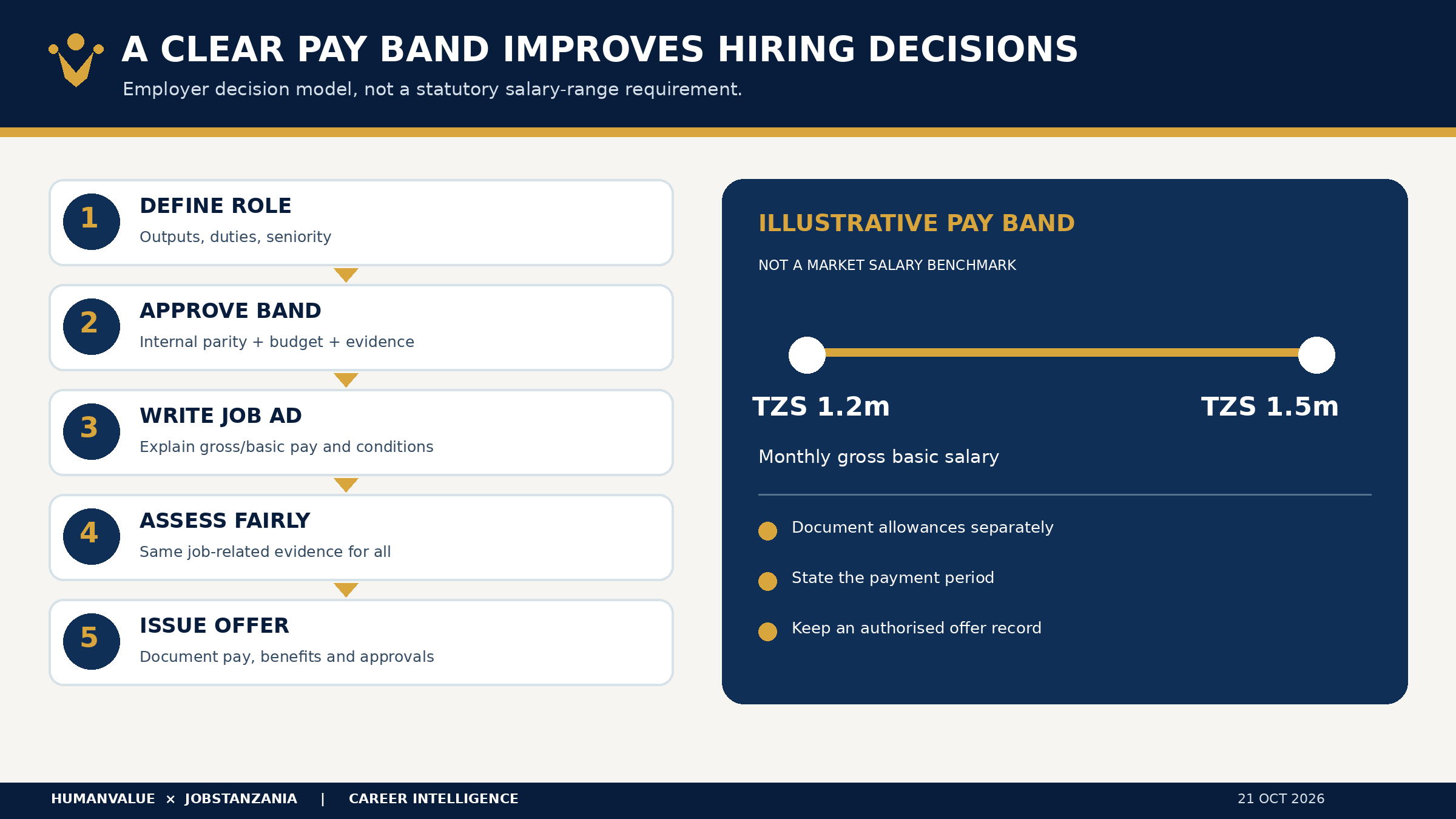
For illustration only, a fictional employer might approve a monthly gross basic salary range of TZS 1,200,000–1,500,000 for a particular specialist position. This is a hypothetical teaching example, not a verified market rate, statutory minimum or JobsTanzania salary recommendation. A candidate with the essential capabilities may enter the lower half, while a candidate with demonstrably broader responsibility may justify a higher point, provided the decision follows a consistent policy.
Agree who can approve an offer above the range and what evidence is needed. A manager who quietly offers one candidate a premium without recording the reason creates internal equity and governance questions. HR should maintain a short compensation decision record that is accessible only to authorised staff.
Step 3: Explain basic pay, gross pay and benefits accurately
A common problem is a vacancy saying “salary TZS 1.5 million” while the employment letter uses a different combination of basic pay, allowances, variable bonuses and deductions. Distinguish the agreed basic wage from gross remuneration, discretionary or conditional allowances and expected net take-home pay. Do not promise a precise net figure without considering the worker's actual statutory and lawful deductions.
Under Tanzania's Employment and Labour Relations Act, Cap. 366, section 15 requires written particulars of employment, including remuneration, its calculation and relevant benefits. The Employment and Labour Relations (General) Regulations also address information supporting remuneration paid, including statutory deductions and gross or basic and net pay. These are employment-documentation obligations, not proof of a universal job-ad salary-range mandate.
If transport or housing support is conditional, say so. If commission depends on achieved sales, distinguish target earnings from guaranteed earnings. If the role includes a shift allowance, explain the eligibility trigger. Ask a payroll specialist to verify the treatment of allowances and deductions before issuing the offer.
Step 4: Write a vacancy that helps applicants self-select
A useful advertisement includes the real employer or authorised recruitment agency, duty station, work outcomes, essential qualifications, required experience, application deadline, application channel and any important working conditions. If the company elects to disclose a range, specify the pay period and whether the figure is gross or basic. A statement such as “competitive salary” provides little screening information on its own.
Example, fictional advertisement excerpt: “Operations Reporting Officer, Dar es Salaam. Responsible for weekly inventory and delivery reporting, exception tracking and supervisor dashboards. Essential: demonstrated Excel reporting ability and two years of relevant operations experience. Approved illustrative gross basic salary band: TZS 1.2m–1.5m monthly, depending on documented role fit. Benefits and any variable components will be explained in the offer.”
This is not a live vacancy. The amount is a classroom illustration, and an actual employer should replace it with its own approved range. The advert should not demand irrelevant sensitive data, such as national identity scans or medical records, from every applicant at the initial screening stage.
Step 5: Use a consistent evidence-to-offer matrix
Define three to five role-related competencies and assign each a weight. For the fictional reporting officer, a scorecard might allocate 30% to data accuracy, 25% to reporting skills, 20% to operations knowledge, 15% to communication and 10% to reliability evidence. Scores should be based on documented answers, work samples and relevant checks rather than personality impressions.
Decide how evidence maps to the pay band before meeting the final candidates. A candidate who demonstrates advanced reporting and process improvement might justify a higher offer than someone who meets only the essential requirements. The justification must be tied to job-related criteria and applied consistently. Keep candidate data secure and limit access to people involved in recruitment.
The Tanzania Personal Data Protection Commission explains the legal framework governing personal data processing. An applicant's current salary, identity documents and interview notes should not become freely circulated spreadsheets or social-media discussion material. Retain only what is needed for a legitimate recruitment purpose, subject to the organisation's applicable legal obligations and retention policy.
Step 6: Match the recruitment channel to the hiring problem
An employer with a clear vacancy and capacity to manage applications can use the JobsTanzania employer pricing page to compare registration and advertising plans. At the 21 October 2026 check, the main pricing page described a three-vacancy introductory allowance, while a separate older employer-plans page presented different free-plan wording. Employers should confirm the live terms in their account rather than rely on an archived screenshot.
If the company wants to identify candidates without first posting a vacancy, HumanValue Talent Bank provides anonymised profile previews, a one-time seven-day trial with up to three candidate unlocks and a separate paid Talent Search option. At review, the page listed TZS 40,000 for 30 days with up to 50 unique unlocks. Search access is not the same as verified candidate availability, background checking or an agency placement service.
If the vacancy is confidential, senior or difficult to define, HumanValue HR Services offers recruitment and workforce support subject to an agreed scope. A recruitment consultant can help the employer clarify role requirements, source prospects and design assessments; the employer still needs an appropriate compensation decision and an authorised offer.
Case study: a fictional logistics employer corrects its brief
A fictional Kibaha logistics company needs a fleet coordinator. Its first draft asks for “five years' experience, all logistics systems and ability to manage everything,” without defining the actual work or budget. HR interviews candidates whose expectations vary widely. Instead of simply advertising again, the team separates essential fleet scheduling and incident reporting from optional systems knowledge.
It then approves a salary band using internal pay parity and the actual role, specifies whether overtime and transport are included, and asks all finalists to complete the same 30-minute scheduling scenario. The shortlist discussion becomes about evidence and affordability rather than who negotiated most aggressively. No percentage reduction in hiring time is claimed; the case is an illustrative process redesign.
Case study: a small employer with a limited budget
A fictional retail business cannot match a large corporation's salary for a full finance manager. Rather than advertising a senior title at an unrealistic budget, it defines a narrower accounts-assistant role, adds external oversight for statutory matters and offers a realistic development plan. It may recruit a suitable candidate for the actual duties without misrepresenting the level of responsibility.
The lesson is not to underpay. It is to align scope, qualifications, pay and support. If the organisation cannot fund the work safely and lawfully, it should revise the staffing model before recruiting.
A one-page hiring budget approval checklist
Before posting, confirm the job description and essential criteria; approved basic or gross pay range; allowances and variable pay rules; payroll and statutory cost assumptions; contract type and duration; duty station and working pattern; assessment scorecard; approval authority; candidate-data access; and the channel through which the vacancy will be advertised. Attach the approved range to the requisition so that the final offer cannot quietly drift from the original business decision.
Review the range when responsibilities change materially, not only when a candidate negotiates. A documented process helps the company explain its choices and update them when market conditions change.
Frequently asked questions
Must every Tanzanian job advert state a salary range?
This article does not claim a universal requirement. Employers should check current sector-specific rules, applicable collective agreements and legal advice. The recommendation is to establish a clear internal band and communicate compensation accurately.
Should employers ask candidates for their current salary?
First ask what remuneration the candidate expects for the advertised role. Any collection of current-pay information should have a legitimate, transparent purpose and follow applicable data-protection requirements. Do not use unrelated personal details to determine pay.
Does a Talent Bank profile guarantee that the candidate is available?
No. Profiles support sourcing and initial screening. Confirm availability, consent, qualifications and fit directly before progressing.
Is the lowest offer always the best value?
No. Compare total workforce cost, capability, supervision needs, quality and retention risk. An under-scoped or poorly paid role may create operational problems that the headline salary conceals.
Next step for Tanzanian employers
Write a one-page vacancy brief with a defensible pay band, a consistent scorecard and an authorised offer process. Then choose the recruitment route that fits your capacity: compare JobsTanzania employer plans, preview Talent Bank candidates or request scoped HumanValue recruitment support.
Editorial review: 21 October 2026. Illustrative salary figures are not market benchmarks. Labour-law and payroll questions require case-specific verification, including the 2025 amendments where applicable.