
Why skills-based hiring matters now
The World Bank’s 2026 Tanzania Economic Update highlights the importance of workforce skills and more productive jobs. Employers can respond by assessing evidence of capability rather than treating degree titles or years of experience as sufficient proof of job readiness.
Define the work, not just the qualification
Identify the tasks that matter most during the first three months. For a customer service officer, these might include complaint handling, accurate records and communication. For an electrical technician, they might include fault isolation, safe work procedures and maintenance documentation.
Separate essential requirements from preferences
Licences, legally required credentials and safety competencies should remain mandatory where applicable. Other capabilities can be assessed directly or developed through training. Avoid eliminating candidates solely because they lack an unrelated preferred credential.
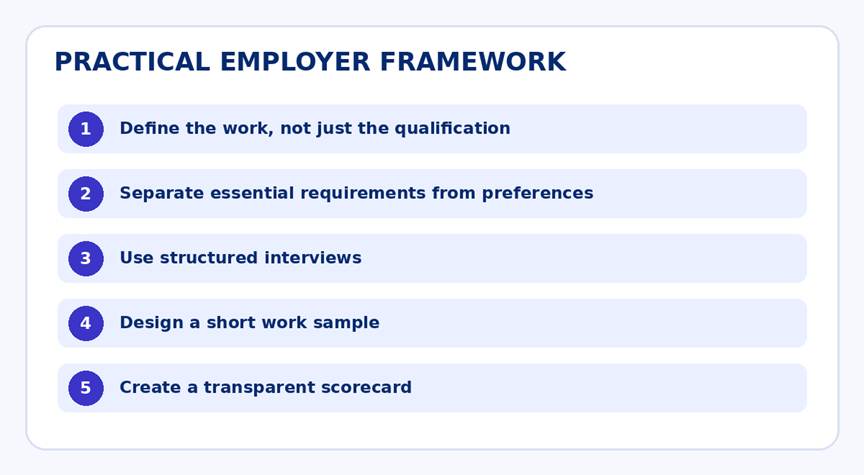
Use structured interviews
Ask every applicant comparable job-related questions and score answers against predefined indicators. For example: describe a time you found a process error, explain what you checked and show how you verified the result. Keep interviewer notes tied to evidence rather than impressions.
Design a short work sample
A practical exercise should resemble a genuine job task, fit the level of the vacancy and avoid demanding unpaid productive work. Examples include a spreadsheet reconciliation, a short customer response, a maintenance checklist or a basic sales proposal. Offer reasonable adjustments where needed.
Create a transparent scorecard
Use a 1-to-5 scale for technical accuracy, problem solving, communication, safety and role-specific outcomes. Weight safety-critical skills appropriately. Train assessors to apply the same rubric and document why a candidate met or missed a threshold.
Assess potential as well as current proficiency
Some roles require immediate competence; others permit supervised learning. Distinguish essential day-one skills from trainable gaps. A development plan can broaden the talent pool while keeping performance expectations clear.
Link recruitment with training
Where multiple shortlisted candidates lack the same skill, review whether job requirements are realistic and whether a structured learning pathway is appropriate. Employers can use onboarding, short courses and coaching to close noncritical gaps after hiring.
Protect fairness and candidate information
Only collect information necessary for the hiring purpose, explain how assessments are used and protect test results and CVs. Document decisions consistently and review outcomes for unintended exclusion.
Turn the method into an employer pilot
Select one vacancy, agree on three to five competencies, test a short work sample and compare assessment outcomes with early job performance. Repeat the process only after reviewing candidate experience and manager feedback.
Where JobsTanzania fits
Use JobsTanzania to reach applicants, HumanValue Talent Bank to identify relevant candidates and HumanValue Learning Center to support targeted capability development. HumanValue HR services can support structured assessment design.
Frequently asked questions
Does skills-based hiring mean degrees do not matter?
No. Mandatory qualifications remain important, while other skills can be assessed through practical evidence.
What is a work-sample test?
A short, job-relevant exercise that demonstrates how a candidate approaches actual tasks.
Can small employers use skills-based hiring?
Yes. A simple rubric and a short practical task can be sufficient for many roles.