


HumanValue Employer Recruitment Intelligence | Tanzania | 19 October 2026
Employers do not always lose good candidates because they lack applicants. Sometimes the vacancy is advertised without a clear decision owner, applications sit untouched, interviews are repeatedly postponed, or a preferred candidate accepts another offer while the business waits for approval. A better approach is not to promise an instant hire. It is to define a transparent, measurable shortlisting workflow that respects candidates and makes decisions faster without skipping checks. This article presents a ten-working-day planning model for Tanzanian employers and recruitment agencies, from role approval to documented selection.
Why more applications do not automatically mean better hiring
Consider a growing distribution company in Dar es Salaam that needs an inventory controller. Its advertisement attracts many CVs, but the manager has not agreed on the essential ERP skill, salary range or shift pattern. HR shortlists 15 applicants. Operations rejects them because the actual role requires warehouse reconciliation, not general office administration. The employer pays for another advertisement, while the original applicants hear nothing.
This is a process-design problem, not evidence that Tanzania lacks capable candidates. The World Bank's September 2026 Tanzania Economic Update, Making Jobs Work points to the importance of skills, productivity and stronger firms in creating better-quality jobs. An individual employer can respond by describing the work clearly and testing the capability that matters.
Before day one: approve a one-page hiring brief
The line manager and HR should agree on the business problem, job location, reporting line, work arrangement, compensation band where possible, must-have licences or credentials, and the three outcomes expected in the first 90 days. For an inventory controller, these could be: reconcile weekly stock differences, produce an accurate variance report and follow an approved dispatch-control process. Separate legally required qualifications from preferences that can be trained.
Write down who can approve the shortlist, who conducts the technical assessment, who checks references and who authorises an offer. One unclear approval point can waste days. A practical hiring brief also states how candidate information will be handled, who may view it and when records should be deleted under the organisation's applicable retention policy.
A ten-working-day shortlisting model
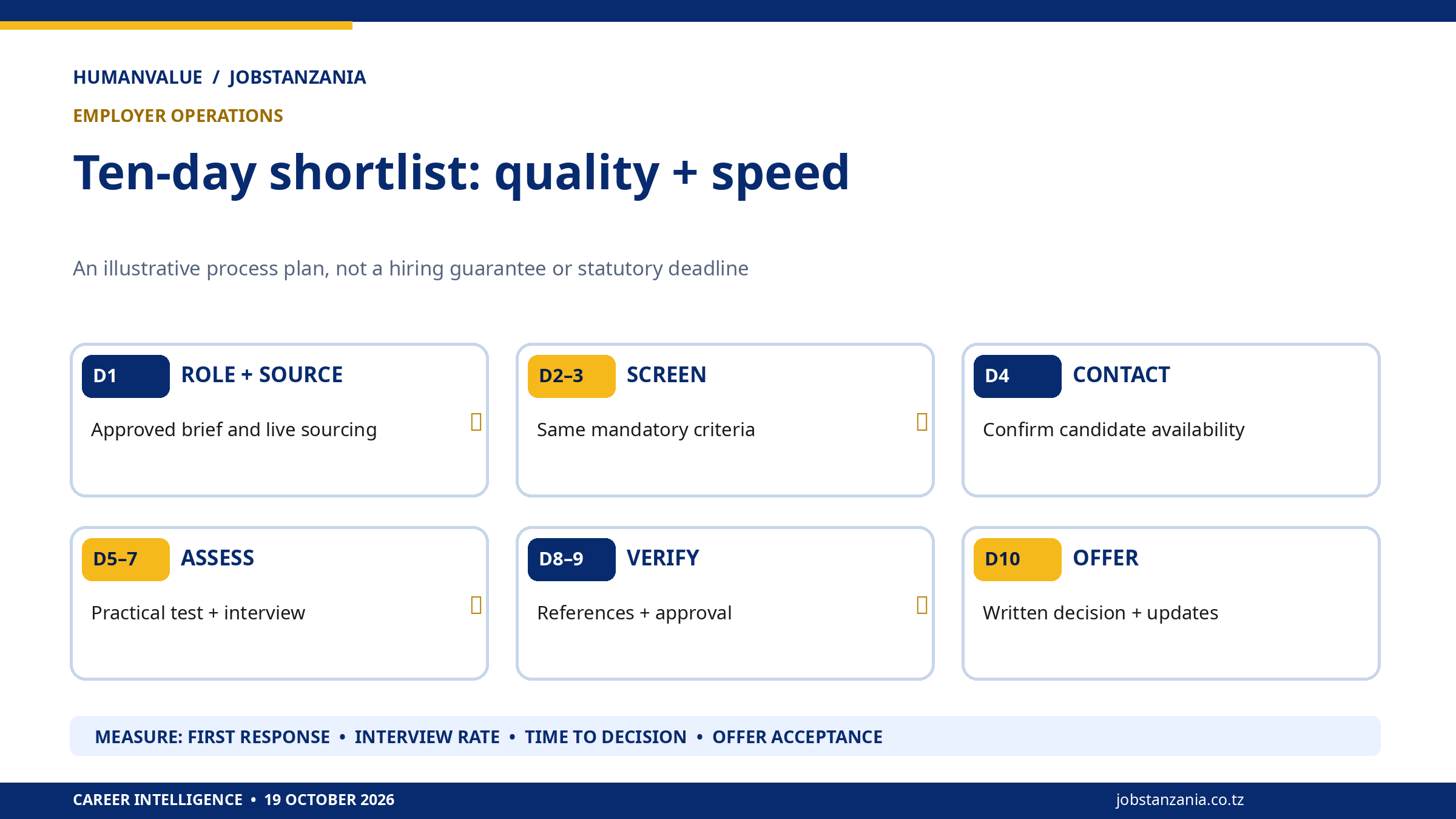
Day 1: Publish or activate sourcing. Use a specific title, duties, location, application deadline and accessible application route. Employers who need both advertising and applicant management can compare JobsTanzania employer plans; because plan details currently conflict across public pages, verify the actual checkout entitlement before committing.
Days 2–3: Screen against the same essentials. Record which candidates meet mandatory criteria. Reject no one solely because a CV uses an unfamiliar format. Do not treat AI-generated profile summaries as verified credentials. If the employer needs candidates without advertising a vacancy, HumanValue Talent Bank offers anonymised previews and a one-time seven-day trial with up to three candidate unlocks, subject to its published terms.
Day 4: Contact a manageable shortlist. Invite candidates with a clear role summary, assessment format, date, location or video instructions and contact point. Ask them to confirm availability. Do not request sensitive documents that are unnecessary at this stage.
Days 5–6: Assess actual work. For an inventory role, give every shortlisted candidate the same small, fictional stock reconciliation and the same time allowance. Score accuracy, reasoning, exception handling and communication against a pre-agreed rubric. Accommodate disability-related access needs so the exercise measures the relevant skill, not the applicant's ability to overcome an avoidable barrier.
Day 7: Structured interviews. Use comparable behavioural and technical questions. Capture evidence rather than impressions such as “good attitude” without examples. If a panel member disagrees, ask which job requirement the concern relates to.
Day 8: Reference and qualification checks. Obtain appropriate candidate permission, verify relevant credentials through authorised channels and contact references responsibly. For regulated professions, check practising status where required. Do not rely on a screenshot as proof of a qualification.
Day 9: Decision and approvals. Record the chosen candidate, evidence of fit, compensation approval, alternatives and any unresolved condition. Ensure the proposed terms are consistent with applicable Tanzanian labour law and organisational policy.
Day 10: Offer and candidate communication. Issue a clear written offer subject to appropriate checks. Notify unsuccessful finalists respectfully, preserving their information only under a lawful, communicated retention policy. This ten-day sequence is a model for planning, not a guarantee that every recruitment can lawfully or safely finish in ten days.
The five metrics a hiring manager should actually monitor
Time to first candidate response measures the interval between application and meaningful contact. Screen-to-interview conversion helps diagnose whether the advert attracts relevant applicants. Interview-to-offer ratio can reveal unclear criteria or inconsistent evaluation. Offer acceptance rate highlights whether compensation, location or response delays are causing avoidable losses. Time to decision separates employer-controlled delays from candidate availability or statutory checks.
Define each metric before comparing teams. A small organisation should start with a spreadsheet: vacancy ID, opening date, shortlist approval date, assessment date, offer date, reason for delay and source channel. Do not collect applicant medical details, identity numbers or personal contact data in a public analytics dashboard. Use access-controlled HR systems for necessary candidate records.
The shortlist quality scorecard
An illustrative inventory-controller scorecard might assign 30 points to stock and ERP accuracy, 25 to reconciliation reasoning, 20 to safety and controls, 15 to communication and 10 to shift and location availability. The weights are examples, not a universal hiring standard. Mandatory licences and legal requirements remain pass/fail prerequisites where applicable. Test the scorecard against the actual role, document the rationale and adjust before assessing candidates, not after seeing preferred names.
The strongest shortlist is not necessarily the five most impressive CVs. It is the set of candidates who meet the essential requirements, have credible evidence of ability and can realistically accept the job's terms. Where AI-assisted matching is used, a trained human should verify the outputs and watch for unfair exclusions.
Choosing between advertising, Talent Bank and assisted recruitment
Advertise a vacancy when you want a broad applicant pool, employer visibility and a managed application process. Use Talent Bank when you have a defined role and want to search existing profiles, including when you are not posting a vacancy. Request assisted recruitment when you need specialist sourcing, confidential searches, assessment design or HR support beyond a database. These are different services; do not imply a Talent Search purchase includes job posting.
At the time of this review, HumanValue Talent Bank publicly lists a seven-day trial, three candidate unlocks, and a TZS 40,000/30-day search-only option with up to 50 unique unlocks. Employers should check the current terms before payment. For a role requiring hands-on screening or a wider workforce solution, HumanValue HR Services provides an enquiry route to discuss scope and quotation.
Candidate communication is part of the employer brand
Applicants notice whether a company explains the role, responds when it promises to respond and respects their time. A rejection message need not disclose another candidate's private details. A useful update says the recruitment stage, expected next contact and whether further documents are needed. The CIPD's guidance on employer brand emphasises mapping candidate touchpoints and consistent communication; it is guidance, not a Tanzania-specific legal deadline.
For a multi-location employer, give one coordinator ownership of candidate messages. If a manager needs three extra days, inform finalists instead of leaving them guessing. When a candidate withdraws, record a factual reason if voluntarily provided. Avoid assuming every withdrawal means salary was too low.
Frequently asked questions
Can a company hire someone in ten working days?
Sometimes, but timing depends on the role, checks, approvals and candidate availability. This article's schedule is a process-planning example, not a service-level guarantee or a substitute for legal compliance.
Does Talent Bank guarantee that all candidate skills are verified?
No. The platform describes structured and AI-assisted profiles as screening aids. Employers must independently confirm current availability, qualifications, references and suitability before making a decision.
Is it better to advertise or search existing profiles?
Use an advertisement for broad market reach and employer visibility. Search existing profiles when the role is clearly defined and a narrower talent pool may be suitable. Assisted recruitment may be appropriate when specialist screening or confidential sourcing is needed.
The employer action for this week
Select one active vacancy. Approve a one-page role brief, assign an owner to every decision and set a candidate-contact commitment that the team can actually meet. Then choose the sourcing route that matches the need: create an employer account, start a Talent Bank trial or discuss a HumanValue recruitment assignment. Measure what improves, not merely how many CVs arrive.
Editorial note: The ten-day timeline and scorecard are illustrative management tools. Recruitment timelines, legal obligations, contractual terms and data handling must be verified for each employer and role.