


A construction contractor can receive dozens of CVs for an electrician or welder and still be unable to answer the question that matters: Can this person perform the specific work safely, to the required standard, under the conditions of this site? A certificate, an impressive job title and years of claimed experience are useful signals, but they are not interchangeable with role-specific evidence. Employers need a repeatable process combining lawful screening, document checks, supervised practical assessments, safety induction and clear hiring decisions.
This guide is designed for Tanzanian building contractors, industrial maintenance companies, engineering firms, factories and project owners. It is not a replacement for a competent technical assessor, a regulated licence check or an occupational safety plan. It shows how HR and the site team can collaborate before a person is offered work on live equipment.
Start with the work, not the job title
“Experienced electrician” is too broad for a useful shortlist. One employer may need industrial motor-control troubleshooting; another needs domestic installation; a third needs low-voltage maintenance in a factory with strict isolation procedures. The risks, equipment and acceptable evidence differ. The hiring manager should define the equipment or process, environment, level of independence, supervision, certifications or registrations required and outcomes expected during the first 90 days.
A strong role brief might say: Diagnose and document routine faults in an industrial electrical distribution environment, follow approved isolation procedures, interpret diagrams and escalate work outside authorisation. This is more actionable than “must be hardworking and able to work under pressure.” The HR team can then screen against criteria that are job-related rather than relying on vague impressions.
For welders, specify process, material, position, inspection requirements and whether the work is structural, fabrication or maintenance. For plant operators, define the equipment type, site conditions, load restrictions, signalling arrangements, manufacturer requirements and applicable authorisations. Do not treat a driver's licence as automatic proof of competence to operate every industrial machine.
Separate four kinds of evidence
The first is identity and employment history, verified through appropriate documents and references. The second is training and recognised qualifications, including relevant vocational training or documented prior learning. The third is observed task performance, evaluated by someone technically competent. The fourth is safe working behaviour, including the ability to recognise a hazard and stop or escalate unsafe work. A candidate may be strong in one area and need supervised development in another.
Tanzania's Vocational Education and Training Authority describes Recognition of Prior Learning as a process for identifying and validating skills acquired outside formal learning. This is important for experienced tradespeople who learned through apprenticeships or work experience. RPL is not a shortcut around safety, site-specific competence or any licence that a particular task requires.
The Occupational Safety and Health Authority identifies workplace registration, risk assessment, safety policies, inspections and appropriate training among its compliance themes. Employers should treat the assessment itself as a controlled workplace activity, not as an informal trial that exposes applicants or employees to unnecessary danger.
A five-stage hiring method for technical roles
Stage 1, agree the task standard. Before advertising, have the site engineer or technical lead describe the tasks that distinguish competent performance. List the tools, drawings, inspection steps and documentation required. Record what an acceptable result looks like and what would be a critical safety failure.
Stage 2, screen for evidence. Review experience by type of installation or machine, not years alone. Ask what the candidate personally did, what equipment they handled, what standards they followed and how work was checked. Verify essential credentials and employment claims with consent and appropriate recordkeeping.
Stage 3, conduct a safe practical exercise. Use a de-energised training panel, a simulation, a sample weld coupon or a controlled planning scenario as appropriate. A competent assessor should select the exercise and define the controls. Do not use unqualified applicants to perform live electrical work, lift real loads or complete productive hazardous work merely to “prove” themselves.
Stage 4, interview for judgement. Ask what the candidate would do if a supervisor requested a shortcut, a drawing conflicted with site conditions or a critical safety device appeared defective. Good answers identify the limit of personal authority and the escalation process. A confident but unsafe answer should not be rewarded simply because it sounds decisive.
Stage 5, document the decision and development plan. Use the same job-related criteria for all applicants. Record observations, any necessary accommodations, gaps requiring training and the reason for the final decision. Where a hire is made, convert the assessment into a supervised induction and competency-development plan.
A sample scorecard that reduces guesswork
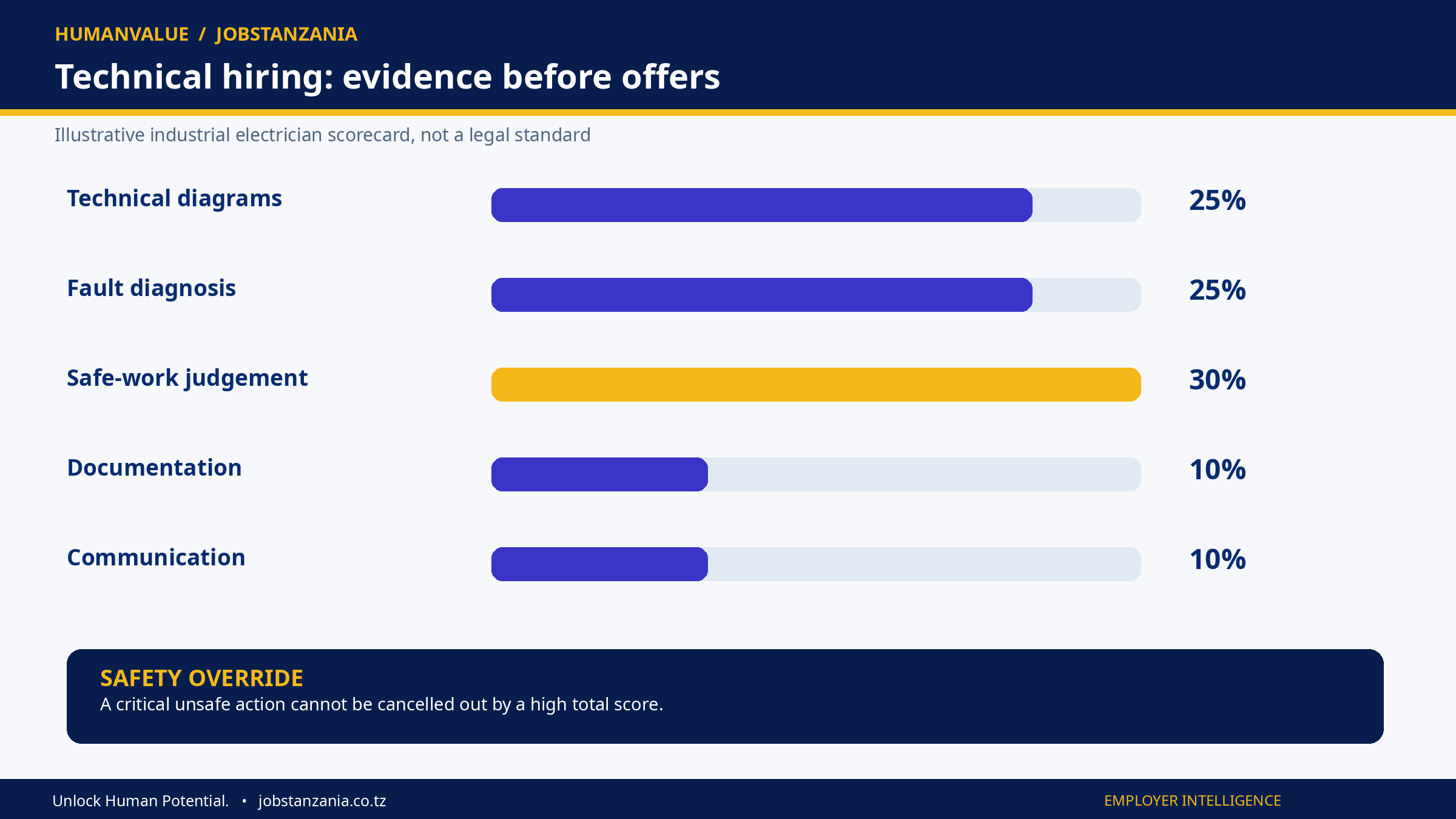
Consider a fictional industrial electrician vacancy. The employer decides in advance to weight technical interpretation at 25%, controlled fault diagnosis at 25%, safe-work judgement at 30%, documentation at 10% and communication at 10%. Each category receives a score from one to five using written behavioural anchors. A weighted score helps reviewers compare evidence consistently, but it must not override a critical safety failure or a mandatory credential requirement.
For example, Candidate A may score strongly on speed but fail to identify the need for isolation before work. Candidate B may work more slowly but explain the controls correctly, document findings and know when to ask for supervision. An employer should not reward unsafe speed. The scorecard is a decision aid; it does not remove the need for qualified assessment and legal compliance.
A practical assessment can also identify training potential. Someone who can read a drawing and explain a fault but has limited exposure to a particular manufacturer may be suitable for a supervised junior role, if the employer has the capacity to train. This is different from placing an unprepared person into a safety-critical role without oversight.
Avoid three costly hiring mistakes
The first mistake is advertising a long list of certificates without explaining the work. That can exclude capable applicants while attracting irrelevant credentials. The second is letting a single interviewer rely on confidence or personal familiarity rather than observable evidence. The third is forgetting the handover after selection: even a skilled worker needs site induction, equipment authorisation, emergency procedures and clear reporting lines.
Construction and maintenance businesses should also plan for temporary labour, subcontractors and seasonal project peaks. Before choosing a staffing model, define who supervises the worker, who supplies PPE, who records training, who investigates incidents and who verifies the person's authority to use equipment. Contracting arrangements do not make workplace risks disappear.
How HumanValue Talent Bank fits into this workflow
When a project manager needs a shortlist quickly, a searchable talent pool can help identify people with relevant trade backgrounds, locations and experience. The HumanValue Talent Bank, powered by JobsTanzania, currently advertises anonymised previews, a one-time seven-day employer trial with three candidate unlocks, and a separate 30-day Talent Search option. These are sourcing features, not certification that a candidate has passed your practical test.
An employer can start by searching for the role and location, then use a structured screening call to confirm equipment exposure and availability. Where the organisation needs applications from a wider market, JobsTanzania employer plans offer job advertising options. If the internal HR team lacks capacity to design the shortlist, arrange interviews or coordinate a volume campaign, HumanValue HR and recruitment services can discuss an assisted assignment with an agreed scope.
This is the right point for a commercial decision: do you need candidate discovery, public advertising or managed recruitment? A small firm with an experienced technical supervisor may use Talent Bank and handle its own assessments. A project mobilising several trades across multiple sites may need coordinated sourcing, verification and workforce planning. The choice should reflect the employer's capacity and risk profile.
A practical 30-day implementation plan
During week one, identify the three hardest-to-fill trade roles and rewrite each role profile around actual work. In week two, agree the evidence and safe-assessment standards with the technical team. In week three, trial the process on a small shortlist and compare assessor notes for consistency. In week four, review candidate quality, time to shortlist, safety observations and hiring-manager satisfaction. Keep a baseline so improvements are measured rather than asserted.
Do not publish a made-up “time to hire” improvement. If a team reduced the median shortlist time from ten to six days in a verified sample, explain the sample and period. If there is no baseline, say the process is being piloted. Credible evidence strengthens both operational decisions and employer trust.
Frequently asked questions
Can an employer rely on a VETA certificate alone?
A relevant qualification is valuable, but employers should also verify the specific task, safety requirements, equipment and any additional licences or site authorisations. A qualification does not prove current readiness for every role.
Is a practical test always necessary?
Not for every vacancy. Use a risk-based method appropriate to the work. For safety-critical technical roles, observed competence or a defensible equivalent is especially important. Tests should be fair, safe and related to the role.
Can a candidate be rejected for failing a safety step?
Employers should establish lawful, job-related criteria in advance and document the result. Critical safety failures require serious consideration. Apply consistent standards and seek qualified HR or legal advice where fairness or discrimination issues arise.
Does Talent Bank verify every licence and trade skill?
No. Its profiles and matching tools help identify candidates. Employers remain responsible for verifying qualifications, authorisations, references and suitability before hiring.
Turn hiring activity into a repeatable system
The aim is not to make recruitment more bureaucratic. It is to prevent avoidable mismatches between the vacancy, the worker and the workplace. Start with one role, one safe assessment and one scorecard. Then explore HumanValue Talent Bank for candidate discovery or book HumanValue recruitment support when the project requires a managed process. Hiring speed matters, but only when it produces capable people working safely.
Editorial note: This is operational recruitment guidance, not a technical safety procedure or legal opinion. Employers must apply current Tanzania Mainland or Zanzibar rules, applicable sector requirements and competent technical supervision.