


Quick answer
The UK’s public register of licensed Worker and Temporary Worker sponsors is an essential starting point for international job seekers. It does not, however, prove that a listed organisation has an open vacancy, will issue a Certificate of Sponsorship (CoS), or can sponsor every job title. For African professionals seeking UK employment, the safest strategy is to verify the employer, occupation and salary separately before investing money in an application.
The official sponsor register: what it actually proves
The Home Office publishes a downloadable register of organisations licensed to sponsor workers, including their worker routes and sponsor rating. The official register was updated on 9 October 2026. Use the current GOV.UK publication rather than a copied social-media spreadsheet. Match the full legal organisation name and check the relevant route. A licence is permission to sponsor under specified rules, not a promise of an available job or an invitation to apply.
The four-stage sponsor verification test
First, confirm the company’s legal identity and website. Second, locate its name in the current Home Office register and check the relevant Worker sponsorship route. Third, verify that the specific job appears on the company’s own careers page or another authentic recruitment channel. Fourth, ask whether that vacancy offers Skilled Worker sponsorship and whether the employer intends to assign a valid CoS if you are selected. Keep written evidence of the offer and communicate using verified corporate channels.
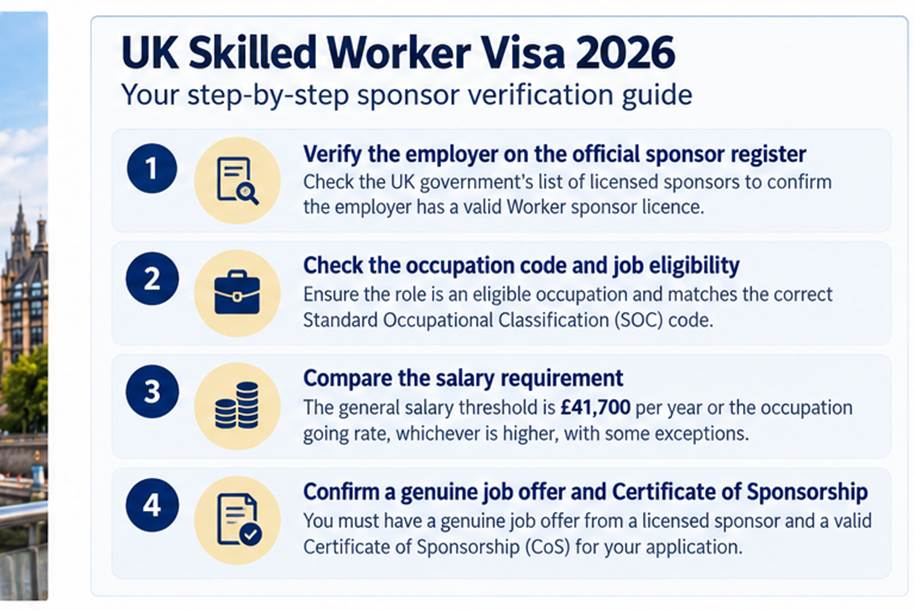
In-body infographic: key eligibility and verification rules. Source: official government guidance listed below.
Eligible jobs and four-digit occupation codes
A genuine offer must match an eligible occupation code, based on actual job duties rather than a convenient job title. Ask the employer for the four-digit occupation code and compare it with GOV.UK’s eligible occupations guidance. Some medium-skilled roles face additional restrictions and may require inclusion on an applicable list or qualifying transitional circumstances. An employer’s sponsor licence does not override occupation eligibility.
UK Skilled Worker salary requirement in 2026
The usual salary test is at least £41,700 annually or the occupation’s published going rate, whichever is higher. For example, an offer of £42,000 does not meet the standard test where the going rate is £45,000. The correct going rate depends on the occupation code and working hours. Some healthcare and education roles use separate pay-scale arrangements, while eligible new entrants, relevant PhD holders and other specified categories may qualify for different thresholds.
When a lower salary can be lawful
GOV.UK describes certain eligible cases in which applicants may be paid between 70% and 90% of the standard going rate, subject to an applicable minimum such as £33,400 and additional conditions. This is not a universal discount. Healthcare and education roles, immigration salary list occupations, extensions and transitional cases can have distinct rules. Always check the current rule that matches your personal circumstances and the exact occupation code.
A realistic sponsorship example
A Tanzanian software professional finds a UK employer on the register and a vacancy offering £44,000. The employer being licensed is encouraging but insufficient. The applicant must confirm the role’s occupation code, current going rate, whether the company sponsors that vacancy, the applicant’s English and experience evidence, and whether the employer will issue a CoS. If the going rate exceeds £44,000, the offer may fail the standard salary test even though it exceeds £41,700.
Warning signs of UK job sponsorship scams
Be cautious of requests to purchase a CoS from an unknown intermediary, pay into a personal bank account, communicate only through messaging apps, or accept an offer without a verifiable employer interview. Independently contact the employer using its official website. Do not treat a PDF bearing a company logo as proof of a legitimate vacancy. Report suspected fraud to the relevant authorities and preserve correspondence.
Your practical application checklist
Identify target employers and live vacancies; confirm the sponsor route; match the occupation code and going rate; prepare a UK-focused CV and evidence of experience; confirm English and any registration requirements; obtain an authentic offer and CoS; then use the official visa application process. Budget separately for visa fees, immigration health surcharge where applicable, travel and initial living expenses.
Frequently asked questions
Does the register list all current sponsored jobs? No, it lists licensed organisations, not vacancies. Does every licensed employer sponsor overseas candidates? No. Is £41,700 sufficient for every job? No, the occupation going rate may be higher and different rules apply in some cases. Can I buy a genuine CoS from a third party? Treat such offers as a major fraud warning and verify directly with the licensed employer.
Conclusion: verify before you invest
The best UK sponsorship strategy is evidence-led: a genuine licensed employer, a real vacancy, the correct occupation code, compliant salary and a valid CoS. This disciplined approach protects applicants from avoidable losses and helps employers identify candidates who understand the process and are ready to contribute.
Next steps with JobsTanzania and HumanValue
Check your international career readiness, improve your CV, build relevant skills and explore genuine opportunities. The HumanValue career assessment is a professional readiness service, not a visa or employment guarantee.
· International Opportunities and career assessment (TZS 50,000)
Official sources and fact-checking
· GOV.UK, register of licensed sponsors:
· GOV.UK, Skilled Worker visa: your job:
· GOV.UK, when you can be paid less:
· GOV.UK, healthcare and education salary rules: