


For African technology professionals, the UK remains attractive because it combines a large digital economy with employers that recruit internationally for selected roles. But the useful question is not simply whether the UK 'needs tech workers'. It is whether your specific capability is in demand, whether you can prove it at the level the employer needs, and whether the vacancy can lawfully support your route to work.
Recent UK hiring research reported that 47% of surveyed employers planned to expand technology teams before the end of 2026, with cybersecurity, agentic AI, generative AI and cloud among the leading capability priorities. That is a market signal, not a promise of a vacancy or visa. HumanValue's recommended approach is to convert the signal into evidence: choose a role family, build proof, target employers carefully and verify sponsorship conditions before investing heavily in an application.
|
KEY ANSWER: Treat UK tech hiring as an evidence-and-eligibility problem. Choose a specific role family, prove relevant outcomes, verify the employer and current Skilled Worker requirements, then tailor the CV and interview evidence to the vacancy. |
Start with role families, not the word 'tech'
Research / continue: Robert Half UK technology hiring research (2026)
Research / continue: JobsTanzania International Opportunities
AI, cybersecurity and cloud are not single jobs. Employers hire for defined outcomes: securing networks, engineering cloud platforms, building data pipelines, governing AI use, automating operations, supporting products or translating technical capability into business value. A candidate who applies broadly to 'AI jobs' will usually look less credible than one who can explain a clear role family and evidence base.
For AI-oriented work, distinguish data and machine-learning engineering from AI product, automation, analytics, governance and adoption roles. For cybersecurity, distinguish security operations, identity, governance-risk-compliance, cloud security, application security and incident response. For cloud, distinguish architecture, platform engineering, DevOps/SRE, infrastructure, FinOps and cloud security. Your target determines the proof you need.
Recent UK hiring reporting based on Robert Half research found strong employer interest in cybersecurity, agentic AI, generative AI and cloud capability. Use that as a direction signal, then validate the exact vacancy, employer and required level before applying.
|
ROLE FAMILY |
EVIDENCE AN EMPLOYER CAN ASSESS |
COMMON WEAK SIGNAL |
|
AI / automation |
Deployed workflow, model evaluation, measurable time/quality gain, governance controls |
Only listing AI tools |
|
Cybersecurity |
Incident handling, controls, audit evidence, detection, risk reduction |
Certification with no applied examples |
|
Cloud / platform |
Architecture, migration, uptime, cost, automation, security |
Generic 'AWS/Azure knowledge' |
|
Data / analytics |
Pipelines, dashboards, decision impact, data quality |
Software list without business outcome |
|
Tech leadership |
Strategy, budgets, teams, risk, transformation, stakeholder outcomes |
Title without scale or results |
Build a proof stack that travels internationally
An international employer may not know your Tanzanian employer, university or project context. Do not compensate by inflating titles. Add concise context and show scale. A cloud migration becomes more legible when you state users, sites, workload, availability target, security requirement and measurable result. A cybersecurity achievement becomes stronger when you show the risk, control, response time or audit outcome.
Build a private evidence inventory before writing the CV: problem, action, technology, scale, metric, date and evidence source. Separate confidential details from publishable proof. Where numbers cannot be disclosed, use authorised ranges or operational descriptions. Keep facts consistent across LinkedIn, CV, portfolio and interview.
Projects matter particularly for early-career candidates. A well-documented lab, automation, dashboard, cloud deployment or security exercise can demonstrate method even when paid experience is limited. Explain the problem, architecture, trade-offs, testing, result and what you would improve.
INFOGRAPHIC PLACEMENT — UK TECH READINESS: DEMAND → EVIDENCE → ELIGIBILITY → APPLICATION
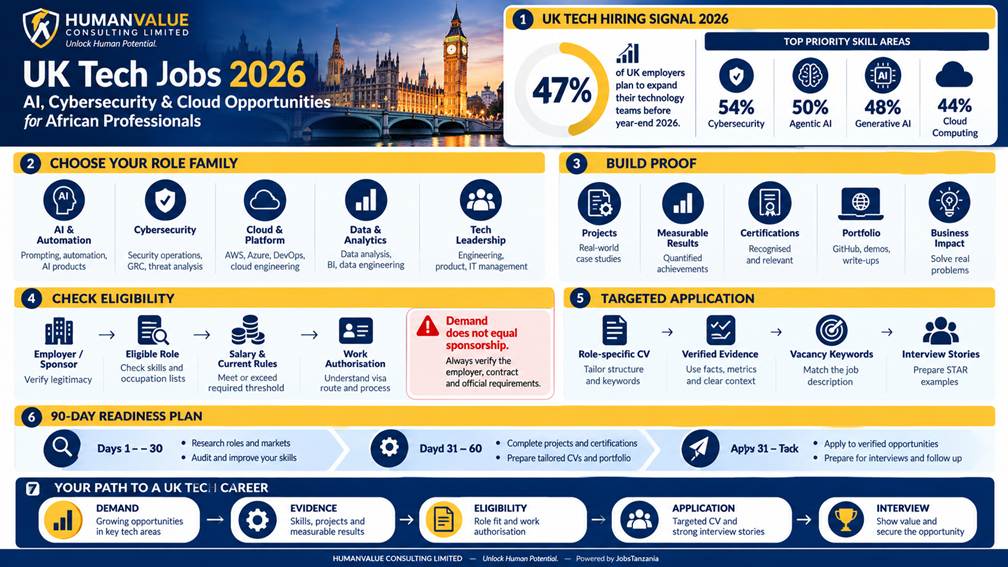
Place after the role-family section. The visual should show that market demand is only the first gate; proof of capability and lawful work eligibility must follow.
Understand sponsorship as a separate gate
Research / continue: GOV.UK register of licensed worker sponsors
Research / continue: GOV.UK Skilled Worker route
A strong technical profile does not automatically create a UK work route. For the Skilled Worker route, current official rules govern whether the employer is approved, whether the job is eligible, what salary conditions apply and what documentation is required. Verify these points on GOV.UK for the exact vacancy and date.
Do not treat phrases such as 'international applicants welcome' as proof of sponsorship. Ask whether the employer can sponsor this role, not merely whether the company has sponsored somebody before. Check the employer against the official sponsor information and confirm the occupation and salary position using current rules.
Never pay an individual for a certificate of sponsorship or for a guaranteed job. Keep recruitment services, immigration advice and employer selection clearly separate. Where immigration advice is required, use an appropriately qualified adviser.
Make the CV answer the UK employer's risk questions
Research / continue: HumanValue ATS Scanner
Research / continue: HumanValue Learning Center
The first half-page should establish target role, level, core capability and two or three outcomes. Use UK terminology naturally where appropriate, but do not rewrite your history to imitate a British career. Explain unfamiliar employers in a short descriptor and make qualifications precise.
Match truthful keywords from the vacancy, especially technologies, frameworks, security standards, platforms and delivery methods you have actually used. Then connect each important skill to evidence. 'Azure' is a keyword; 'migrated 18 workloads to Azure with automated deployment and documented recovery controls' is evidence.
If sponsorship is required, state it accurately when the application asks. Do not hide the requirement and do not claim right to work that you do not possess. Save each job description and keep a version register so your applications remain consistent.
Prepare interview stories around judgement, not tools
International technology interviews often test how you think under constraints. Prepare stories about incidents, trade-offs, stakeholder disagreement, security, quality, cost, failed assumptions and recovery. A senior candidate should be able to explain governance and business impact; an early-career candidate should show method, learning speed and disciplined execution.
For AI roles, expect questions about evaluation, privacy, hallucination risk, human oversight and where automation should stop. For cyber roles, be ready to explain detection, containment, root cause, control design and communication. For cloud roles, explain resilience, identity, observability, automation, cost and architecture choices.
Use a simple evidence structure: context → responsibility → decision → action → measurable result → lesson. The lesson is important because it shows whether experience has become judgement.
A 90-day UK technology readiness plan
Days 1–30: choose one primary role family and one adjacent option. Audit ten to twenty real vacancies. Record recurring skills, level, sector and sponsorship wording. Build the master evidence inventory and identify the three largest gaps.
Days 31–60: complete one or two proof projects or capability upgrades that close genuine gaps. Rewrite the CV around the target role, clean LinkedIn, create a concise portfolio and prepare six interview stories. Ask a technically credible reviewer to challenge the evidence.
Days 61–90: apply selectively, prioritising roles where evidence and eligibility align. Track employer, vacancy, sponsor check, CV version, closing date, outcome and feedback. After a meaningful sample of targeted applications, diagnose the stage that is failing rather than redesigning everything after each rejection.
Use a decision dashboard instead of application volume
Track four measures: fit, evidence, eligibility and response. Fit asks whether your level and specialism match. Evidence asks whether the CV proves the essential requirements. Eligibility asks whether the work route is plausible and verified. Response tracks screening, interview and progression.
If fit and evidence are weak, more applications create more rejection. If fit is strong but eligibility is consistently absent, adjust employer targeting. If interviews occur but progression stops, strengthen technical storytelling, judgement and assessment preparation. This turns job search into a controlled improvement process rather than an emotional volume contest.
|
BUILD PROOF BEFORE YOU CHASE SPONSORSHIP |
|
TECHNOLOGY TALENT IN AFRICA? |
Frequently Asked Questions
Are UK employers still hiring technology professionals in 2026?
Yes, current reporting shows continued hiring intent in selected technology areas, especially cybersecurity, AI and cloud. Hiring intent varies by employer, level and sector, so candidates should verify live vacancies rather than treating a market statistic as a guarantee.
Does a cybersecurity, AI or cloud job automatically qualify for sponsorship?
No. Sponsorship depends on the employer, the specific job, current occupation and salary rules and the candidate's circumstances. Check the current GOV.UK Skilled Worker requirements for each application.
Should I collect more certifications before applying?
Only when a certification closes a real requirement or strengthens credible evidence. Applied outcomes, projects and judgement often matter more than accumulating unrelated badges.
Can a fresh graduate compete for UK technology roles?
Yes for suitable entry-level roles, but international competition can be strong. Graduates should build demonstrable projects, internships, labs and clear role focus rather than presenting only coursework.
Can HumanValue guarantee a sponsored UK job?
No. HumanValue can support readiness, evidence, CV positioning and recruitment services, but employer selection and government immigration decisions remain independent.