

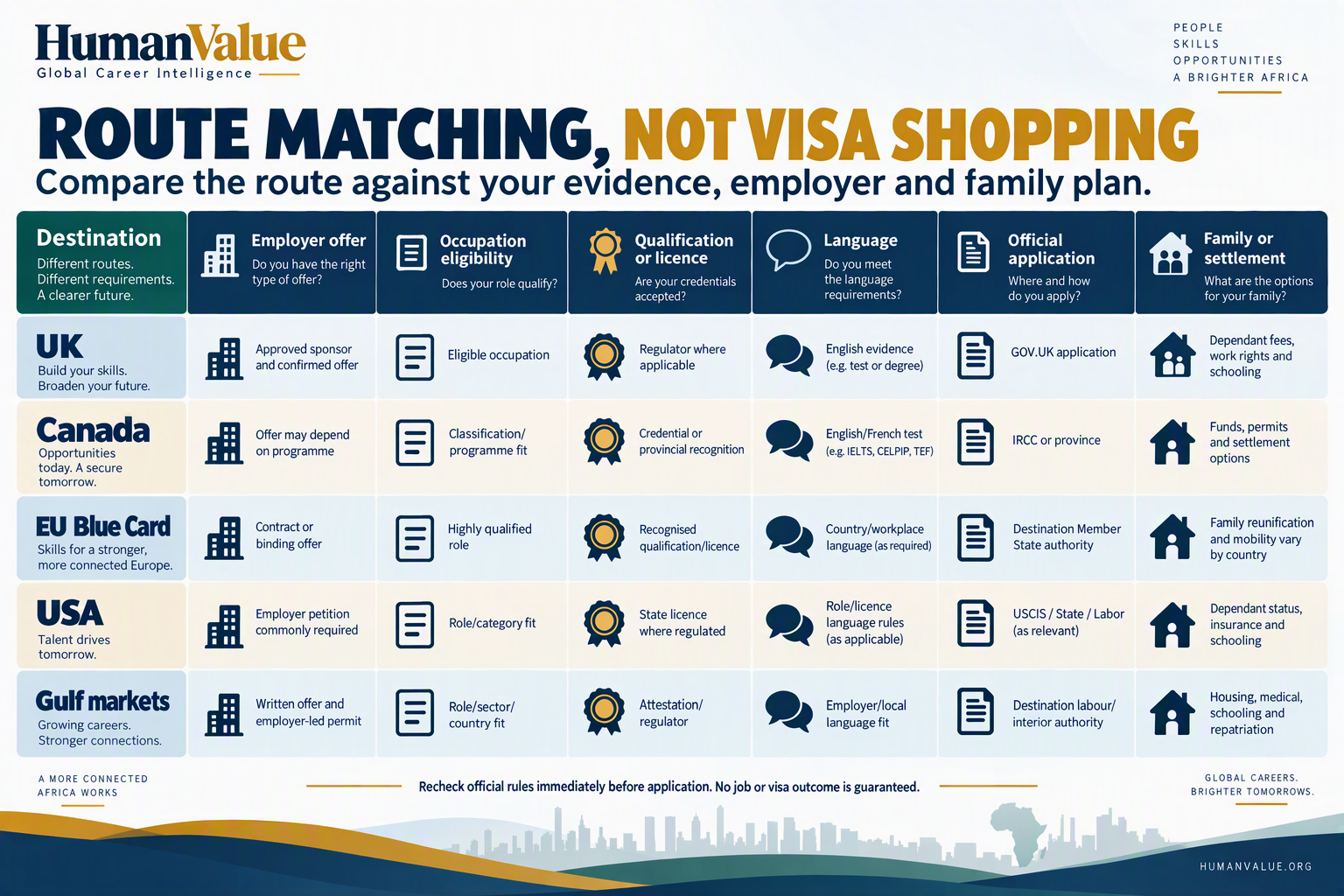
“Visa sponsorship” is often used as if it were a job benefit that can be added after an offer. In reality, every destination has different routes, eligible occupations, employer obligations, salary rules, qualification checks and government decisions. The job, employer and immigration route must fit each other.
African professionals can improve their odds by reversing the usual search. Do not begin with a country dream and apply to everything. Begin with your occupation, verified experience, language, licensing status and shortage relevance. Then identify the official routes and employers capable of using them. This reduces wasted applications and exposure to scams.
|
Key answer: A legitimate pathway normally requires a real role, an eligible and willing employer where sponsorship is employer-led, authentic evidence and a government application. No recruiter can sell or guarantee a visa approval. |
Separate three decisions that are commonly confused
The first decision is employability: does an employer need your capability and consider your evidence competitive? The second is sponsorship or work authorisation: can the employer and role use an official route? The third is relocation feasibility: does the total package work after housing, tax, family, licensing and transition costs?
Passing one decision does not guarantee the others. A shortage occupation may still require registration. A strong candidate may meet the skill requirement but not the salary threshold. An attractive gross salary may be weak after rent and school costs. Treat the process as a chain; the weakest link determines the outcome.
Use JobsTanzania International Opportunities as a discovery channel, but always verify the vacancy, employer and immigration conditions through the recruiting organisation and the destination government's official portal.
United Kingdom: employer approval, eligible role and confirmed offer
The official UK Skilled Worker route requires a job with a Home Office-approved employer, a certificate of sponsorship, an eligible occupation and the applicable minimum salary. Applicants must have a confirmed job offer before applying and generally need to prove English ability. Exact salary and occupation rules can change, so use GOV.UK rather than social-media summaries.
A practical UK search therefore starts with the sponsor and occupation, not the words “visa job.” Check whether the organisation appears on the official sponsor register and whether the role description matches the occupation code and genuine level of work. Ask when sponsorship is discussed in the recruitment process and who pays each authorised cost.
Healthcare, education, technology, engineering and selected skilled roles can offer routes, but eligibility is not the same as vacancy volume. Regulated professions may require professional registration, credential review, English tests or supervised practice. Begin those checks before interviews if they have long lead times.
Canada: distinguish economic immigration from employer sponsorship
Canada's Express Entry system manages applications for the Federal Skilled Worker Program, Federal Skilled Trades Program, Canadian Experience Class and part of the Provincial Nominee Program. It is not simply an employer-sponsorship list. Candidates create profiles and may be invited according to programme and category rules.
Canada announced 2026 category priorities including researchers and senior managers with Canadian work experience, transport occupations and highly skilled foreign military applicants in selected roles. It also continued focus on strong French language skills, healthcare and social services, and trades. These categories are precise and can change; candidates should check Immigration, Refugees and Citizenship Canada for current eligibility and invitation rounds.
For African applicants outside Canada, the route may involve economic immigration, a provincial pathway, a genuine employer process or study-to-work decisions, each with different evidence and risk. Do not pay for a job offer or assume a paid representative can create eligibility. Verify authorised representatives and official fees.
European Union: understand both the EU Blue Card and national permits
The European Commission states that the EU Blue Card is available in 25 of 27 EU Member States, excluding Denmark and Ireland. It generally requires higher professional qualifications or recognised higher professional skills, and a work contract or binding offer for at least six months. Salary thresholds are set by the country within the directive's framework.
The Blue Card is not one central application issued by Brussels. Applications go to the competent authority in the destination Member State, and national rules, shortage lists, qualification recognition and processing details matter. Some countries also operate national skilled-work routes alongside the Blue Card.
For Europe, choose the country and role before tailoring the CV. Check whether the profession is regulated, whether documents need translation or recognition, and whether language is required for the work even if the immigration route does not demand it. The Europass CV can be useful where requested, but follow the vacancy's format instructions.
United States: role and visa category must be employer-specific
The United States has several employment-based categories rather than a universal sponsored-work visa. Some are temporary; some support permanent immigration; some are capped, time-bound or restricted by occupation and employer type. The correct route depends on the role, qualifications, employer and current rules.
Candidates should be cautious about adverts that say only “US sponsorship available” without naming the role or process. Ask whether the employer has sponsored the relevant category before, which legal entity employs the role and at what stage immigration counsel becomes involved. Use official US government sources for requirements.
The US Bureau of Labor Statistics projects strong 2025–2035 growth in occupations including nurse practitioners, solar photovoltaic installers, data scientists, information security analysts and medical and health services managers. These figures identify demand signals, not immigration eligibility. Licensing and sponsorship remain separate tests.
Middle East: assess the employer, contract and worker protections
Across Gulf and wider Middle Eastern markets, work authorisation is commonly tied to an employer and destination-country process. Packages may include housing, transport, medical cover, annual travel or allowances, but terms vary widely. Never assume “fully sponsored” explains who pays, what is included or what happens if employment ends.
Request a written job description and contract showing employer identity, location, currency, base pay, allowances, working hours, overtime, leave, medical cover, probation, notice, travel, accommodation and repatriation terms. Verify the employer independently and use the destination government's official portal or embassy guidance. Do not surrender your passport to an unauthorised intermediary.
Ethical recruitment matters. The International Labour Organization's fair-recruitment principles and the International Organization for Migration's IRIS framework support lawful, transparent recruitment that respects worker rights. Candidates should not carry recruitment fees simply to access a job.

Build a sponsorship-ready evidence file
Prepare a controlled digital folder with passport identity page, qualifications, transcripts, employment letters, professional licences, language results, police or medical documents only when officially required, and verified references. Keep originals secure. Share minimum necessary information through approved channels and record what was sent.
Your employment letters should confirm dates, title and relevant responsibilities. Your CV must match the evidence; inconsistent dates, inflated titles and copied duties can damage both recruitment and immigration credibility. If a name or date differs across documents, obtain a lawful explanation or correction rather than hiding it.
For regulated occupations, create a licensing tracker with authority, required documents, fees, lead time, examinations and renewal. For unregulated roles, build a skills portfolio and achievement inventory. HumanValue's CV service can help present accurate evidence for the target market, while the Learning Center can support gap closure.
A safer international search sequence
1. Define the occupation: select the exact role family, seniority and sector.
2. Check official pathways: identify the government route and current requirements.
3. Assess evidence: qualifications, experience, language, licence and funds where applicable.
4. Build a sponsor map: target employers with relevant operations and lawful hiring capacity.
5. Tailor the application: connect achievements to the vacancy and market.
6. Verify every contact: employer domain, recruiter identity, interview and contract.
7. Model relocation: calculate total package, family impact and downside scenario.
8. Apply officially: use the employer and government channels; keep records.
Do not resign, sell assets or borrow heavily on the basis of a message, preliminary letter or verbal promise. Move only when conditions are documented and independently verified.
Create a route-control sheet for every target country
Maintain one current page per destination. Record the official route name, government source, eligible occupation or programme, minimum offer or points conditions, language requirement, qualification or licensing gate, employer action, candidate action, official fees, expected evidence and the date last verified. Add a “do not rely on” column for outdated posts, copied salary tables and unverified agents.
Next, connect the route sheet to your employer pipeline. A sponsor-capable organisation is not necessarily hiring your occupation, and an eligible vacancy is not necessarily sponsored. Track both facts separately. During recruiter conversations, ask whether the organisation has used the route for a comparable role and who owns immigration coordination. Do not pressure a recruiter to provide legal certainty they cannot give.
Create document lead times. Degree verification, professional registration, language testing, police certificates and reference letters may take months. Start lawful preparation early, but do not obtain short-validity documents prematurely or send them to unknown intermediaries.
Finally, define a maximum at-risk budget. Separate official fees, professional advice, travel and document costs from recruitment fees. Never borrow against an unverified promise. Record receipts and use official payment channels. If an employer reimburses costs, confirm the amount, timing and any repayment clause.
This control sheet turns a vague “sponsorship search” into a governed project. Review it monthly and immediately before submission. Archive old requirements rather than overwriting them, so you can explain which rule informed each decision.
|
BUILD A VERIFIED INTERNATIONAL CAREER PLAN |
|
RECRUIT ACROSS BORDERS RESPONSIBLY |
Frequently asked questions
Which country is easiest for visa sponsorship?
There is no responsible universal answer. Ease depends on occupation, employer, salary, qualifications, language, nationality, quotas and current policy. Compare routes against your evidence rather than choosing from social-media popularity.
Do shortage occupations guarantee sponsorship?
No. A shortage signal can improve relevance, but the candidate must still secure a genuine role, meet qualification and licensing rules, satisfy salary or programme criteria and receive government approval.
Can a recruiter charge me for a sponsored job?
Be extremely cautious. Fair recruitment principles oppose workers paying recruitment fees. Legitimate optional CV or coaching services must be clearly separate from the employer's hiring decision and must never promise a job or visa.
Should I use an immigration consultant?
Complex cases may benefit from qualified advice. Verify that any representative is authorised in the relevant jurisdiction, understand the written scope and fees, and remember that representation cannot guarantee approval.
Can I relocate first and then find work?
Some countries have job-search or open-work routes for eligible people, while others require authorisation before work. Never assume visitor status permits employment. Check the official rules for your nationality and circumstances.
How often should I recheck requirements?
At the start of planning, before accepting an offer and immediately before submitting or paying. Immigration rules, salary thresholds, eligible occupations, fees and processing arrangements can change.
Want to go and work in Europe? Check the opportunities here and complete the registration form for free: International Jobs Online Form