


A hotel can shortlist a candidate with an attractive CV and still discover on the first busy shift that expectations were never clear. Does the front-office role include night audit? Who handles an unresolved guest complaint? Is staff transport available after a late finish?
For Zanzibar hotels, restaurants and hospitality operators, good recruitment connects the vacancy to daily operations. This guide offers an employer workflow built around observable skills, accurate terms and a supported start. It makes no claim about current vacancy volumes, industry salaries or guaranteed hiring times.
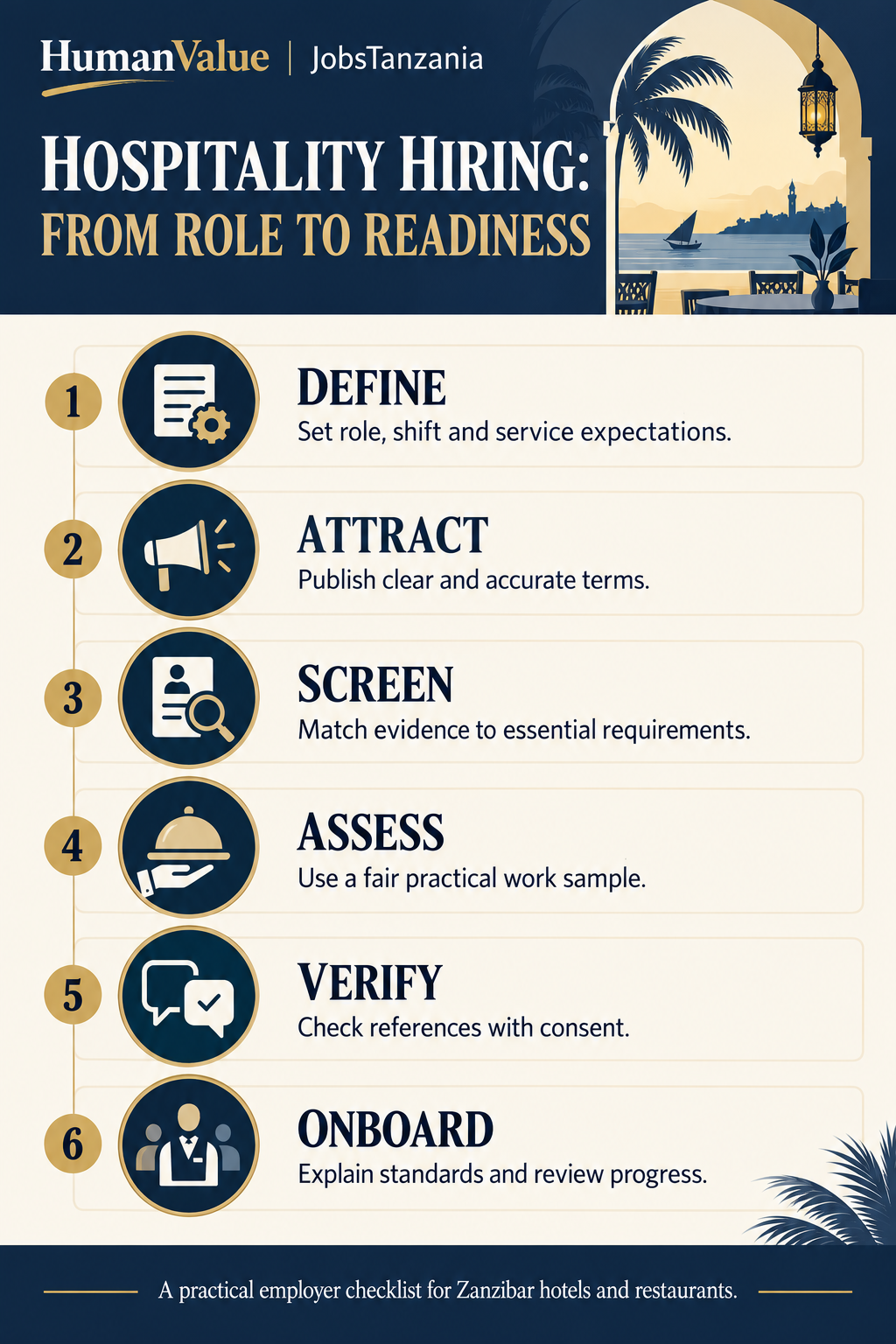
Begin with the shift and the service standard
Write a brief that explains the property, department, reporting line, working location and responsibilities. Identify the tasks the successful candidate must perform and what the team can teach after appointment.
A front-office position might require guest communication, reservation handling, payment procedures and accurate handovers. Housekeeping may require preparation to a documented standard, safe use of approved materials and prompt reporting of maintenance issues. Food and beverage roles may combine order accuracy, service sequence and escalation of food-safety concerns.
Separate essential requirements from preferences. A specific hotel system may be teachable; a required professional credential may be a genuine entry condition. Explain the difference before screening. Avoid adding a long list of qualifications that has little connection to the actual work.
Make the employment proposition clear
Publish enough information for candidates to judge fit. Explain the role, location, application process and deadline. Be precise about whether accommodation, meals, transport or service-charge arrangements are included, conditional or absent.
Discuss working hours, shifts, rest arrangements, pay structure and probation in clear written terms consistent with applicable requirements. Avoid phrases such as “all benefits included” without explaining what the employer means. Confirm details before an applicant relocates or resigns from another role.
Use Zanzibar’s applicable employment framework when preparing contracts and policies. Do not assume Mainland Tanzania procedures automatically resolve a Zanzibar employment question. Obtain qualified local advice when the legal position needs confirmation.
Screen against a short scorecard
Use the same job-related criteria for each applicant. Record evidence rather than impressions such as “good personality”. A practical scorecard can distinguish relevant experience, service communication, task accuracy and readiness for the specified shifts.
For an illustrative front-office role, you might give each area a score from one to five with written anchors. A low task-accuracy score might mean key booking details were missed; a strong score might mean the candidate identified the issue, checked the record and explained the next action correctly. Agree the anchors before interviews.
This is an assessment design example, not a statutory scoring system. Adjust it to the work and review the criteria for fairness. Give candidates clear instructions and appropriate access arrangements so the assessment measures relevant capability.
Test a small sample of real work
| Role | Illustrative assessment | Evidence to record |
|---|---|---|
| Front office | Respond to a fictional booking discrepancy | Accuracy, calm explanation, checks and escalation |
| Housekeeping | Explain preparation of a training room against a checklist | Sequence, attention to detail and reporting |
| Food and beverage | Handle a fictional incorrect order and an allergy concern | Listening, verification and safe escalation |
| Supervisor | Plan a short shift handover using a fictional staffing problem | Priorities, communication and follow-up |
Keep tasks bounded and use fictional guest information. Explain the purpose and scoring in advance. Avoid turning assessment into unpaid productive shifts or asking applicants to do unsafe work. A recruitment exercise should provide evidence for a hiring decision without replacing normal staffing.
Ask candidates to explain their reasoning. A memorised script may sound fluent while hiding a failure to verify a guest request. The explanation reveals whether they understand the service process and their authority limits.
Conduct structured interviews
Ask the same core questions and use follow-up questions to clarify evidence. A useful prompt is: “Describe a guest issue you could not resolve yourself. What did you check, who did you involve and how did you hand it over?”
Record the candidate’s personal contribution. A team achievement can be valuable, but distinguish the applicant’s action from the manager’s decision. Ask what they learned and how they would apply it at your property.
Avoid requesting private guest records, confidential employer reports or personal information unrelated to the role. An applicant’s ability to protect information is part of professional judgement.
Verify references with consent
Tell the candidate which references you intend to contact and obtain appropriate permission. Verify the referee’s identity through reliable organisational channels where possible. Ask factual, role-related questions about dates, responsibilities and observed performance.
If a reference conflicts with the application, investigate and give the candidate a fair opportunity to explain. Record the source and outcome. Do not turn an unverified allegation into a permanent conclusion.
Restrict access to candidate documents and keep a clear retention process. Share only the material needed by the people making the decision.
Keep recruitment fair and transparent
The ILO’s fair-recruitment guidance supports the principle that workers should not bear recruitment fees or related costs. It also provides a framework for preventing abusive and fraudulent recruitment. Treat this as international guidance and check the applicable legal obligations for your arrangement.
An optional training product should have a clear, independent learning purpose and scope. Do not present a candidate’s purchase of a CV service or course as a condition for a promised job. Employers should distinguish their recruitment obligations from services a jobseeker chooses to buy.
Check permits before employing foreign nationals
For non-citizen appointments, confirm the relevant work and residence authorisations before the person begins work. Tanzania Immigration’s residence-permit guidance distinguishes permit categories and identifies employer and work-permit documentation. Check the process applicable to Zanzibar with the relevant authorities; citizenship, role and circumstances affect the requirements.
Build permit lead times into the recruitment plan. Do not treat an offer letter or visitor permission as sufficient evidence of the right to work. Keep verification responsibility clear between the employer, candidate and any authorised adviser.
Make onboarding part of the hiring decision
Prepare the first shifts before the new employee arrives. Assign a supervisor, provide the role checklist and explain guest information, safety, complaints and escalation procedures. Confirm how attendance, uniforms, equipment and handovers work.
Use early review points to check practical progress. Agree a few observable outcomes: completing a handover accurately, following a room checklist or escalating an unresolved billing question correctly. Give feedback and training against those outcomes.
After the recruitment cycle, compare screening evidence with actual performance. If a task proved irrelevant or a requirement excluded suitable people, improve the process before the next vacancy. Avoid claiming success solely because the role was filled quickly.
HumanValue and JobsTanzania support
Employers can use JobsTanzania’s job-posting route to review vacancy-publication options and contact HumanValue to discuss recruitment needs. Confirm the proposed scope, fees and responsibilities before commissioning work. A recruitment enquiry is not a promise of candidate availability or a fixed hiring outcome.
For capability development after hiring, explore the HumanValue Learning Center. Choose products against a documented skills gap and check their current syllabus and delivery details. Learning supports performance when it is connected to the work and reinforced by supervisors.
Frequently asked questions
Should every applicant complete the same practical task? Use equivalent job-related tasks and consistent scoring, with appropriate access arrangements.
Can references replace an assessment? They provide a different kind of evidence. Combine relevant checks rather than expecting one source to answer every question.
What should a small property do first? Write a one-page role brief, a short scorecard and one realistic assessment. Then prepare the new employee’s first shifts.
Sources and review
ILO fair-recruitment principles and definition of fees, Tanzania Immigration residence-permit guidance, JobsTanzania and HumanValue Learning Center. Checked 19 October 2026. Role briefs, scorecards and assessment examples are original editorial recommendations, not statutory forms.