


HumanValue Career Intelligence | Tanzania | Researched 8 November 2026
An accounts receivable ageing report is useful when you can explain its date basis, trace the balances and identify the next question for each material item. Reading the oldest column aloud is not enough. Before recommending follow-up, establish what the report includes, whether payments and credits are reflected and which balances are disputed or still being checked.
For Tanzanian job seekers, this is a practical way to understand the work behind an accounts receivable assistant title. The role can combine record checking, customer communication and support for a finance reviewer. This guide uses a fictional report to demonstrate those skills. It is not an accounting policy, a debt-collection instruction or advice on a real customer balance.
1. Understand the role before learning a report layout
An assistant may prepare account information, investigate mismatches, maintain follow-up notes or support approved customer communication. The finance manager decides the actual responsibilities and review process. Some employers require specific qualifications or system experience; a spreadsheet exercise does not replace those requirements.
Ask what the report is used for and who reviews it. Is the task to explain the ledger, investigate an allocation question or prepare a customer update? Those are related activities, but they require different evidence. A useful assistant makes the distinction clear instead of treating every overdue-looking row as an instruction to demand payment.
2. Read the report settings first
Microsoft’s Dynamics 365 customer-ageing documentation describes a report of customer balances sorted into date intervals or ageing periods. It includes configuration choices that affect the output. This is a software example: your employer’s system and approved report definitions may differ.
| Setting or context | Why it matters | What to state in your note |
|---|---|---|
| Report date | The balances describe a particular point in time | The date and relevant reporting cut-off |
| Ageing basis | Ageing from an invoice date differs from ageing from a due date | The selected basis; do not infer it from the column title |
| Period definitions | Column boundaries determine where an item appears | Exact ranges and treatment of current items |
| Currency | Amounts cannot be combined meaningfully without a common basis | Currency and any approved conversion convention |
| Filters and scope | The report may cover only selected accounts or transactions | Material exclusions or filters |
| Payments and credits | Unallocated or unreflected items can affect interpretation | Which checks are complete and which need review |
If a setting is unknown, say so and obtain the definition from the responsible person. A polished explanation based on an assumed date rule can be less useful than a short question that prevents the wrong interpretation.
3. Work through a fictional three-account example
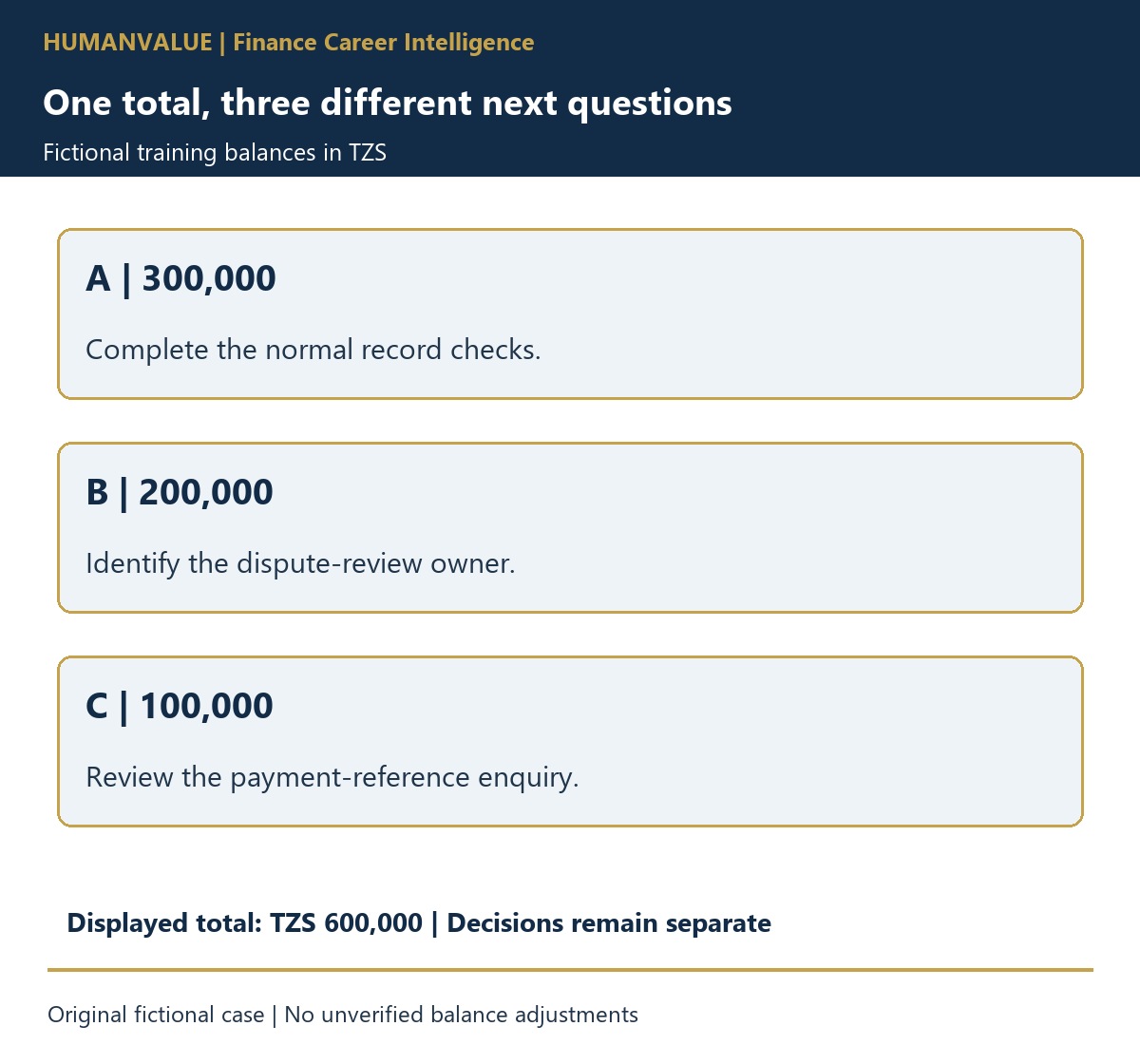
Imagine an invented report prepared for training in Tanzanian shillings. Account A has an outstanding invoice balance of TZS 300,000 in the first overdue period. Account B has TZS 200,000 in an older period, with a recorded invoice dispute awaiting review. Account C has TZS 100,000 outstanding, while a payment reference has been supplied but has not yet been matched in the exercise records.
The displayed outstanding total is TZS 600,000. That arithmetic does not establish that all three amounts should receive the same communication. B needs the dispute owner and required evidence identified. C needs the payment-reference question reviewed. A still requires the normal account checks before any approved reminder. Keep those issues alongside the report, without changing balances merely to reflect an unverified statement.
Fictional reviewer note: “The training report shows TZS 600,000 across three accounts. B’s TZS 200,000 remains subject to a recorded dispute review. C’s TZS 100,000 has a payment-reference enquiry pending. Please confirm the review owners and approved next actions; no adjustment has been assumed from these notes.”
All amounts, accounts and circumstances are invented. The example illustrates how to distinguish a balance, a reported issue and a decision. It does not establish the accounting treatment of an actual dispute or payment.
4. Trace a balance before explaining it
Use the approved system to follow a balance to its supporting entries. Check references, dates and relevant credits or payments through the employer’s process. If an item does not reconcile, record the difference and refer it to the responsible reviewer. Do not overwrite a source figure in an exported report to make the total look tidy.
A report export can be useful for review, but it should not become an uncontrolled second ledger. State where the authoritative records are held, who can amend them and how the report was produced. Keep customer information in approved locations and share only what the recipient needs for the task.
Xero’s ageing-report explanation distinguishes summary information from invoice-level detail and notes the relevance of credits or adjustments. Use it to understand report interpretation, not as an instruction to alter a real account without the employer’s controls.
5. Write next actions that can be followed
A note such as “follow up urgently” does not identify the unresolved question. Write a specific action: request a missing approved reference, ask the dispute owner for the evidence needed, or refer an unmatched-payment enquiry to the designated finance role. Name the owner and the next review time under the agreed process.
Avoid promising a waiver, payment arrangement or account adjustment unless the authorised person has approved it. Do not treat a customer’s expected payment date as cleared funds. Record the statement accurately and keep it distinct from a completed transaction.
6. Prepare a sample that shows your reasoning
Create six invented accounts with a clear report date and explicitly defined periods. Include a current item, a disputed invoice, a credit, an unmatched-payment enquiry and a case requiring clarification. Provide the report, a page explaining its assumptions and a short action log. Use fictional data throughout.
Ask a peer to trace one amount to your invented supporting entries and identify the next owner. If they cannot tell whether a note is a fact, a customer statement or a proposed action, revise it. Describe the exercise honestly in an application; do not claim real recoveries or reduced overdue balances from a training project.
For spreadsheet foundations, explore Workplace Excel Essentials in Tanzania. For related hiring expectations, read the HumanValue credit-control assessment guide. These resources support learning rather than professional accounting certification.
7. Frequently asked questions
Does an old balance prove that a customer refuses to pay?
No. It identifies an item to investigate within the report’s settings. Review the supporting records and any unresolved issues before drawing a conclusion.
Should every payment mentioned by a customer reduce the report immediately?
Follow the employer’s verification, posting and allocation process. A payment statement and a confirmed entry are different evidence. An assistant should not invent an adjustment.
Can I use this exercise instead of a required finance qualification?
No. Read the vacancy’s actual requirements. The sample demonstrates a defined reasoning and record-handling skill, not a qualification or permission to make accounting decisions.
8. Choose your next step
Prepare one explainable fictional report before adding broad finance claims to your CV. The HumanValue CV & Application Pack Lab can help you present genuine evidence clearly. Employers seeking receivables support can discuss a recruitment brief with HumanValue that specifies the workflow, review responsibilities and required experience, with scope and fees agreed before work begins.