


HumanValue Employer Intelligence | Tanzania | Prepared 8 November 2026
Before hiring a credit control assistant, ask the candidate to work through a disputed invoice using a small fictional account pack. Look for four things: accurate checking, a clear request for missing evidence, professional communication and respect for approval limits. A candidate who sends the most forceful reminder may still leave your finance team with an unresolved discrepancy.
For Tanzanian distributors, service businesses and growing SMEs, the role often sits between accounts, sales and customer service. The hiring exercise should reflect that handover. This article provides an original assessment design for ordinary business account administration. Any actual collection, settlement or legal action must follow the organisation’s authorised process and applicable requirements.
1. Clarify the decisions the assistant will own
Write down who allocates incoming payments, checks disputed charges, approves credit notes, agrees settlement terms and escalates unresolved cases. The assistant may gather information and maintain the follow-up record while a supervisor owns the final decision. Your vacancy should make this distinction clear.
Ask the hiring manager to describe a normal week: approximate account volume, customer contact channels, reporting expectations and systems used. Decide which capabilities are essential at entry and which can be taught. Someone who can trace a discrepancy carefully may learn your software faster than a candidate who knows a system but changes records without explaining why.
2. Give every candidate the same fictional pack
Prepare a one-page customer statement, three sample invoices, one payment-reference note and a short authority policy. Use invented organisations, references and contact details. Include two issues: a payment whose allocation needs checking and an invoice the customer says contains an incorrect quantity. Keep the exercise small enough for the candidate to explain their reasoning.
| Item | Evidence supplied | What remains to check |
|---|---|---|
| Invoice A-101 | Customer statement and invoice copy | Whether a payment note relates to this invoice |
| Payment P-08 | A fictional payment reference | Matching transaction evidence and authorised allocation |
| Invoice A-103 | Invoice and a reported quantity dispute | Order and delivery evidence supporting the quantity |
| Authority policy | Assistant may investigate and request records | Supervisor approval required for a credit or settlement |
Tell candidates where information is intentionally missing. You are testing whether they identify the gap, not whether they can guess the answer the panel has in mind. Do not ask applicants to bring customer statements or internal records from previous employers.
3. Run a focused 35-minute exercise
Allow ten minutes to review the pack, ten to create a discrepancy log, ten to draft a customer message and five to explain the proposed next action. These are suggested assessment timings, to be piloted and adjusted for the actual role. Give candidates the same instructions, clarification opportunities and relevant assessment arrangements.
If your team’s development gap is the underlying spreadsheet work, Workplace Excel Essentials offers practice in organising information, formulas, sorting and filtering. Those skills support a clear discrepancy log; role-specific account procedures and approval limits still need to be taught by the employer.
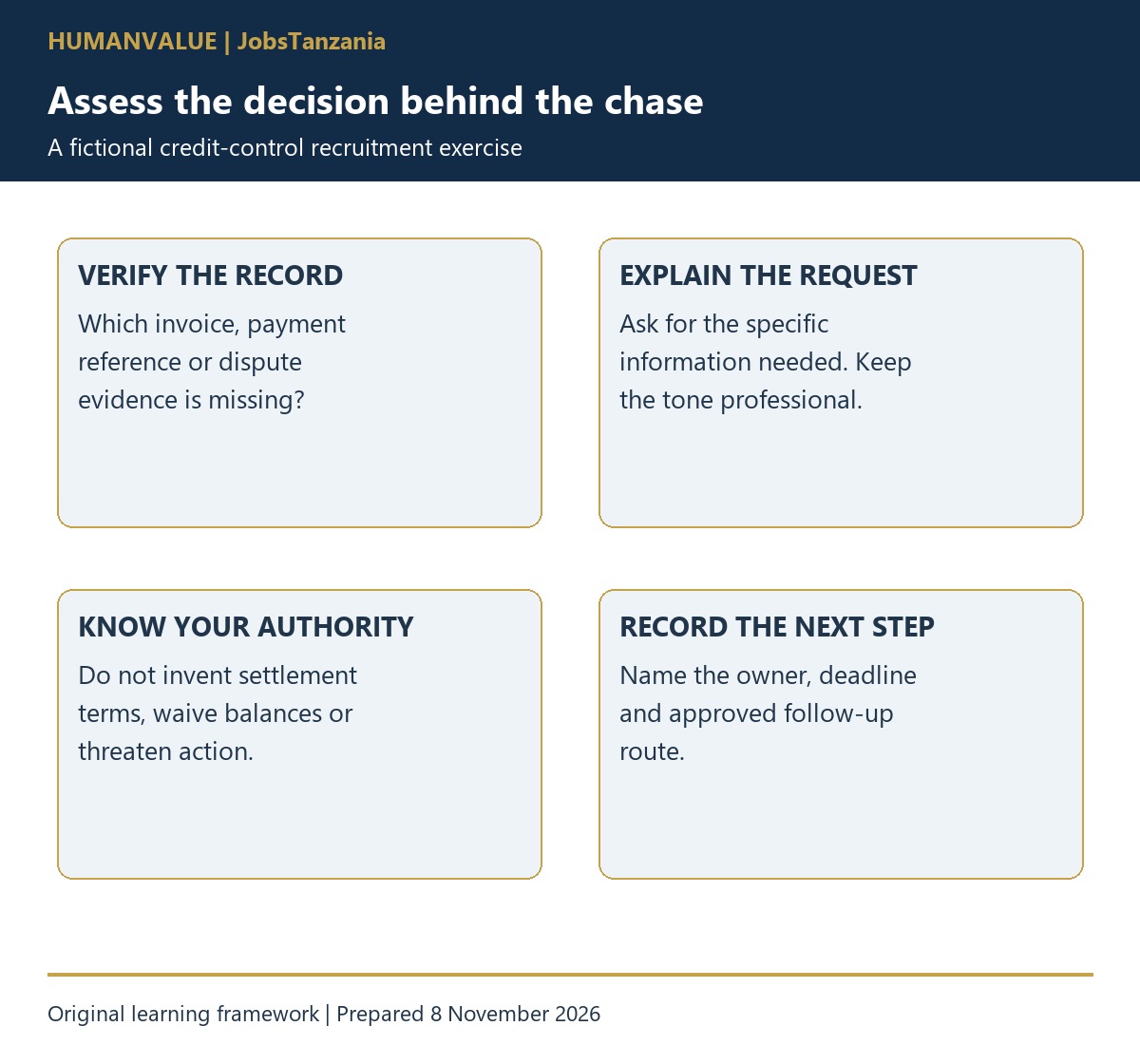
The strongest log separates the customer’s statement from confirmed records. It identifies the evidence needed to resolve each item and names the responsible internal owner. It should remain understandable when the original assistant is absent.
4. Assess the message as well as the spreadsheet
Example candidate message: “Thank you for explaining the quantity concern on A-103. We are checking the order and delivery records with the responsible team. Please share the specific line you are querying through our agreed channel. I will update you at the time we confirm, including if the review is still open.”
This is original fictional teaching material. The wording acknowledges the concern without accepting an unsupported adjustment or making an unauthorised promise. A candidate may use different words and still demonstrate the same skills. Ask how the message would change if the customer had already provided the evidence.
Watch for vague requests such as “send all documents”, repeated demands that ignore a recorded dispute, or promises to waive an amount without authority. Ask neutral follow-up questions rather than turning the exercise into a confrontation.
5. Score observable evidence
| Area | Points | Evidence to record |
|---|---|---|
| Record checking | 30 | References, quantities and payment evidence are compared carefully |
| Dispute handling | 25 | Reported concerns and verified facts remain separate |
| Communication | 20 | One clear request, respectful tone and realistic update |
| Authority and information handling | 15 | Approvals and access limits are recognised |
| Follow-up record | 10 | Owner, next action and review time are traceable |
Have reviewers score independently and attach a short example to each rating. The weights are a proposed design, not a validated pass mark. Pilot the exercise with someone who understands the work and revise ambiguous instructions before applicants are assessed.
The US Office of Personnel Management’s structured-interview guidance describes consistent questions and rating standards. It is a methodological reference; your organisation must separately follow its applicable employment and information-handling requirements.
6. Connect the assessment to the first month
Use the results to plan induction. A candidate who checks records well but writes unclear requests may need supervised customer communication. A candidate who communicates confidently but misses reference mismatches may need more reconciliation practice. Review a small sample of supervised cases for accuracy, ownership and approved actions.
Look beyond the number of reminders sent. Ask whether the team can tell which items are disputed, what evidence is pending and who owns the next decision. This creates a more useful conversation about readiness and support than a broad label such as “good with customers”.
7. Bring HumanValue a practical hiring brief
If your business needs credit control support, share the account workflow, reporting line and limits of the role. HumanValue can discuss recruitment support built around sourcing, role clarification and relevant assessment. Agree the deliverables, timeline, responsibilities and fee before work begins. For employers managing selection internally, post the vacancy on JobsTanzania with the actual duties and requirements.
Editorial contact: Emily Sebashahu
HR Services & Recruitment Director
HumanValue Consulting Limited
Follow Emily on LinkedIn for HR and recruitment insights, or discuss your recruitment brief with HumanValue.
Before using the assessment, read how to calibrate a hiring-panel scorecard.