

Research checked: 28 October 2026 | Audience: African ICT, cybersecurity and data professionals researching Australian skilled migration
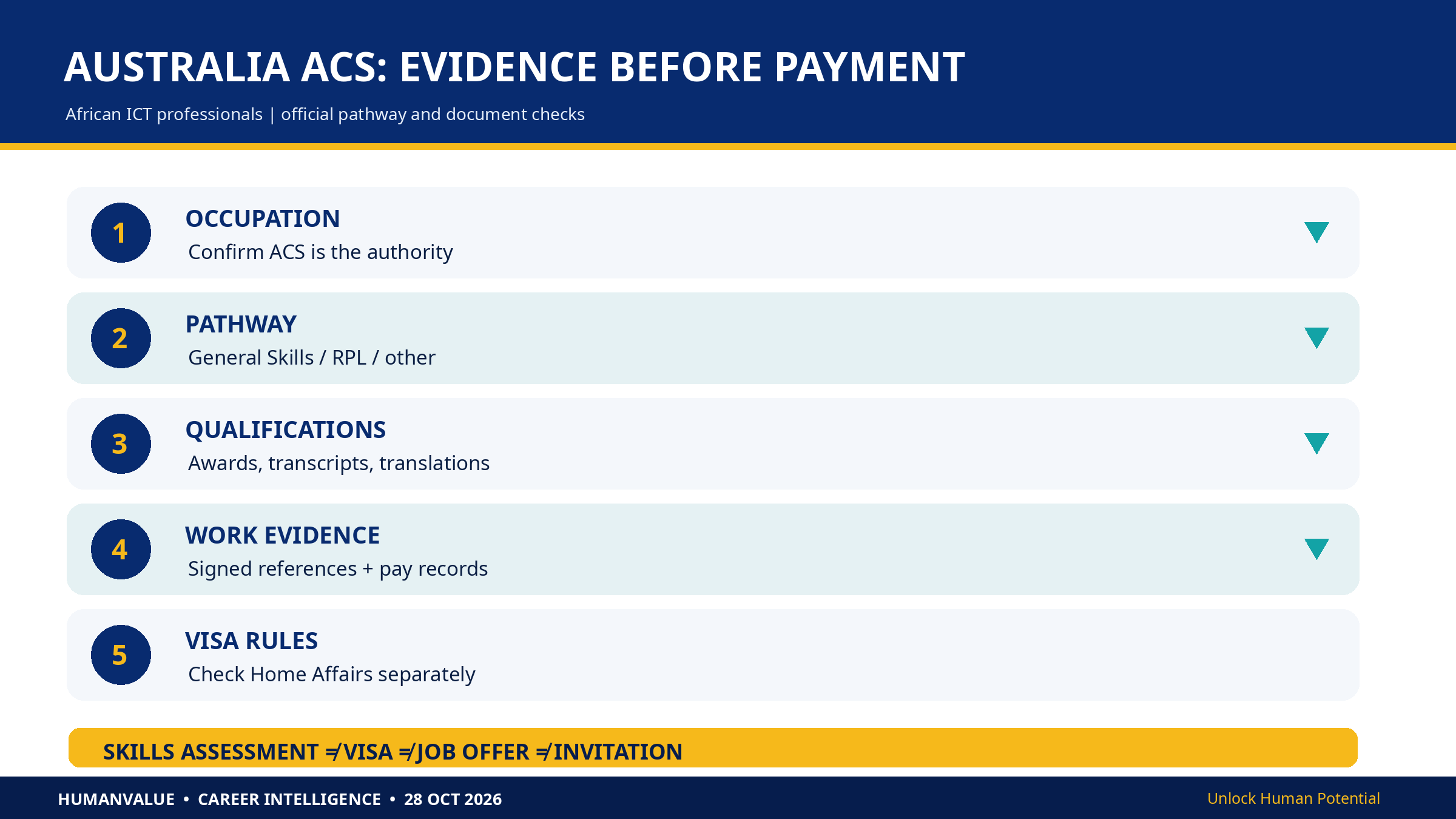
Quick answer: Before an African ICT professional pays for an Australian Computer Society (ACS) migration skills assessment, they should confirm that ACS assesses the intended occupation, select the correct pathway, and collect employer-issued references and payment evidence that match their real duties, dates and hours. A skills assessment is not a visa, a job offer or an invitation to migrate. Australia’s Department of Home Affairs makes the immigration decision under the relevant visa rules; ACS evaluates professional skills and qualifications for specified occupations.
Start with the occupation, not a social-media promise
“IT manager,” “software engineer” and “cybersecurity analyst” can describe very different work across African employers. Australian migration assessments use occupation classifications and assessing-authority rules, not simply the title on a LinkedIn profile. The Australian Computer Society's official applicant guide states that ACS assesses specified ICT, data science and cybersecurity occupations. Check its current occupation list and the Department of Home Affairs skilled occupation list before deciding which authority applies.
For example, a professional who leads infrastructure operations should not assume that a general “IT specialist” title is enough. Compare the actual duties, decision authority, technical depth and reporting responsibility with the occupation requirements. A mismatched nomination can weaken otherwise substantial experience.
Understand the difference between assessment and immigration
An ACS outcome assesses qualifications and relevant work history for a nominated occupation. A visa pathway can have separate age, English-language, points, health, character, sponsorship or nomination conditions. The Australian government's skills-assessment guidance explains that a suitable assessment is needed before submitting an Expression of Interest for the points-tested subclass 189, 190 and 491 pathways. Being assessed as suitable does not guarantee an invitation, nomination, job or visa grant.
Some applicants investigate employer-sponsored options instead. Do not assume the same assessment requirements apply to every visa. Check the current visa subclass, occupation, sponsor and evidence rules directly with Home Affairs. Immigration settings can change, so a 2026 article is a starting checklist, not a substitute for current official instructions or registered professional advice.
Select the correct ACS assessment pathway
ACS describes different routes including General Skills, Recognition of Prior Learning (RPL), Post Australian Study and Temporary Graduate 485. The ACS pathway page explains the broad distinction: General Skills is for applicants with relevant ICT qualifications and professional ICT work experience, while RPL addresses qualifying applicants without the relevant tertiary qualifications and requires additional project and currency evidence. Applicants must use the exact current checklist for their chosen pathway.
A Tanzanian systems administrator with a computing degree should not automatically choose RPL because they have practical experience. Equally, a self-taught developer should not assume a short vendor certificate is equivalent to a completed degree. The route depends on the official criteria and the applicant's documents, not an agent's preference.
The employment reference that can make or break an application
The official ACS employment-reference guidance requires employer-issued references with identifiable letterhead and signatory details, dates, status, hours, salary information, work location, role title and specific duties. It requires the duties to describe work actually performed rather than copy an occupation code. ACS also publishes detailed experience-evidence rules.
For each relevant employer, build an evidence folder containing: employer identity and website; your name; employment dates in the requested format; titles held and changes over time; weekly hours; location of work; duties and technical responsibility; signed contactable reference; and separate remuneration evidence where required. Check the current document checklist for the precise format and acceptable alternatives.
Do not create a reference on behalf of an employer and present it as employer-issued. You can prepare an accurate factual summary for a supervisor to verify, but the employer must independently approve and issue the reference. Never invent salary, hours, projects, reporting lines or a signatory.
Three common African employment situations
Situation A: One employer, several promotions. A software engineer moves from junior developer to technical lead over five years. A single vague letter saying “worked in IT” conceals progression. ACS guidance expects distinct positions, periods and duties where several roles were held. Ask the employer to separate them clearly.
Situation B: Consultancy and client placement. A Nairobi-based contractor is employed by an agency but works at a bank. ACS explains that, for agency employment, the host company may need to provide the work reference, while certain payment records may come from the agency. Confirm the applicable documentation instead of assuming the payroll employer can attest to work it did not supervise.
Situation C: Freelance or self-employed ICT work. A Dar es Salaam developer has contracts with several SMEs but no conventional HR letter. ACS publishes specific requirements for freelance evidence and statutory declarations. Genuine client confirmations and matching financial records may be needed. A polished GitHub portfolio alone is not a substitute for required work and payment evidence.
These are hypothetical examples. No applicant in these cases is represented as assessed, invited or granted a visa.
A ten-day evidence preparation plan
Days 1–2: Define your occupation and pathway. List three to five core responsibilities, compare them with official occupation descriptions and confirm the assessing authority. Save dated screenshots or notes of the rules you reviewed for your own reference.
Days 3–4: Audit your qualifications. Gather completed degree certificates, transcripts and relevant course documentation. If any documents are not in English, follow ACS translation requirements. Do not alter institution-issued records or assume that every university programme will be judged equivalent.
Days 5–6: Map every employment episode. Build a chronological table with exact dates, roles, employer, country, hours and responsibilities. Highlight overlaps, gaps, freelance periods and promotions. Reconcile this table against your CV, tax or payslip records.
Days 7–8: Request proper references. Send each employer the official ACS requirements and a factual summary of your work. Ask the authorised supervisor to verify duties and dates. Use a professional, respectful request; some employers need time to retrieve archived records.
Day 9: Check financial evidence and file quality. Match pay evidence to the periods claimed, confirm scans are legible and follow the pathway-specific format. Keep sensitive records in secure storage and share them only through appropriate official channels.
Day 10: Conduct a contradiction review. Does your CV say 2019–2023 while your reference says 2020–2022? Are you describing architecture work when your letter only mentions helpdesk tickets? Resolve discrepancies honestly before submission. A correction is better than a fabricated explanation.
What a technical portfolio can and cannot prove
A strong portfolio can help a recruiter understand your judgement. Show an anonymised network migration plan, secure configuration checklist, incident-response retrospective, cloud cost-control example or software release pipeline. Describe context, your decision, controls and verifiable outcomes. Never publish passwords, internal diagrams, client identifiers or personal data.
However, ACS is not merely reviewing a marketing portfolio. It has formal evidence rules for qualifications and employment. RPL applicants should study the official project-report and professional-currency requirements rather than submit generic case studies. Keep your public job-search portfolio separate from confidential migration evidence.
Where HumanValue support fits, and where it does not
JobsTanzania's Global Career Intelligence and HumanValue Learning Center can help African professionals strengthen their CV presentation, digital skills and evidence habits. The platform's International Opportunities catalogue currently promotes Europe and UAE opportunities and a TZS 50,000 international career assessment. It is not an Australian ACS assessing authority, a migration adviser or an advertised Australian placement route. Do not buy the HumanValue assessment believing it will replace ACS or establish Australian visa eligibility.
For Australia, the appropriate next action is to read ACS official requirements and Home Affairs directly. If your separate goal is to explore the destinations actually listed by HumanValue, compare those programmes and their specific requirements independently. No employment or immigration outcome is guaranteed.
Five red flags in online migration offers
Be wary of anyone who promises a positive skills assessment without seeing documents; sells a guaranteed Australian job tied to an ACS payment; instructs you to copy occupation duties word-for-word; offers to fabricate payslips or references; or claims a “fast-track invitation” without citing an official government mechanism. An ACS assessment fee is not a recruitment placement fee. Verify the receiving institution and its official domain before paying.
Frequently asked questions
Does a positive ACS assessment mean I can work in Australia?
No. A skills assessment is one possible component of a visa process. Work rights depend on the visa granted and its conditions.
Can I use my CV instead of employment references?
No. A CV may help explain your history but does not replace the evidence ACS specifies for your pathway. Follow the official document checklist.
What if my employer refuses to provide a reference?
ACS publishes rules for certain statutory-declaration or affidavit situations. The circumstances and supporting evidence matter; do not create a self-signed substitute without checking the rules.
Is HumanValue's international assessment the same as ACS?
No. HumanValue's catalogue assessment is a separate career-readiness service and is not an ACS migration skills assessment or Australian visa service.
Sources and editorial note: ACS applicant guide; ACS pathways; ACS employment references; ACS experience evidence; Australian government skills assessment; Home Affairs occupation list. Verify current rules at application; this is general information, not individual immigration advice.