


A candidate who wants to become a dispatch coordinator does not need to claim to have managed an entire fleet. A better first step is to demonstrate how they would plan a delivery, detect a late vehicle, reconcile proof of delivery and explain a service exception. In Tanzania, dispatch work connects warehouses, drivers, customers, accounts and operations managers. A carefully documented practice portfolio can make an entry-level applicant more credible than a CV filled with untested claims.
This guide explains the actual work, the difference between dispatch and driving, a realistic 21-day learning project and the evidence an employer can assess. It does not announce an open vacancy or guarantee recruitment. Use it alongside current JobsTanzania listings and the HumanValue Learning Center.
What does a dispatch coordinator actually control?
A dispatch coordinator turns an approved delivery request into a traceable movement. The coordinator checks whether goods are ready, selects an appropriate vehicle under company rules, confirms the driver's assignment, communicates the planned route and delivery window, and records what happened. The role may be called dispatch clerk, transport coordinator, logistics assistant, delivery controller or fleet operations assistant. Titles vary; read duties before assuming equivalence.
The coordinator is not automatically the person legally responsible for licensing a vehicle, certifying a load or driving it. Those obligations depend on the employer, carrier, route and relevant law. The coordinator should know when to escalate a compliance or safety concern instead of approving a trip without authority. Tanzania's Land Transport Regulatory Authority oversees regulated land transport; particular licences and permits should be verified for the transport activity involved.
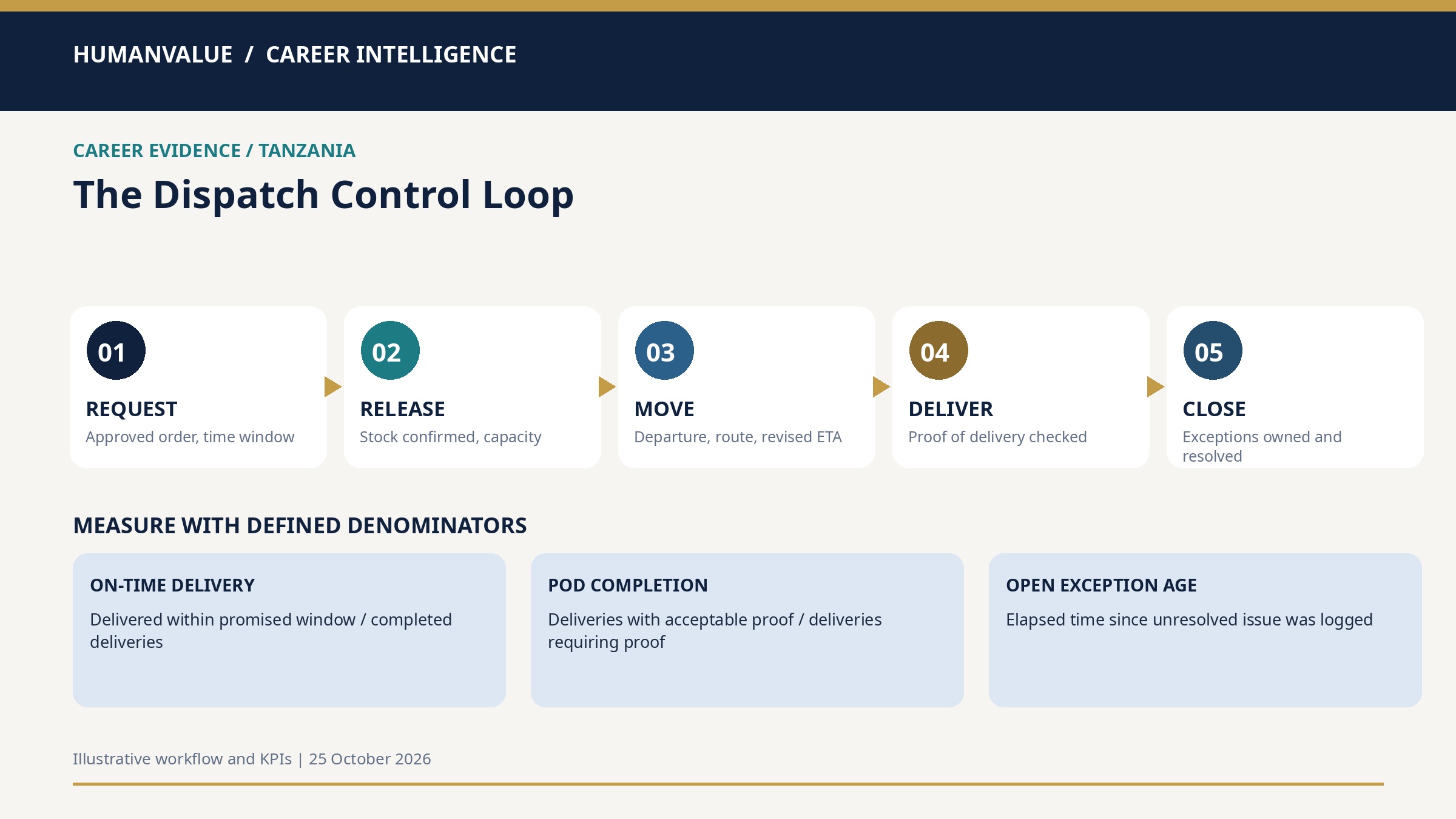
Think of dispatch as a five-part control loop: request, release, movement, delivery evidence, exception closure. A strong candidate can explain each part with one consistent example rather than reciting disconnected software names.
The seven records that make dispatch auditable
1. Delivery request. Record the customer or destination reference, requested quantity, promised delivery window, service priority and approval. Use invented customer data in a practice file.
2. Stock-release confirmation. Dispatch should not assume that an order appearing in a system means stock was picked, counted and approved. Match the release to a warehouse document and note shortages before the vehicle departs.
3. Vehicle and driver assignment. Capture the vehicle reference, capacity assumptions, driver assignment and relevant readiness checks. A training spreadsheet is not a substitute for a company's approved safety inspection.
4. Route and departure log. Record planned departure, actual departure, checkpoints and revised ETA. The most useful column is often not 'status' but 'reason for variance'.
5. Proof of delivery (POD). A signed note, approved electronic acknowledgement or other permitted evidence establishes what the receiving party reported. It should identify discrepancies and be stored securely.
6. Exception register. A late departure, failed delivery, partial quantity, damaged item or vehicle breakdown needs an owner, next action, customer update and closure timestamp.
7. End-of-day reconciliation. Compare orders released, trips dispatched, PODs received, outstanding deliveries and open exceptions. If numbers do not reconcile, investigate rather than marking everything complete.
These records are operational examples, not a claim that one form is mandatory for every company. Adapt them to employer policy, transport rules and data-protection requirements.
A fictional Dar es Salaam to Kibaha dispatch case
Imagine a distribution company has six orders to deliver from Dar es Salaam to customers in Kibaha and nearby industrial areas. Four orders are ready by 08:00, one has a quantity mismatch and one customer has asked to receive goods after 13:00. The dispatch coordinator must not simply assign all six to the first truck.
A sensible plan separates confirmed stock from pending stock, groups deliveries by geography and time window, checks the vehicle's authorised capacity and makes sure the route is operationally realistic. The coordinator then issues a departure list and asks the warehouse to resolve the mismatch before releasing the affected order. When one truck reports a delay, the coordinator records a revised ETA, notifies the customer through the approved channel and escalates if the new arrival time breaches the service commitment.
At day's end, five deliveries have documented receipts and one remains open. A good report says 'five delivered, one open with reason and next action', not 'six completed' to make the dashboard look attractive. No salary, company or actual traffic time is implied by this example.
Build a useful 21-day portfolio, not a fake employment history
Days 1–3: map the process. Draw a one-page swimlane with sales/customer service, warehouse, dispatch, driver and accounts. Show who approves release, who records exceptions and who closes a POD. Keep each handoff explicit.
Days 4–6: create a small dataset. Make 30 fictional orders across Dar es Salaam, Kibaha and one additional delivery area. Include order ID, quantity, promised window, warehouse-ready time, vehicle ID, planned departure and actual delivery. Avoid real names, phone numbers, addresses or customer data.
Days 7–9: calculate three measures. On-time delivery percentage is completed deliveries within their promised window divided by completed deliveries with valid timestamps. POD completion percentage is deliveries with acceptable POD divided by deliveries requiring POD. Open-exception age is time since an unresolved exception was logged. Define denominators clearly; missing data should be marked unknown, not counted as success.
Days 10–12: design a route and capacity check. Build a table showing stop sequence, planned distance assumption, expected loading units, vehicle capacity and risks. Do not invent a legally permissible payload. Label all assumptions as training figures and describe how a real dispatcher would validate them.
Days 13–15: simulate two disruptions. A vehicle becomes unavailable and a customer rejects a partial delivery. Write a concise escalation note for each: what happened, impact, action owner, customer update and next review time. This is more valuable than a decorative dashboard alone.
Days 16–18: write a shift handover. Produce a one-page report with completed trips, pending PODs, late orders, safety or compliance flags, and the first actions for the next shift. Include a simple audit trail of changes.
Days 19–21: package the evidence. Prepare a PDF overview, anonymised spreadsheet screenshots and a two-minute explanation of the trade-offs you made. Keep the actual editable files privately available if an interviewer asks to see them. Label the portfolio 'simulated learning exercise'.
Excel and systems skills employers can test
Start with filtering, conditional formatting, lookup formulas, date-time arithmetic, data validation and a pivot table. A useful exercise checks whether an order has a valid POD and flags records with a missing dispatch timestamp. In an interview, explain what the formula does and how you would investigate an exception. Do not describe yourself as an SAP or ERP expert after only using a mock spreadsheet.
Where an employer uses a transport management system, warehouse management system or ERP, the important skill is following the transaction sequence, preserving accurate records and recognising when a system state does not match reality. The HumanValue Practical Warehouse & Logistics Toolkit is publicly listed at TZS 20,000 for a PDF handbook and Excel exercises, including dispatch and stock reconciliation. Its page states that this ebook is separate from the course and does not include a certificate. Check the product page and checkout before buying. It is a relevant practice resource, not a dispatch licence or employment guarantee.
Turn the portfolio into a truthful CV
Replace 'experienced fleet manager' with a defensible statement such as: 'Created a simulated 30-order dispatch control workbook, including route assumptions, POD reconciliation, late-delivery alerts and exception handovers.' Add a link to a permitted sample if you have one. If you already worked in retail, warehouse receiving or customer service, describe the genuine handoffs you performed and explain how they transfer to dispatch.
A strong CV can be scanned for readability and role alignment through the JobsTanzania free ATS CV scanner. Applicants seeking additional career preparation can review Job Seeker Premium, publicly listed at TZS 30,000 for 30 days, but ordinary job applications remain free. A paid product does not buy a job or interview.
Common errors and the interview questions they trigger
An impressive-looking dashboard can conceal weak controls. Interviewers may ask why a trip shows delivered before departure, whether a customer can sign for a short quantity, or who is authorised to change an ETA. Be prepared to explain source data, permissions, audit trail and what you would do when records conflict.
Never share a former employer's live customer records as portfolio evidence. Remove personal information and commercially sensitive details; seek permission before using actual screenshots. The Tanzania Personal Data Protection Commission provides guidance on responsible personal-data handling. A simulated dataset is usually safer and more useful for a public work sample.
FAQs
Do I need a driving licence to become a dispatch coordinator?
Not necessarily for every desk-based role, but employers may require one if the duties involve driving or vehicle movement. Read the actual vacancy and applicable rules.
Is dispatch the same as warehouse inventory control?
No. They overlap at stock release and reconciliation, but dispatch focuses on movement, delivery timing, communication and closure. A warehouse role may focus more on storage, counting and picking.
Can a beginner apply without fleet experience?
Some entry-level employers may accept transferable operations experience and strong evidence. Others require direct transport experience. The portfolio improves clarity, not eligibility for every vacancy.
Does the HumanValue toolkit issue a certificate?
The current toolkit listing explicitly says no certificate is included. It is a separately purchased PDF and Excel resource, not the full course.
Which metric matters most?
It depends on the employer's service promise. On-time delivery, POD completion and exception closure should be interpreted together, with clear definitions and reliable data.
Your next practical step
Create a fictional ten-order delivery log today. If you cannot explain which orders are released, in transit, delivered or unresolved, fix the workflow before adding charts. Then compare your evidence with genuine vacancies on JobsTanzania, explore the Learning Center and improve your CV using the free scanner. The most convincing applicant is the one who can show how a delivery moves from instruction to verified completion.
Editorial scope: general career education, reviewed 25 October 2026. All case data and exercises are fictional; no vacancy, salary or placement is represented.