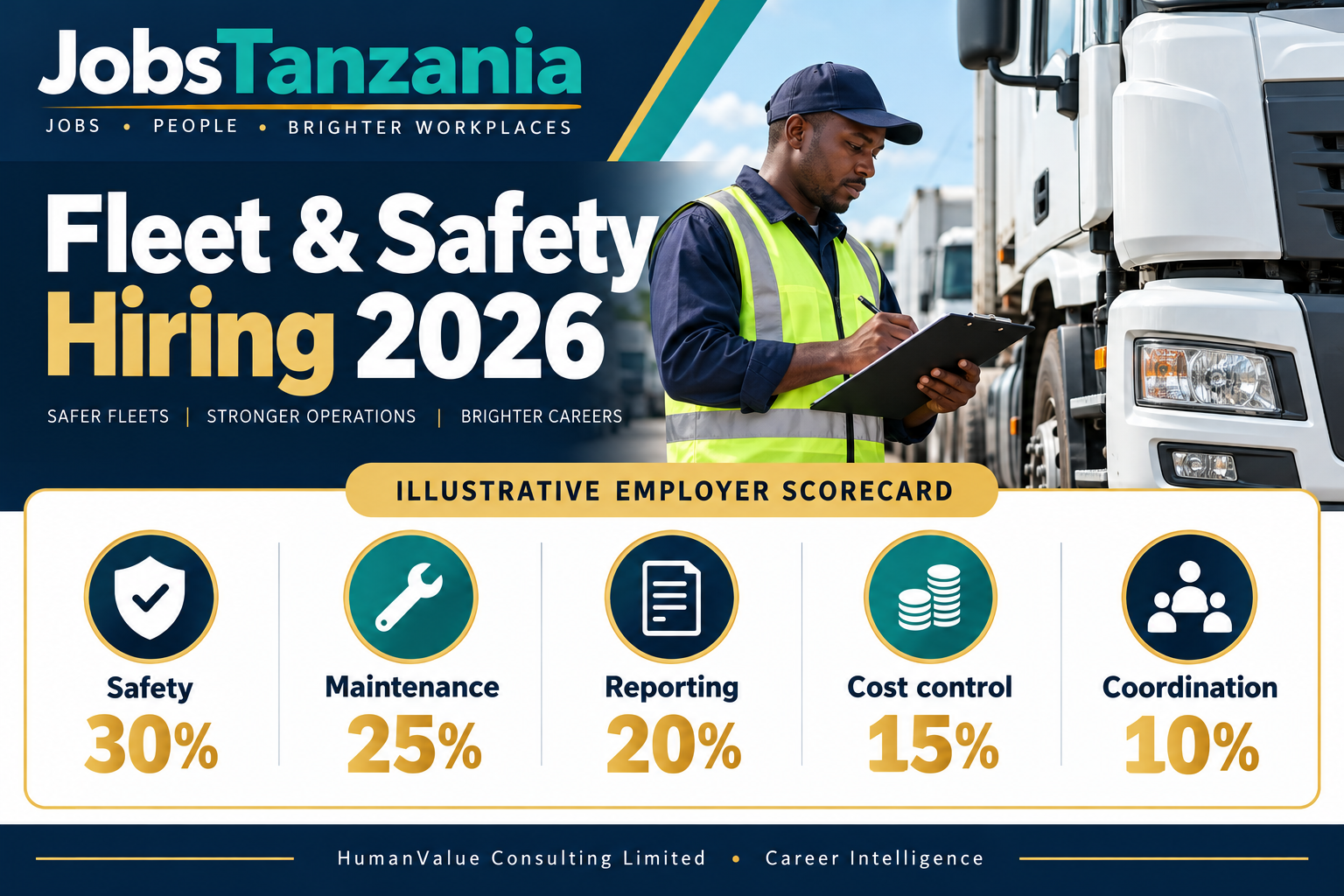


To hire a dependable fleet maintenance technician in Tanzania, test diagnostic reasoning, safe decision-making, documentation and communication before relying on years of experience or brand familiarity. A candidate who can explain why a vehicle should not return to service, isolate a likely fault and write a usable job card may be more valuable than one who names many parts without evidence. Employers can assess those capabilities through a 45-minute simulated diagnostic exercise and a structured scorecard, without asking applicants to perform risky unpaid repairs.
Define the fleet and operating risk before writing the vacancy
A city delivery fleet of light vans has different failure patterns, tools and operating constraints from a quarry's heavy equipment or a passenger-transport operation. Specify the asset classes, workshop environment, maintenance systems, shifts, travel expectations and reporting line. Distinguish preventive maintenance, fault diagnosis, inspection, repairs, spare-parts control and external-vendor coordination.
State which qualifications, licences or safety certifications are truly essential for your work. Do not add a generic 'must know every truck brand' requirement when the job mostly involves systematic inspection and reliable escalation. Equally, do not treat a short skills test as a substitute for legally required competence or supervision.
Design a safe, realistic 45-minute work sample
Use a fictional vehicle history rather than a running engine or energized machinery. Give every shortlisted candidate the same packet: service dates, odometer readings, a driver complaint, inspection notes, a basic schematic and three potential causes. Explain that the packet contains invented information. Provide reasonable adjustments and assess the job-related skill, not the candidate's ability to guess your preferred wording.
First 10 minutes, triage: Candidate identifies immediate safety concerns, asks clarifying questions and states whether the asset should remain out of service pending assessment. Next 15 minutes, diagnosis: Candidate proposes a test sequence, tools and decision points. Next 10 minutes, job card: Candidate records symptoms, checks, suspected causes, parts to verify and escalation. Final 10 minutes, handover: Candidate explains the finding to a nontechnical fleet supervisor and suggests a preventive follow-up.
No candidate should be asked to bypass guards, work beneath an unsupported vehicle, disconnect live systems or perform safety-critical repair without the controls, qualifications and oversight required by the employer. The Occupational Health and Safety Act provides Tanzania's statutory safety framework; the exact controls depend on the task and workplace.
A 100-point evidence-based hiring scorecard
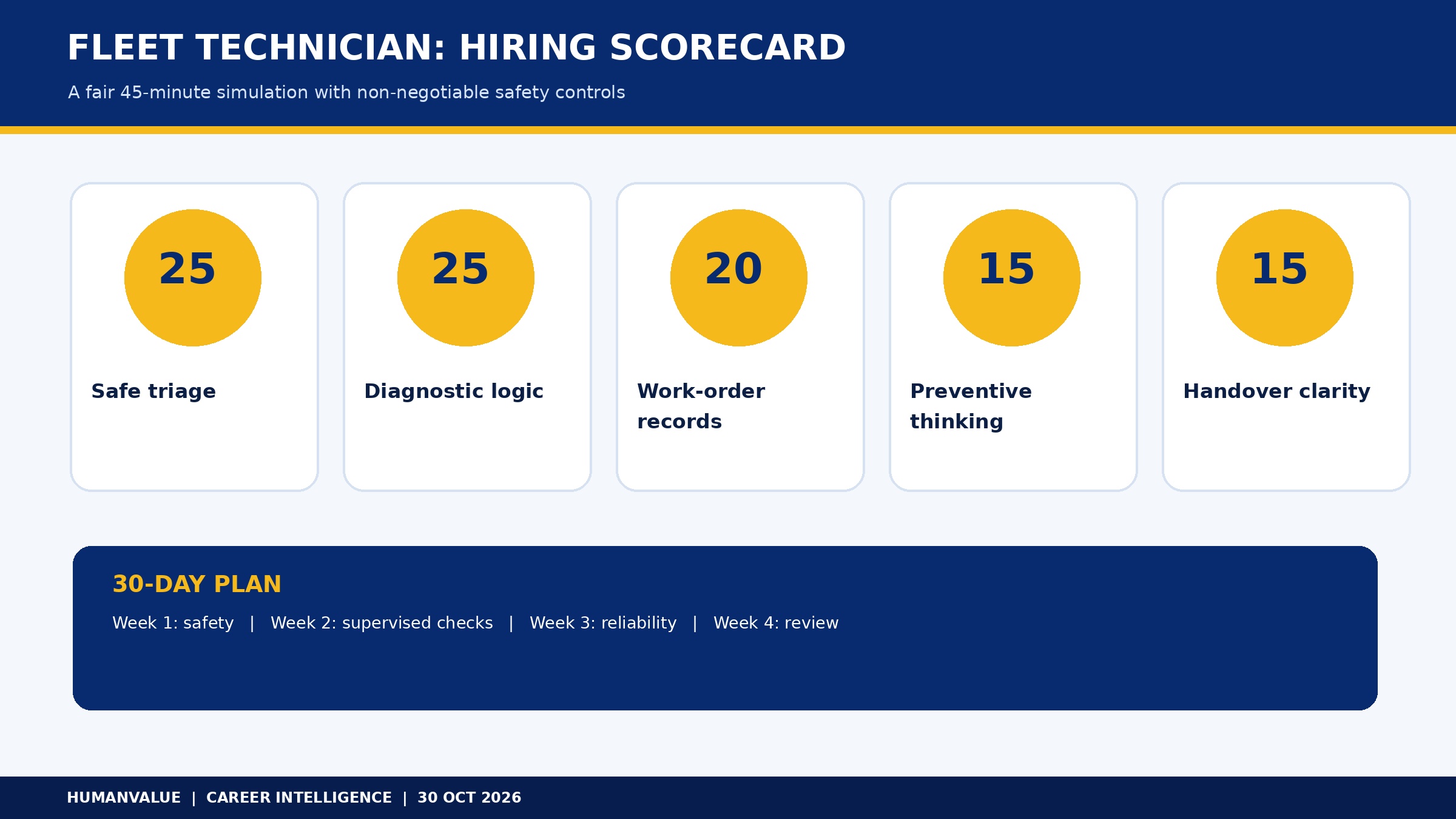
Allocate 25 points to safe triage, 25 to fault-isolation logic, 20 to work-order accuracy, 15 to preventive-maintenance thinking and 15 to communication and handover. These are proposed employer weights, not a statutory or nationally validated scale. Use anchored scores: zero for missing or unsafe evidence, middle marks for adequate steps with supervision, and full marks for clear, verified reasoning.
Set non-negotiable safety conditions before the exercise. A candidate who proposes a hazardous shortcut should not be selected merely because their arithmetic gives a high total. Conversely, one minor terminology error should not automatically disqualify a candidate whose approach is safe and systematic. Have two assessors score independently before discussing the result.
Worked scenario: the delivery van with repeat brake complaints
A fictional van has returned twice in one month with a brake-noise complaint. The driver says the issue occurs after long descents. A weak candidate immediately orders a full replacement without inspecting records or defining safe checks. A stronger candidate treats braking as safety-critical, advises the supervisor not to dispatch the van until authorised inspection, reviews the service history, identifies plausible causes and sets out the inspection evidence required before any release decision.
This scenario is not a repair manual. Only competent, authorised personnel should perform actual brake inspection or maintenance under approved controls. The point of the assessment is disciplined decision-making and escalation, not demonstrating unsafe procedures for an interview.
Test the paperwork as seriously as the tools
Give the candidate an incomplete job card and ask what is missing. Useful fields include asset ID, date, complaint, inspection result, parts requested, approval, technician, quality check and return-to-service authorisation. A record that says 'fixed' without the tested fault or approval is not a reliable control.
Ask how the technician would handle a missing spare part. Look for accurate status reporting, safe parking of the vehicle where necessary, vendor lead-time communication and escalation of a potential service disruption. An employer should not reward fabricated completion times or hidden outstanding faults.
Distinguish reliability from rushed throughput
Track measures that technicians can influence fairly: preventive-maintenance completion, repeat defects after repair, work-order completeness and verified downtime reasons. A single metric such as 'vehicles repaired per day' can reward superficial work and under-reporting. Use measures as learning signals, with an opportunity to explain differences in asset age, parts availability and workload.
For example, if ten fictional preventive-maintenance tasks were scheduled and eight were completed on time, the completion measure is 8/10 = 80%. It is a teaching example, not a Tanzanian industry benchmark. The remaining two tasks need documented reasons and owners, not deletion from the denominator.
A 30-day onboarding and reliability plan
Week one: Complete safety induction, asset familiarisation, work-order standards, escalation contacts and supervised inspections. Confirm that any required credentials and task authorisations are valid.
Week two: Assign bounded diagnostic tasks with a supervisor. Review the quality of notes, parts identification and adherence to controls. Avoid using probation as a reason to withhold training.
Week three: Review repeat defects and preventive-maintenance backlog with the technician. Ask for one process improvement based on actual evidence, such as better job-card fields or an earlier parts request trigger.
Week four: Conduct a documented performance conversation covering safe behaviour, diagnosis, records, teamwork and development needs. Compare results with expectations explained at the start, not new targets invented at day 30.
Verify references and protect candidate data
With an appropriate basis and notice, verify employment dates, actual asset types worked on, supervisory responsibility and job-related training. Do not circulate identity documents or CVs through public WhatsApp groups. Tanzania's Personal Data Protection Commission provides official privacy guidance. Talent Bank profiles and AI-assisted matching are screening aids, not proof that a candidate is currently available or licensed for every task.
Choose the recruitment route that matches the need
The live JobsTanzania pricing page, checked 30 October 2026, lists Single Job at TZS 20,000, Employer Monthly at TZS 79,000 per 30 days and Employer Annual at TZS 690,000. The HumanValue Talent Bank advertises an eligible seven-day free trial with up to three candidate unlocks and Search Only at TZS 40,000 for 30 days with up to 50 unique unlocks. Subscription terms and checkout must be confirmed before payment.
If you already have an HR team, use the platform to publish a truthful vacancy and compare candidates against the same evidence. If the role is urgent or highly specialised, request a scoped HumanValue shortlist and practical assessment, with fees and responsibilities agreed in writing. Do not assume the platform's listed candidate count means every candidate has been interviewed or is available immediately.
Frequently asked questions
Is a hands-on repair test necessary?
Not always. A well-designed simulation can test reasoning first. Any practical assessment involving equipment must be safe, job-relevant and supervised.
Should we prefer a candidate with experience on one truck brand?
Only when that experience materially matters to the role. Systematic diagnostics, safety and accurate records can transfer across equipment with proper training.
Does a Talent Bank trial include job advertising?
The trial concerns candidate search; check the current plan terms for publishing. Search Only is separately priced and does not include job posting.
Can AI matching replace reference checks?
No. Confirm competence, identity, availability and qualifications through appropriate human review and lawful verification.
Take action with one clear role brief
Write the asset list, critical safety tasks, expected documentation and scorecard before contacting candidates. Then start an employer search, compare hiring plans, or request HumanValue recruitment support. A reliable hire begins with a fair assessment and a safe operating system, not an inflated job title.
Sources and editorial scope (30 October 2026): Tanzania Occupational Health and Safety Act; Personal Data Protection Commission; JobsTanzania pricing; Talent Bank. Fictional exercises and score weights are editorial tools.