


HumanValue Employer Intelligence | Tanzania | Researched 9 November 2026
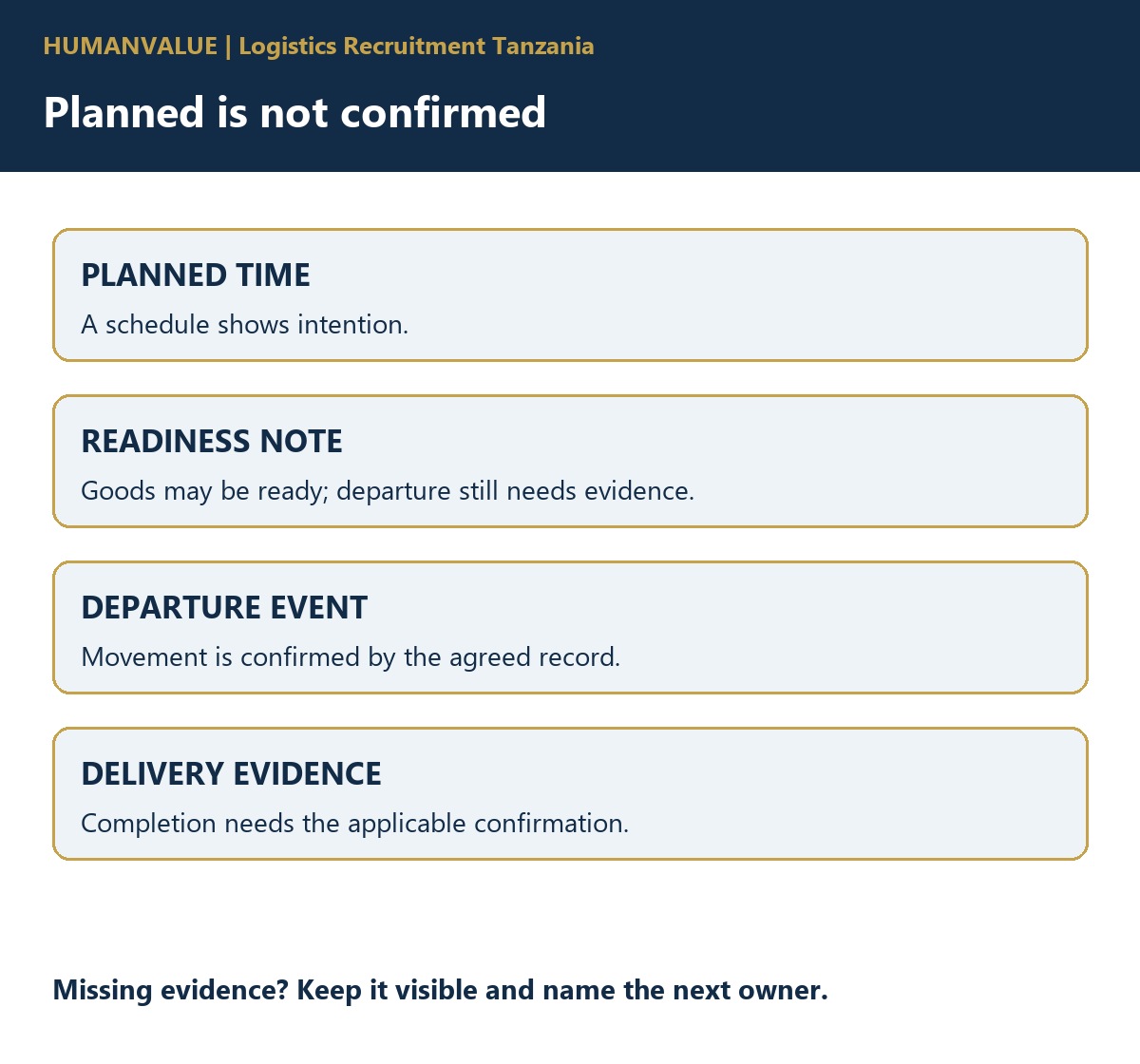
A dispatch clerk should help the operation distinguish planned movement, confirmed movement and completed delivery. When something changes, the clerk needs to record the evidence, identify the next owner and communicate an accurate update. Hire for those decisions as well as speed of data entry.
For Tanzanian employers coordinating deliveries, an unclear status can lead to repeated calls, unnecessary escalation or an unsupported promise to a customer. This guide helps define the role, assess a fictional dispatch exception and plan induction. It is an original assessment framework to adapt and pilot, not a validated test or a description of a particular employer’s vacancies.
Clarify the dispatch clerk’s part of the operation
The clerk may prepare dispatch records, check references, update movement information and follow up missing evidence. The role should not silently include authority to change routes, approve extra charges or promise a revised delivery time unless the employer has assigned those responsibilities.
Set the reporting line and the handover points between warehouse, transport, service and finance. Identify which system is authoritative for each event. A message saying a vehicle is ready is different from confirmation that goods have departed; a customer query is different from evidence of a failed delivery.
If the clerk will use a carrier portal, train them in that carrier’s definitions. For example, UPS’s tracking-status guidance distinguishes movement, final delivery and exception statuses. This illustrates why status labels need interpretation; it does not establish the workflow or delivery commitments for a Tanzanian operator.
Give the hiring panel a common picture of good work
| Responsibility | Employer decision | Evidence to assess |
|---|---|---|
| Record preparation | Which references and checks are required before dispatch? | Accurate use of the supplied manifest and instructions |
| Status updates | Which event or record supports each status? | No unsupported jump from planned to completed |
| Exception handling | Who resolves missing information or changed arrangements? | A precise query with the right owner |
| Communication | Who may update customers and approve commitments? | Helpful wording within the role’s authority |
| Handover | How are open items passed to the next shift? | Facts, dependencies and next actions remain visible |
Use this brief to distinguish essential entry capability from systems knowledge the employer will teach. Someone may understand evidence and escalation while being unfamiliar with your software. Conversely, fast typing in a familiar system does not prove sound judgement.
Use a fictional exception with incomplete evidence
Prepare an invented pack for dispatch reference D-041. The exercise shows a planned dispatch time, a warehouse readiness note and a later request from the service team asking whether delivery has happened. There is no confirmed departure event or delivery evidence in the pack.
Ask the candidate to update the register, write a short internal response and list what needs checking. A stronger response preserves the known facts and seeks the missing movement evidence. It does not mark the consignment delivered because the planned time has passed.
Fictional internal update: “D-041 has a warehouse readiness note, but the supplied records do not confirm departure or delivery. I have kept the delivery status unconfirmed and referred the movement query to the designated transport owner. Please obtain an authorised update before giving the customer a delivery confirmation.”
Then introduce a second exercise message: a colleague says the customer requested a different receiving location. The candidate should identify the need to verify the request and obtain the relevant approval. Do not reward someone for changing the destination without checking the supplied authority rules.
Assess accuracy and judgement separately from presentation
A polished message can still contain a false claim. Review the register and wording against the supplied evidence. Ask assessors to identify the exact event supporting each status and the actual action requested in the update.
| Dimension | Stronger evidence | Concern to explore |
|---|---|---|
| Event accuracy | Readiness, departure and delivery remain distinct | A planned time treated as proof of completion |
| Traceability | Updates cite the correct dispatch reference and source | Information copied from another case |
| Authority | Changes and commitments referred appropriately | An unapproved destination or timing promise |
| Follow-up | The missing evidence has a named next-action owner | A vague “checking” status |
| Communication | The recipient understands what is known and needed | Speculation or unnecessary personal information |
Give every candidate equivalent materials and explain the expected outputs and tools. Pilot the task with someone familiar with dispatch work, check the time allowed and consider appropriate adjustments. Use invented addresses and identifiers rather than real customer records.
Use the interview to explore a real exception
Ask for a genuine example of a delivery update that changed after the first message. What evidence arrived, who approved the change and how was the earlier information corrected? Follow up on the candidate’s own actions and the next owner rather than accepting a general account of what “the team” did.
If the applicant lacks dispatch experience, examine transferable coordination skills without relabelling them. A candidate who tracked a fictional exercise can explain their method, but should not claim to have managed actual deliveries. A person with service experience may understand customer updates while needing training in warehouse and transport events.
Induct the clerk into the real event chain
Show the appointed employee the actual documents, systems, status definitions and escalation contacts. Explain how to handle missing scans, contradictory messages and changes to receiving arrangements. Set a clear rule for who can approve customer commitments or commercial changes.
Begin with supervised records and review a small sample for accuracy and useful follow-up. Discuss exceptions that remain open. A low open-item count is not sufficient evidence of good work if items were closed without support.
Questions employers often ask
Must the candidate know our carrier’s system already?
Decide whether that knowledge is essential on entry or can be taught. Test the critical task fairly and distinguish system familiarity from the underlying ability to read evidence and communicate.
Should the fastest candidate score highest?
Use realistic time expectations, but inspect accuracy and authority. A fast incorrect delivery confirmation can create additional work and customer confusion.
Can this exercise replace a full recruitment process?
No. It provides evidence about defined capabilities. Combine it with appropriate screening, interview and other job-related checks under the employer’s process.
Build the recruitment brief with HumanValue
When discussing HumanValue HR and recruitment services, bring the dispatch workflow, reporting line, essential skills and approval boundaries. Agree sourcing, screening or assessment-support deliverables, timing, employer responsibilities and fees. The employer retains appointment and operational decisions.
For panel preparation, read our scorecard calibration guide. For the candidate-development perspective, see the dispatch-coordinator career guide. Review the Learning Center’s Practical Warehouse & Logistics Toolkit against the actual development need; it is a learning resource rather than proof of competence in your operation.
Editorial contact: Emily Sebashahu
HR Services & Recruitment Director, HumanValue Consulting Limited.
Follow Emily on LinkedIn for HR and recruitment insights.