


HumanValue Employer Intelligence | Tanzania | Researched 8 November 2026
A training coordinator should help the organisation deliver the right learning activity, maintain reliable records and follow up what remains unfinished. Do not hire solely on the candidate’s ability to arrange a venue or produce an attractive attendance sheet. Assess whether they distinguish registration, attendance, assessment and workplace application—and whether they can explain the evidence behind each status.
For Tanzanian employers, the role may support induction, internal skills programmes, customer-facing workshops or several sites. The scope determines the experience and judgement needed. This guide provides a fictional coordination case, an evidence-based interview structure and a practical induction approach. Its proposed assessment is original material to adapt and pilot, not a validated certification or a substitute for applicable hiring requirements.
1. Decide whether you need coordination, facilitation or learning design
These responsibilities can overlap, but they are not interchangeable. Coordination may include scheduling, invitations, materials, records and follow-up. Facilitation involves helping learners engage with content. Learning design involves shaping objectives, activities and assessment. A vacancy that silently combines all three can attract applicants whose experience fits only part of the work.
Write the essential duties and reporting line before advertising. Clarify who approves the learning need, content, budget and completion criteria. Describe the systems and working arrangements involved. If the coordinator will work with external trainers, explain who agrees commercial terms and who checks deliverables.
| Responsibility | Employer decision | Evidence to assess |
|---|---|---|
| Planning | Which activities, locations and stakeholders does the role coordinate? | A realistic plan with dependencies and owners |
| Records | What counts as invited, attended, assessed and completed? | Statuses supported by the supplied evidence |
| Communication | Who receives invitations, changes and unresolved questions? | Clear messages tailored to the recipient |
| Evaluation support | What information is collected, by whom and when? | Recognition of the difference between attendance and learning |
| Authority | Who approves expenditure, content and certificates? | Appropriate referrals instead of unsupported commitments |
2. Keep attendance separate from learning evidence
A signed register can support a record that someone attended. It does not, by itself, demonstrate that the person learned a skill or applied it at work. This distinction matters when managers ask whether a programme “worked” or whether someone qualifies for a completion document.
The CDC’s training-evaluation guidance distinguishes assessing learning from assessing its application at work. It also explains that evaluation questions and timing should fit the information needed. These are methodological ideas, not evidence that a particular Tanzanian programme has achieved an impact.
A coordinator may collect and organise the evidence without being authorised to decide competence or issue certificates. Make that boundary explicit. If the course has defined assessment and completion requirements, the candidate should apply them consistently rather than inventing a rule to clear the outstanding list.
3. Use a fictional workshop case with competing records
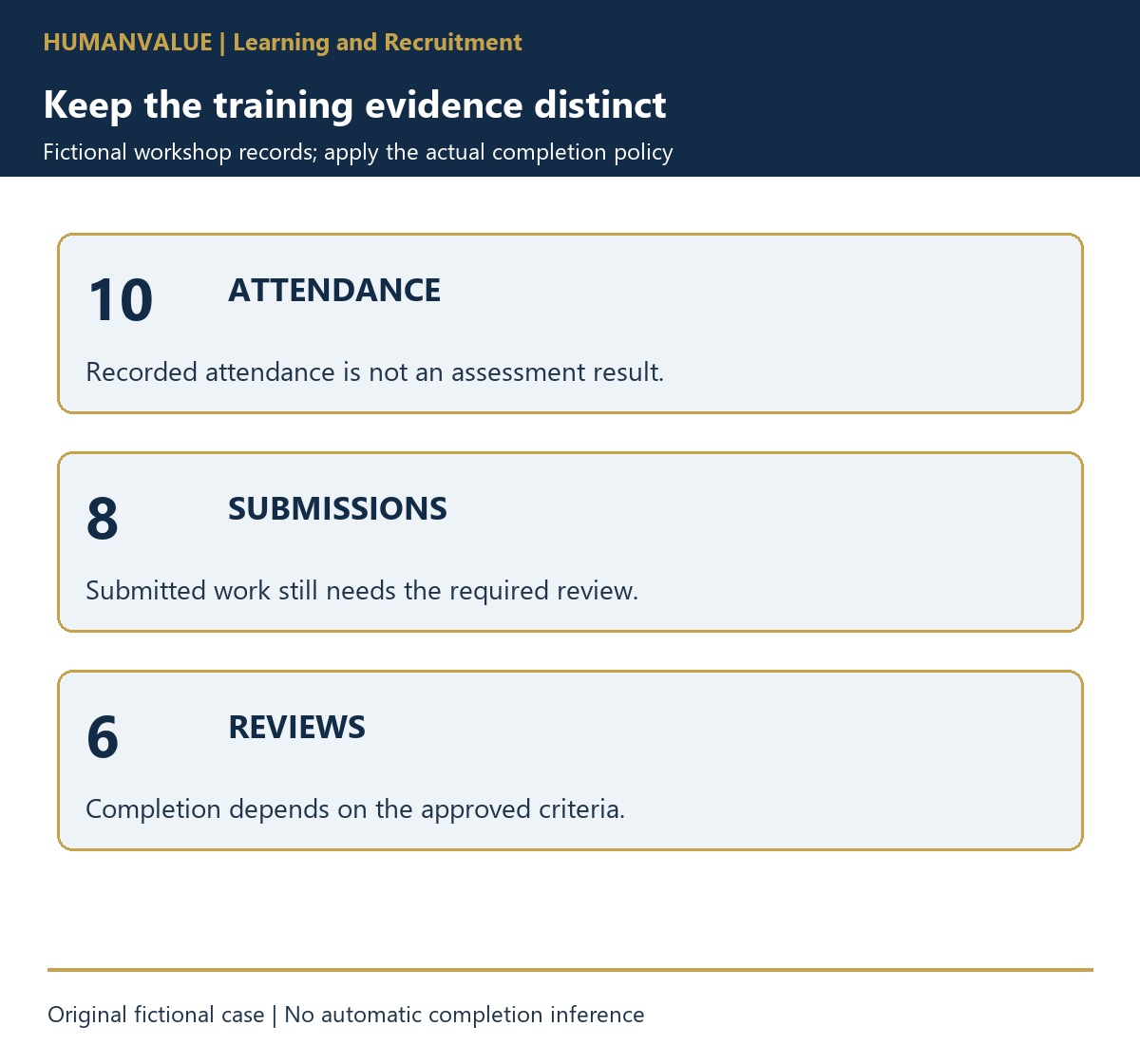
Prepare a training brief for an invented internal workshop with 12 fictional participants. Ten appear on the attendance record; eight have submitted the required practice task; six tasks have been reviewed and two await review. The remaining records contain an invitation change and an incomplete reference. Give the applicant a short written completion policy for the exercise.
Ask for three outputs: a corrected status register, a short update to the learning manager and a plan for resolving the outstanding items. Include invented identifiers rather than real staff names. State the tools available and give every candidate equivalent instructions and time.
A strong response keeps each evidence category visible. It does not mark all ten attendees complete merely because they signed in. It also does not mark an unreviewed task as failed. The candidate should identify who must review the outstanding tasks and what information is needed to resolve the incomplete record.
Fictional manager update: “The workshop file shows ten attendance records and eight task submissions. Six submissions have a recorded review; two await review. Completion status must be checked against the supplied policy. I have listed the unresolved references and proposed owners for follow-up.”
The case numbers are invented and describe the exercise only. They are not a HumanValue course result, attendance rate or claim about training effectiveness.
4. Score the decisions behind the register
| Criterion | Points | Observable evidence |
|---|---|---|
| Status accuracy | 30 | Attendance, submission, review and completion remain distinct |
| Traceability | 20 | Each material status can be traced to a supplied record |
| Follow-up planning | 20 | Outstanding questions have an owner and review time |
| Communication | 20 | The manager can understand progress and decisions needed |
| Authority and discretion | 10 | No invented assessment result, certificate approval or unnecessary personal detail |
Pilot the exercise with someone who understands the role. Check that the completion policy is clear and that the timing measures the intended skills. Have assessors record evidence independently before comparing ratings. If candidates consistently misunderstand a field, inspect the instructions before assuming they all lack the same capability.
5. Ask how the person handled an actual change
In the interview, ask for a genuine example of a training activity that changed after invitations were sent. What changed, who approved it, how were participants informed and how were the records corrected? Follow up on the candidate’s own actions rather than accepting a broad description of what “we” did.
Ask a second question about an incomplete record or delayed assessment. Look for an explanation of uncertainty and the next decision owner. Do not request confidential participant lists or assessment results from a previous employer. A candidate can explain a method without disclosing someone else’s private information.
6. Design induction around the real workflow
Show the appointed coordinator the approved learning request, plan, invitation, attendance, assessment and reporting process. Explain which records are authoritative and who can change them. Start with supervised coordination of a defined activity and review its evidence before expanding responsibility.
Use a realistic set of review questions: were changes communicated, can the manager trace completion status, and do unresolved items have owners? Avoid using the number of certificates issued as the only success measure. Learning objectives and workplace needs should shape the evaluation conversation.
The CIPD learning-evaluation factsheet links evaluation with identified performance gaps and business objectives. Its public summary supports that principle; the detailed resource may require access. Do not imply that reading a summary validates your assessment method.
7. Questions employers often ask
Must every coordinator be a trainer?
Not necessarily. Specify whether facilitation is part of this vacancy and assess it separately if essential. Do not assume that strong administration proves delivery or learning-design skill.
Should all attendees be marked complete?
Apply the programme’s approved criteria. Attendance, assessed performance and completion can represent different evidence. An unresolved review should remain unresolved until the authorised decision is recorded.
Can the candidate use a spreadsheet?
Use a tool appropriate to the job and explain it in advance. A spreadsheet can show coordination reasoning, but live systems, access controls and retention requirements still need employer-specific training.
8. Build the hiring brief with HumanValue
When discussing HumanValue HR and recruitment support, explain the scale of your learning activity, the records that currently cause problems and the responsibilities the new employee will own. Agree sourcing, screening or assessment deliverables, employer responsibilities, timing and fees before work begins.
For a coordinator’s development needs, review Microsoft 365 Collaborative Workplace and Workplace Excel Essentials against the actual gap. For panel preparation, read the HumanValue hiring-scorecard calibration guide.
Editorial contact: Emily Sebashahu
HR Services & Recruitment Director, HumanValue Consulting Limited.
Follow Emily on LinkedIn for HR and recruitment insights.