


HumanValue Employer Intelligence | Tanzania | Prepared 8 November 2026
When you hire a receiving clerk, the useful question is what the person does when the delivery and the paperwork disagree. A short fictional receiving exercise can reveal whether a candidate counts carefully, preserves the difference, asks for the right evidence and recognises who may approve the next action.
For a Tanzanian warehouse, retailer or distribution business, these habits matter at the point where goods enter the record. This assessment uses a desk-based simulation with empty sample cartons or printed cards. It does not require candidates to operate equipment, lift loads or handle actual customer goods.
Start with a receiving process your managers can explain
Before drafting the vacancy, walk through the actual handover from delivery arrival to stock availability. Who checks references? Who counts? Which person inspects condition or approves acceptance? Where is a discrepancy recorded? Which products require specialist inspection or restricted handling?
List the clerk’s responsibilities separately from those of the supervisor, security team, quality specialist and accounts staff. A candidate should not need authority the job does not carry to perform well in the assessment. State genuine physical and systems requirements in the vacancy and arrange an appropriate assessment of the essential work.
The assessment pack: three small problems, one clear policy
Create a fictional order for ten identical cartons and a delivery note referring to that order. Supply a record card showing nine cartons at the simulated desk. Add a second delivery with a mismatched item code and a third with a reported packaging concern. Provide a short policy stating who owns quantity discrepancies, item identification and condition decisions.
| Scenario | What the candidate should make visible |
|---|---|
| Nine cartons against ten on the note | Expected quantity, observed quantity, difference and responsible follow-up |
| Item code differs from the order | The exact mismatch and the evidence needed to identify the item |
| Packaging concern reported | What was observed, what remains unverified and the approved inspection route |
Tell applicants that all data are fictional and that some questions remain unresolved. Give everyone the same core material and a chance to clarify the instructions. The goal is to observe work-related judgement, not to reward someone for guessing a hidden answer or knowing your internal abbreviations already.
Watch the record develop
Allow a short review period, followed by preparation of a receiving record and a spoken handover. Pilot the duration before using it in recruitment. Ask the candidate to point from each entry to the relevant document or count card. A good record can distinguish “reported”, “observed” and “approved” without needing a long explanation.
For supervised learning after selection, the Practical Warehouse & Logistics Toolkit for Tanzania provides fictional warehouse cases, worked exercises and an Excel model. The ebook is a separate learning product and does not include course enrolment or a certificate. Choose it for a defined learning need rather than as a substitute for site induction.
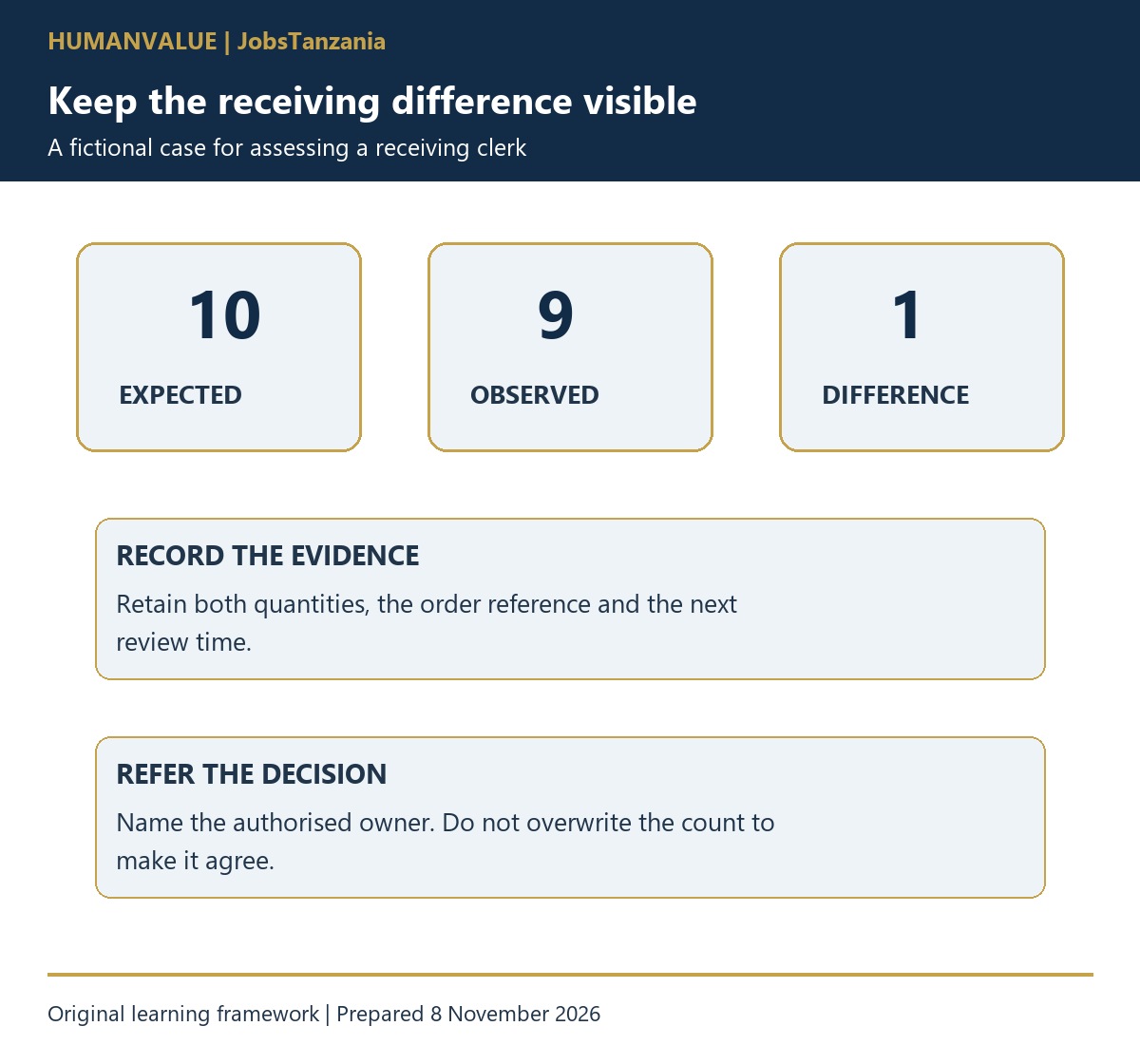
For the nine-carton case, look for a record that retains ten as the expected quantity and nine as the observed quantity. The candidate should not erase the difference to make the documents agree. Ask what action is allowed under the supplied policy and what needs a supervisor’s decision.
In the item-code case, a careful candidate may notice that the description sounds similar while the code differs. Ask what evidence would resolve that uncertainty. Recognising that two descriptions are similar is useful; treating similarity as proof of equivalence is a different decision.
Use a behavioural scorecard
| Area | Observable evidence |
|---|---|
| Counting and comparison | Uses the supplied units and checks the correct order and delivery references |
| Record accuracy | Keeps expected and observed values separate and labels unresolved items |
| Escalation | Names the responsible decision maker and asks a specific question |
| Communication | Explains the discrepancy without unsupported blame or promises |
| Work boundaries | Follows the supplied handling and approval instructions |
Ask two reviewers to record evidence independently before discussing an overall rating. Define the scoring anchors in advance. For example, a weak discrepancy note merely says “short delivery”; a stronger one records the order reference, expected and observed count, follow-up owner and review time. Do not let general confidence replace these observations.
The US Office of Personnel Management’s work-sample guidance describes assessment through tasks that resemble the work. It is a methodological reference, not a Tanzanian legal requirement. Choose activities relevant to capabilities the person needs at entry, and distinguish them from systems you plan to teach during induction.
Ask about three warning signs
If a candidate changes a quantity without explanation, ask them to describe the reasoning. If they accept a substitute item immediately, ask what makes the two items equivalent. If they assign blame, ask which fact supports that conclusion. Use the same neutral follow-up approach with other candidates for the same vacancy.
A single exercise provides limited evidence. Combine it with a structured interview, appropriate checks and a review of the actual role requirements. Keep the candidate’s assessment information in approved recruitment records with suitable access. Use fictional packs in interviewer training as well.
Turn the result into a first-month plan
During induction, explain the actual document flow and escalation contacts before the clerk works independently. Review supervised receiving records for traceability and unresolved differences. Teach the site’s system, product-specific controls and handling requirements through the responsible team. A new hire should know where to ask rather than silently improvise an acceptance decision.
At the end of the first month, sample a manageable set of records and discuss what a colleague could reconstruct from them. Look at the quality of the evidence and handover, not only how quickly a delivery was entered.
A clearer receiving brief makes recruitment more useful
Bring HumanValue the site context, product types, workflow and responsibilities you need the clerk to own. We can discuss recruitment support around role clarification, sourcing and relevant assessment. Agree the scope, deliverables, timeline and fee before work begins. If you are recruiting directly, post the role on JobsTanzania with specific duties rather than a general request for warehouse experience.
Editorial contact: Emily Sebashahu
HR Services & Recruitment Director
HumanValue Consulting Limited
Follow Emily on LinkedIn or discuss your hiring brief with HumanValue.
For the next stage of stock traceability, read the warehouse returns portfolio guide.