


HumanValue Career Intelligence | Tanzania | Prepared 8 November 2026
A returned parcel is not automatically saleable stock. A useful warehouse returns register records what arrived, what the customer reported, what the receiving team actually observed and which authorised person decided the next step. For a Tanzanian job seeker, a small fictional returns exercise can demonstrate these distinctions without claiming experience with a particular employer’s system.
This guide is a learning project for warehouse, distribution and retail support roles. It is not a vacancy notice, a product-inspection qualification or authority to approve refunds, stock write-offs or the resale of goods. Follow the employer’s actual controls and product-specific safety requirements in a real role.
1. Separate three questions at the receiving bench
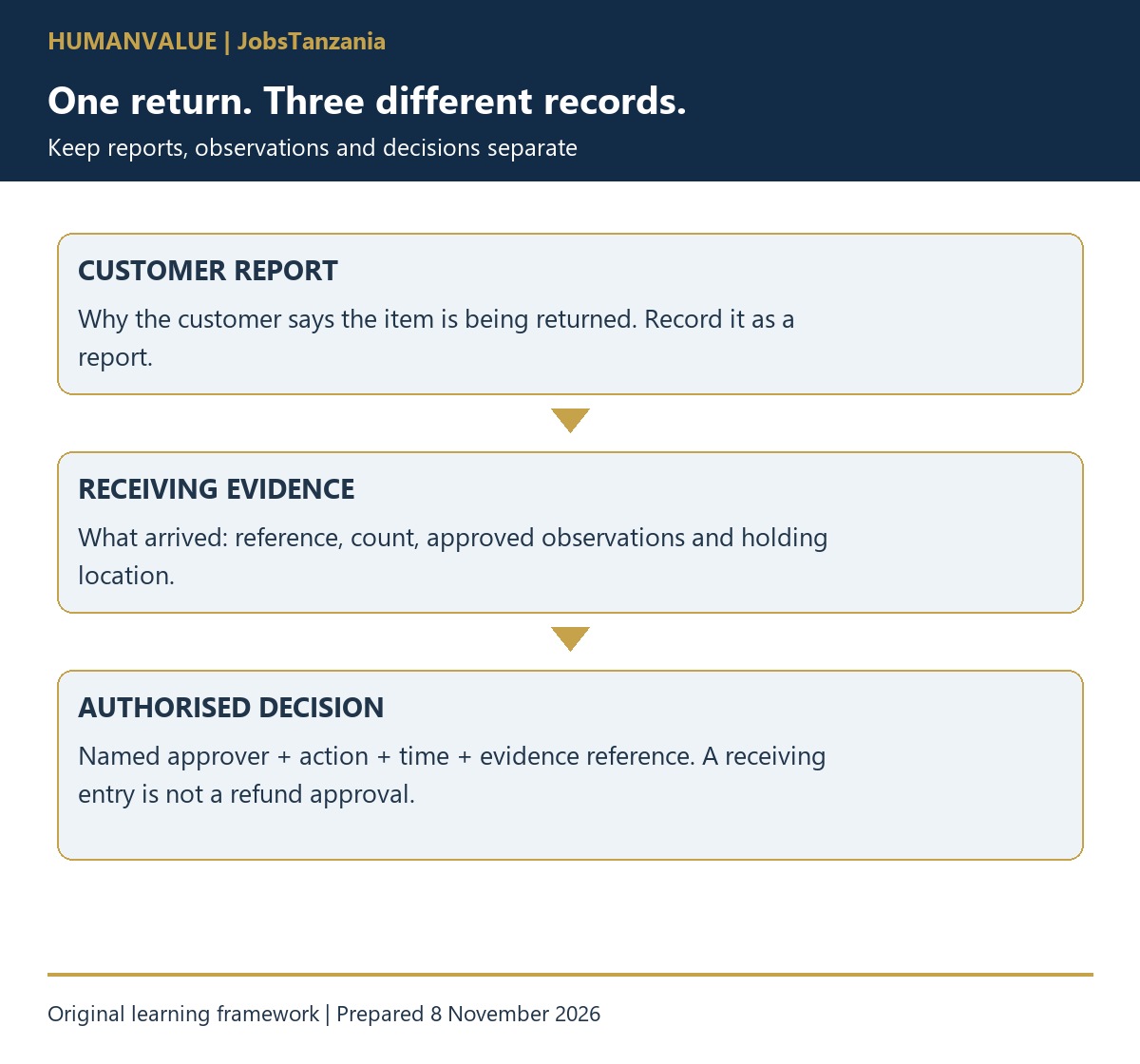
First, why does the customer say the item is being returned? Second, what goods and documents did the receiving team actually receive? Third, what action is authorised after the required checks? Combining these questions in one notes field can hide the difference between an allegation, an observation and a decision.
For example, a fictional customer returns six desk organisers because two were reportedly damaged in transit. The receiving record should not quietly turn that statement into “six damaged units”. Count the units, record visible packaging observations within the role’s competence and refer the condition assessment to the responsible person. Do not open or handle hazardous, contaminated or otherwise restricted returns outside approved procedures.
2. Build a register with linked evidence
| Record | What it establishes |
|---|---|
| Return reference and receipt time | Which case is being followed and when the goods arrived |
| Original order reference | Which authorised sales record the return relates to |
| Expected and received quantities | Whether the physical count matches the paperwork |
| Customer’s reported reason | The explanation given, identified as a report |
| Receiving observations | What the receiver can actually verify |
| Holding location and status | Where the goods are and whether a decision is pending |
| Authorised action and approver | What may happen next and who approved it |
| Linked evidence and next review | Where approved supporting records are held and what remains open |
Use separate columns for expected and received quantities. A single quantity field can conceal a difference. Keep a reference to the approved evidence location instead of copying customer details into every row. Restrict access to the people who need the record.
3. Keep the reported reason separate from the disposition
Microsoft’s Dynamics 365 documentation on return reason and disposition codes illustrates a useful systems distinction: a reason explains why a return is requested, while disposition relates to the action taken on returned goods. Your employer may use different labels or software. Learn its approved process rather than assuming a spreadsheet label changes stock status.
For the learning exercise, use simple statuses such as received, awaiting review, decision approved and action recorded. A status called “awaiting review” should never be interpreted as permission to place the goods back into ordinary pick stock. The appropriate holding arrangements depend on the product and site rules.
For additional stock-record practice, the HumanValue Practical Warehouse & Logistics Toolkit for Tanzania includes warehouse exercises and an Excel model covering stock reconciliation and related workflows. It is a separate ebook-and-workbook product, not course enrolment or a certificate. Use the product page to check the current contents before choosing it.
4. Investigate a fictional mismatch without changing the evidence
Create case R-014. The return document lists six organisers, but the receiving count is five. The customer’s message refers to two damaged units. Write three separate entries: expected quantity six, received quantity five and reported reason two damaged units. Keep the discrepancy open and ask the authorised owner to reconcile the missing unit and condition evidence.
Example internal update: “R-014 remains open. Five units were counted against six on the return document. The customer’s statement refers to damage to two units; the condition review is pending. Please confirm the discrepancy investigation owner and the next review time.”
This wording and every identifier are fictional. It demonstrates how to describe uncertainty. It does not accuse a customer, courier or colleague of causing a loss. Never alter the expected quantity merely to make a report balance.
5. Show the decision trail through to closure
After a decision is authorised, record the approver, time, instruction and evidence reference. Keep stock movements, refund processing and any other accounting steps with the responsible roles. A warehouse record alone does not prove that a credit note has been issued or a customer has been refunded.
If an earlier entry was wrong, use the system’s approved correction method and retain the explanation. In a fictional workbook, a change log can show the original entry, corrected entry, reason and reviewer. Do not present a learning workbook as a compliant production inventory system.
6. Prepare an interview-ready work sample
Build eight fictional return cases: a quantity difference, a wrong item, damaged packaging, a missing reference, an unidentified parcel, a complete return awaiting review, an approved action and a reopened case. Include a one-page explanation of your field choices and two short escalation notes. Ask a peer to trace one case from receipt to its current status without your help.
A good interview explanation identifies the mismatch, the evidence you kept and the decision you could not make yourself. It also explains what you would ask about the employer’s actual process. Do not claim warehouse certification, software proficiency or a measured reduction in losses from a fictional exercise.
7. Choose a relevant next step
Read the actual vacancy for product knowledge, record-keeping, systems and safety requirements. Some roles combine returns with receiving or customer service; others require specialist training. Use your portfolio to show a careful method and be candid about the experience you still need.
Explore the HumanValue Learning Center for relevant learning. When applying to a genuine role, the free ATS CV scanner can help you review how clearly your real experience is presented. Your next useful action is to create one traceable fictional return, not to fill a CV with unsupported inventory claims.
Related reading: review the distinction between records and physical stock in the stock-variance interview exercise.