


International remote work has widened the addressable market for professionals in Tanzania and across Africa. A software engineer in Arusha can support a European product team; a finance analyst in Dar es Salaam can serve a Gulf-based group; and a customer-success specialist in Accra can cover UK or North American hours. Yet remote access is not automatic. Employers still buy evidence, reliability, communication and low execution risk.
The most useful mindset is to stop searching for “any online job” and start building a cross-border value proposition. Define the business problems you solve, the hours you can cover, the tools you use, the outcomes you have delivered and the legal engagement model you can support. That creates a stronger search than sending one generic CV to hundreds of listings.
|
Key answer: The safest route is a focused role target, a proof-based CV and portfolio, verified employer research, a structured interview process and a written contract that explains status, pay, currency, tax responsibility, equipment, data security and termination. |
Why global remote demand does not remove the competition
Digital labour platforms and distributed teams have changed how work is organised. The International Labour Organization describes digital labour platforms as a significant transformation in the world of work, while the World Bank reports that internet availability can increase jobs and welfare in African countries. However, the same World Bank research warns that connectivity, affordability, electricity and skills remain practical constraints. A candidate who plans for those constraints is more credible than one who simply says “I have internet.”
Remote employers compare applicants across many countries. Your advantage may be sector knowledge, multilingual communication, time-zone coverage, cost efficiency or experience in high-growth African markets. Your disadvantage may be an unfamiliar qualification, weak online evidence or uncertainty about contracting. The objective is not to hide these differences. It is to make your value easy to verify and your operating model easy to understand.
1. Target work that can genuinely be delivered remotely
Start with work outputs, not job labels. Software development, data analysis, design, finance operations, digital marketing, customer support, research, project coordination, sales development, procurement analysis and selected human-resources services can often be delivered through digital systems. A plant-maintenance role or bedside clinical role may offer international opportunity, but usually requires relocation rather than remote delivery.
Choose one primary role family and no more than two adjacent roles. Write a one-sentence proposition: “I help regional distributors improve inventory visibility through Power BI and disciplined master-data controls,” or “I help business-to-business software companies reduce customer churn through onboarding and account analytics.” Specificity improves your keywords, portfolio and interview examples.
Use the JobsTanzania International Opportunities page to monitor verified and curated global roles, then compare each vacancy with the employer's own careers page. Search by capability as well as title: “financial modelling,” “French-speaking customer success,” “SAP support,” “cybersecurity analyst” or “remote East Africa.”
2. Build an application package that travels well
A remote application needs three connected assets. First, an applicant-tracking-system-friendly CV tailored to the vacancy. Second, a LinkedIn profile that confirms the same role direction and achievements. Third, a small proof portfolio: dashboards with confidential data removed, writing samples, code repositories, project summaries, process maps or before-and-after metrics.
Write achievements in a simple structure: problem, action, scale and result. “Prepared monthly reports” is a duty. “Redesigned a monthly reporting pack for six business units, cutting consolidation time from five days to two” is evidence. Where figures are confidential, use percentages, ranges or operational indicators that you are authorised to disclose. Never invent impact.
If your CV needs repositioning for an international market, use the HumanValue CV service. The purpose is not decorative design; it is stronger targeting, readable structure, relevant keywords and verified outcomes.
3. Make remote readiness visible before the interview
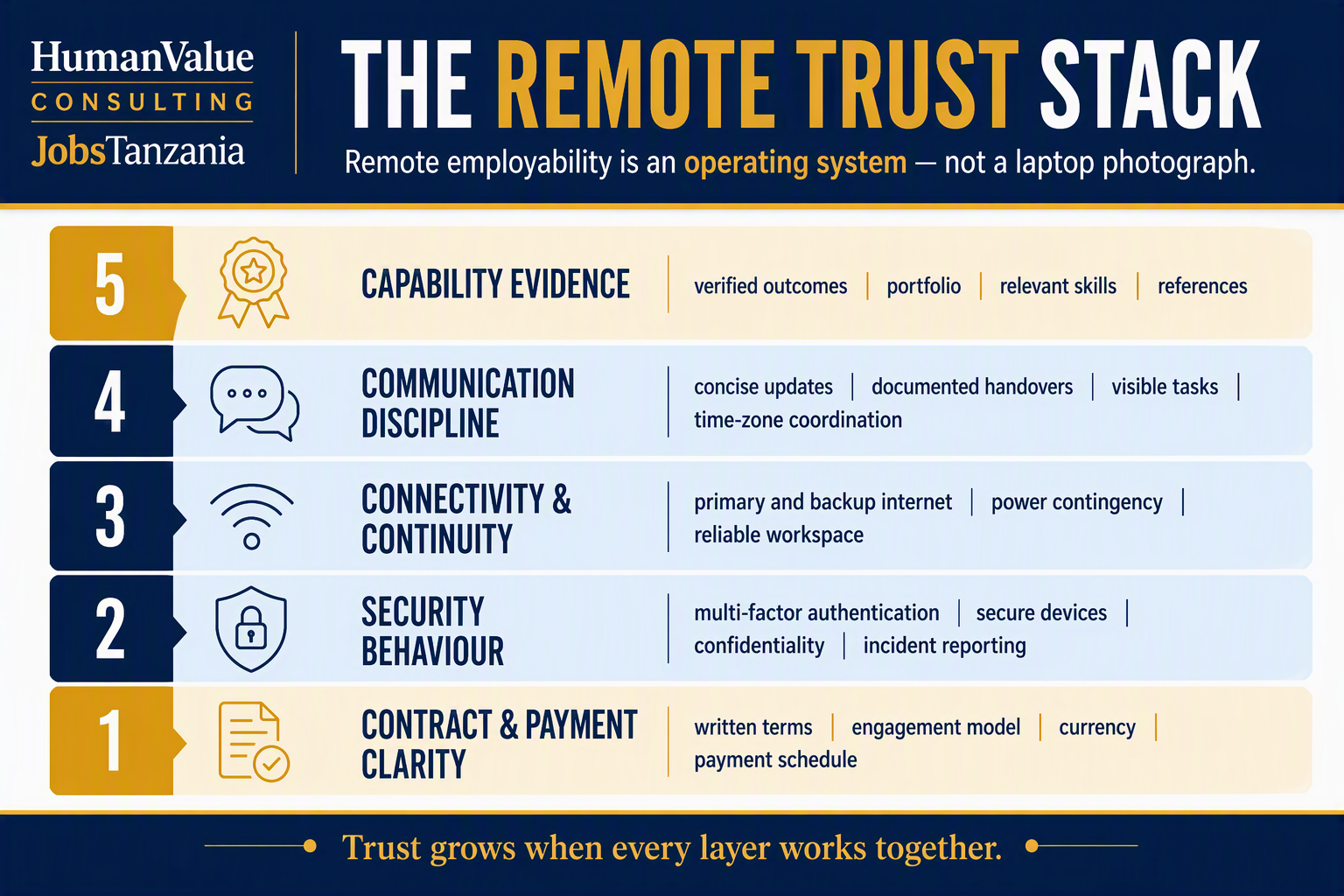
Employers cannot inspect your home office, so describe the controls. State your normal working location and time zone; primary and backup internet; power contingency; availability for overlap hours; collaboration tools; and approach to confidential information. Do not publish sensitive network details. Show that you understand secure access, multi-factor authentication, password management and the separation of work and personal devices.
Create a short “remote operating profile” for your portfolio. Include the hours you can reliably overlap with Greenwich Mean Time, Central European Time, Eastern Time or Gulf Standard Time. Be honest about late-night work. A schedule that damages health and performance is not sustainable. Where the role spans continents, ask whether meetings rotate so one region does not carry the inconvenience permanently.
Asynchronous communication is another differentiator. Practise writing decision notes that state context, recommendation, owner and deadline. Use concise updates, documented handovers and visible task boards. Global teams value professionals who reduce the need for follow-up.
4. Verify the employer and the vacancy
Remote-job fraud is a material risk. The US Federal Trade Commission advises candidates to research the company and recruiter, never pay for the promise of a job and never rely on a “cleared” cheque where the supposed employer asks money to be forwarded or equipment to be purchased. These controls are relevant globally.
Use a five-gate check before sharing sensitive information:
1. Employer identity: confirm a working corporate website, physical or registered address, leadership names and a credible business footprint.
2. Recruiter identity: check that the email domain matches the organisation or an identifiable recruitment partner. Be cautious with free email accounts and messaging-only interviews.
3. Vacancy consistency: compare the advert, job description, reporting line, salary logic and careers-page listing.
4. Selection process: expect a real conversation about the work. Text-only “interviews,” instant offers and pressure are warning signs.
5. Contract and payment: do not start until you have written terms and can verify how, when and by whom you will be paid.
Never pay an employer or recruiter to obtain a job. A legitimate optional career service is different: it has a defined professional deliverable and does not claim to sell an interview, visa or offer. Protect passports, bank details and identity documents until there is a legitimate, explained need and a secure channel.
5. Understand the engagement model before discussing net pay
“Remote” describes where work happens, not the legal relationship. You may be hired as an employee through the employer's local entity, through an employer-of-record arrangement, as an independent contractor or through a staffing partner. Each model affects benefits, tax, social security, leave, equipment, intellectual property and termination. Ask the employer to state the model in writing. Contractors should clarify invoicing, currency, payment method, transfer charges, tax responsibilities, insurance and whether working practices are genuinely independent. Employees should confirm the employing entity, statutory benefits, payroll deductions and applicable policies. Cross-border rules differ; obtain qualified tax or legal advice for your circumstances.
Compare total value, not a headline converted into Tanzanian shillings. Consider payment volatility, unpaid leave, health cover, pension, equipment, data and electricity costs, training, notice period, exchange-rate exposure and the value of stable experience. A lower but compliant and predictable package can outperform a higher offer with unclear status or irregular payment.
6. Interview as a low-risk remote colleague
Prepare six evidence stories covering delivery, problem-solving, communication, conflict, learning and resilience. Use situation, task, action and result, but keep the “action” section specific: what you analysed, decided, built or changed. For remote roles, add how you documented work, protected data, escalated issues and coordinated across time zones.
Test your camera, microphone, internet and backup plan. Join early. Keep the vacancy, CV and examples available, but do not read scripts. Ask questions that reveal operating reality: How many overlap hours are expected? What decisions are documented? Which country employs or contracts the role? How is performance measured? Who provides equipment? What is the security onboarding process?
After the interview, send a concise note that confirms interest and relates one capability to the employer's stated priority. This demonstrates the written follow-through expected in a distributed team.
A 30-day remote-job campaign
Days 1–5 — Position. Select one role family, three target markets and 20 target employers. Rewrite your headline, summary and top achievements around outcomes.
Days 6–10 — Prove. Produce two portfolio items and a one-page remote operating profile. Ask a trusted peer to test whether the evidence is understandable outside your sector or country.
Days 11–20 — Apply and connect. Submit five to eight high-fit applications, follow relevant recruiters and request informed introductions. Track source, date, version of CV, contact, response and next action.
Days 21–30 — Improve. Review conversion. If applications receive no screening calls, revisit targeting and CV evidence. If interviews do not progress, improve stories, technical preparation and questions. Use the HumanValue Learning Center to close a specific gap rather than collecting unrelated certificates.
Remote contract review questions to save before you say yes
Use a written checklist during the final interview and offer stage. Ask for the full name and registered location of the employing or contracting entity; the manager and team location; expected hours and measurable outcomes; and the exact date on which payment becomes due. Confirm whether the stated amount is gross or net of deductions, which currency and exchange rule applies, which party pays transfer fees and what happens when a payment date falls on a public holiday.
Clarify equipment ownership, repair and return. Ask who pays for approved software, connectivity and business travel. Identify the systems you may access, the security training required and the process for reporting an incident. Confirm whether work may be performed from another country during travel; cross-border remote work can create immigration, tax and security issues even when the laptop still works.
Read clauses on intellectual property, confidentiality, outside work, exclusivity, monitoring, notice and disputes. Contractors should understand deliverables, acceptance, invoicing and late-payment provisions. Employees should understand leave, benefits, payroll and grievance channels. Keep the signed document and policy versions that apply.
Finally, verify who can answer operational, payroll and legal questions after you join. A professional employer will not object to reasonable due diligence. If answers remain inconsistent, pause the process. The cost of declining an unclear offer is usually lower than the cost of unpaid work, exposed data or a contract that cannot be enforced.
|
CANDIDATE CTA — TURN REMOTE AMBITION INTO A MARKET-READY APPLICATION |
|
EMPLOYER CTA — HIRE AFRICAN TALENT WITH A CONTROLLED PROCESS |
Frequently asked questions
Can I work remotely for a foreign company while living in Tanzania?
Potentially, yes, but the employer and worker must choose a lawful engagement model and manage tax, payroll, social-security, data and contractual obligations. “Remote” does not remove local law. Confirm the employing or contracting entity and seek professional advice where needed.
Which remote jobs are most realistic for African professionals?
Roles with digital outputs and measurable service levels are usually more portable: technology, data, finance operations, design, marketing, customer success, research, project support and specialist advisory work. Realistic fit still depends on capability, language, time zone, licensing and employer policy.
Should I accept payment in cryptocurrency?
Only after understanding legality, volatility, fees, records and tax implications. A legitimate employer should provide transparent written terms and should not pressure you into unfamiliar payment methods. Stable bank or regulated payment channels are generally easier to evidence.
How do I know whether a remote vacancy is fake?
Verify the organisation and recruiter independently, compare the role with the corporate careers site, insist on a real interview, reject upfront fees and fake-cheque arrangements, and do not share sensitive documents before a legitimate need is established.
Do I need a different CV for remote work?
The core career evidence remains the same, but remote roles benefit from visible examples of independent delivery, written communication, digital collaboration, security awareness and cross-time-zone work. Tailor keywords and outcomes to each vacancy.
Can HumanValue find me a guaranteed remote job?
No responsible provider can guarantee an employer's decision. HumanValue can support CV positioning, skills development, job discovery, interview readiness and recruitment processes, but vacancies, shortlisting and offers remain under employer control.
|
HUMANVALUE CONSULTING LIMITED |