

Many candidates describe themselves as “hardworking,” “computer literate” or “open to remote work.” International hiring teams cannot assess those claims without evidence. They need to see the quality of your thinking, how you communicate, whether you can deliver without constant supervision and how you manage practical risks such as connectivity, confidentiality and time-zone overlap.
Remote readiness is therefore a designed capability. It combines role expertise, proof of work, written communication, dependable routines, secure digital behaviour and a contract model that both parties understand. African professionals who make these elements visible can compete on value rather than geography alone.
|
Key answer: Build a portfolio around business problems, not certificates. Pair it with a remote operating profile, concise written updates, a realistic overlap schedule and evidence that you can protect information and recover from power or internet interruptions. |
Start with one problem you want employers to remember
A broad profile is difficult to refer. “I work in administration, procurement, customer service and marketing” forces the recruiter to decide where you fit. A tighter proposition travels further: “I coordinate supplier data and purchase-order follow-up for distributed operations,” or “I turn raw sales data into weekly management dashboards.”
Select a problem with three qualities. It should be valuable to organisations in more than one country; it should produce an output that can be delivered digitally; and it should connect to experience you can prove. Then identify the tools, decisions and quality standards involved. This becomes the spine of your CV, LinkedIn profile, portfolio and interview narrative.
International audiences may not recognise every employer or qualification in your history. Add context without overexplaining: sector, operating scale, countries served, team size, budget range or customer type. Translate local experience into universal business language — revenue, cost, risk, time, quality, compliance and customer outcomes.
Build a minimum viable proof portfolio
A portfolio is not only for designers or developers. A finance professional can present an anonymised variance-analysis template. A recruiter can show a sourcing plan and candidate scorecard. A project coordinator can share a redacted project dashboard. A customer-service leader can demonstrate a service-recovery workflow. An operations professional can document a process improvement with baseline, action and result.
Use this five-part case-study format:
1. Context: What organisation or process was involved, described without confidential information?
2. Problem: What was slow, costly, risky or unclear?
3. Your decision: What did you personally analyse, prioritise or change?
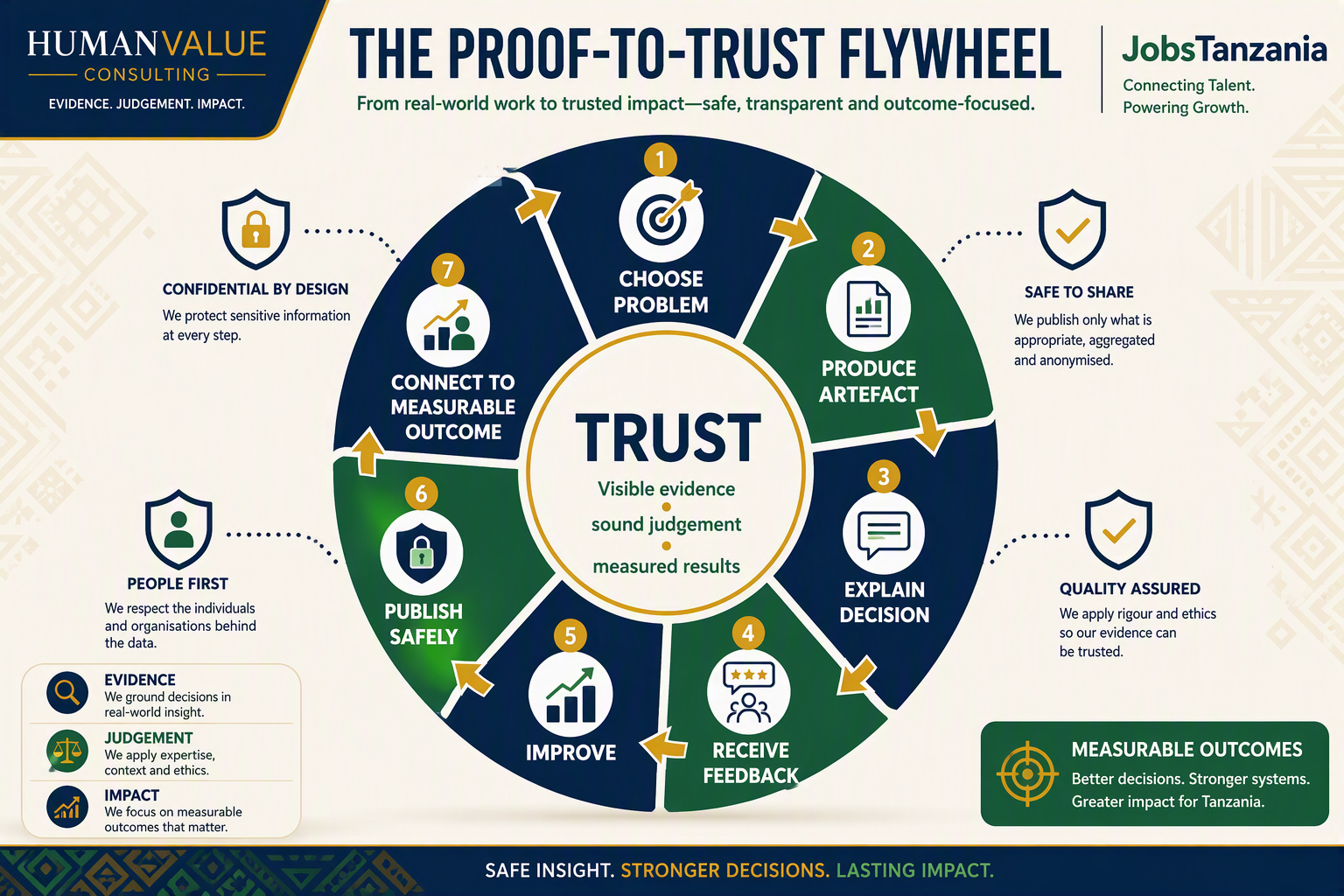
4. Artefact: Show the dashboard, framework, code, checklist, brief or workflow.
5. Outcome: State the authorised metric, stakeholder result or lesson.
Two strong cases are better than ten weak attachments. Remove client names, personal data, passwords, financial details and proprietary methods. If you cannot publish an old artefact, recreate a demonstration using fictional data and label it clearly. The objective is to reveal judgement, not expose an employer.
Write for an asynchronous workplace
Distributed teams cannot put every question into a meeting. They depend on searchable decisions, clear ownership and good handovers. Practise a four-line update: outcome completed, evidence or link, blocker or risk, next action with date. This small habit demonstrates maturity more effectively than a list of collaboration tools.
Before sending a message, ask whether the receiver can act without another meeting. Put the decision or request first. Add essential context, not a chronological story. Use descriptive file names, version control and one agreed source of truth. When a task is ambiguous, restate the expected output and acceptance criteria.
Create one public writing sample relevant to your work: a short analysis, implementation note, technical explanation or process guide. Good writing signals clear thinking to recruiters in the USA, Canada, UK, Europe and the Middle East, even when English is not your first language. Accuracy and structure matter more than complicated vocabulary.
Design a credible continuity plan
The World Bank's Digital Africa research notes both the employment potential of internet access and the continuing constraints of affordability, coverage, electricity and skills. Do not wait for an interviewer to assume the worst. Explain your practical continuity plan at the right level.
Document your primary connection, an independent backup, expected speeds where relevant, power backup, quiet workspace and recovery process. Do not promise uninterrupted service if that is unrealistic. Instead, show how you communicate an outage, protect work, switch channels and recover deadlines. Employers value transparent controls.
Security is part of continuity. Use multi-factor authentication, approved storage, current devices, locked screens and separate work accounts. Never move employer data into personal messaging or unapproved artificial-intelligence tools. Ask what security and data-residency rules apply before accessing production systems.
Make time zones an explicit service decision
State your home time zone and the overlap you can offer consistently. East Africa Time overlaps naturally with much of Europe and the Middle East, can support part of the UK day and may require early or late windows for North America. The right answer depends on role requirements, not willingness to sacrifice sleep.
Ask whether the organisation is synchronous, asynchronous or hybrid. Clarify core hours, on-call requirements, weekend work, public-holiday policy and whether difficult meeting times rotate. If you are a contractor serving more than one client, ensure commitments do not conflict. A realistic schedule builds more trust than unlimited availability.
Use a weekly capacity plan. Protect focus blocks, communication windows, learning time and recovery. Remote work can hide overload because the commute has disappeared; it has not removed human limits.
Replace certificate collecting with a skills evidence ladder
The World Economic Forum reports that employers expect 39% of workers' core skills to change by 2030. Learning matters, but a certificate is only the first rung. A useful evidence ladder is: understand the concept; practise in a controlled task; produce an artefact; apply it to a real problem; explain trade-offs; and obtain feedback or a verified outcome.
For example, “completed a data course” is weak on its own. Stronger evidence is a clean dataset, documented model, dashboard, explanation of assumptions and a decision that the analysis supports. In cybersecurity, show a safe lab, risk assessment or incident-response tabletop. In marketing, show a campaign brief, experiment design and measured result.
Use the HumanValue Learning Center to close the gap between your target role and current proof. Choose learning that produces an output you can discuss, not training selected only because it is popular.
Create a remote-ready profile recruiters can scan in 60 seconds
Your headline should combine target role, sector or problem and one differentiator. Your summary should cover the value you create, evidence, tools, markets or languages and the role you seek. Your latest experience should prioritise outcomes relevant to that target.
Add a “Selected Projects” section to the CV when project evidence is more persuasive than duties. Link to a clean portfolio landing page rather than sending many files. Test all links on mobile and desktop. Use a professional email address, consistent name and a location line that clearly states “Dar es Salaam, Tanzania — open to remote international roles,” or the correct equivalent.
For a structured rewrite, use the HumanValue professional CV service. Keep one master evidence inventory, then create targeted versions for specific role families. Do not manipulate keywords or claim tools you cannot use in an interview.
A 90-day remote-readiness build
Days 1–30: Position and diagnose. Analyse 20 relevant vacancies. Record repeated outputs, tools, experience, communication requirements and time zones. Select one target role, score your evidence and repair the biggest gap.
Days 31–60: Build and validate. Create two portfolio cases, a remote operating profile and six interview stories. Ask a practitioner or mentor to review whether your contribution and result are clear. Improve language, visuals and confidentiality controls.
Days 61–90: Publish and activate. Update your CV and LinkedIn profile, publish selected proof, join relevant professional conversations and apply selectively through trusted sources such as JobsTanzania International Opportunities. Track conversion and change one variable at a time.
Remote-readiness scorecard
|
Dimension |
Evidence recruiters should see |
Minimum standard |
|
Role capability |
Two relevant case studies |
Clear problem, action and outcome |
|
Communication |
Decision note and status update |
Concise, actionable writing |
|
Reliability |
Connectivity and power plan |
Primary, backup and recovery process |
|
Collaboration |
Tools and handover example |
Visible ownership and deadlines |
|
Security |
Safe-work practices |
MFA, approved storage and discretion |
|
Market fit |
Targeted CV and profile |
One coherent role direction |
A hiring-manager view of your first remote month
Imagine how a manager will experience your first four weeks. In week one, can you access systems safely, understand the team's objectives and confirm priorities without repeated chasing? In week two, can you complete a small deliverable, document assumptions and ask focused questions? In week three, can you coordinate a dependency across time zones? In week four, can you present progress, risk and next actions clearly?
Build portfolio evidence for those behaviours. Add a sample onboarding checklist, a short decision log and a weekly status note. Show how you would escalate a missed dependency and recover a deadline. These artefacts are small, but they answer the employer's real concern: “Will this person make distributed work easier or create more coordination?”
Ask a reviewer to score the portfolio using four questions. Is the problem clear in one minute? Can they identify your personal contribution? Does the evidence show quality and control? Would they trust you with the next level of complexity? Record the feedback and revisions.
Remote trust also depends on boundaries. State when you are available, when an urgent channel should be used and how you protect focus time. A candidate who promises permanent availability may appear enthusiastic but not sustainable. Mature remote professionals create predictable service, communicate exceptions early and protect both delivery and wellbeing.
This manager-centred test should happen before every application campaign. If your materials show only technical output, add communication and control. If they show only process, add a measurable result. The combination creates a more complete remote hiring case.
|
CANDIDATE CTA — BUILD THE EVIDENCE BEFORE YOU INCREASE APPLICATION VOLUME |
|
EMPLOYER CTA — ASSESS REMOTE READINESS, NOT LOCATION STEREOTYPES |
Frequently asked questions
Do I need a personal website?
No. A clean portfolio can be a simple web page, repository or securely shared document. The important elements are relevant proof, clear explanation, working links and protection of confidential information.
What if I have never worked remotely?
Use evidence from projects where you worked independently, coordinated across locations, documented decisions or delivered through digital systems. Then complete a realistic remote project or volunteer assignment to test your routines.
How much time-zone overlap should I offer?
Offer what the role requires and you can sustain. Confirm core hours, meeting frequency and on-call expectations. Long-term performance is more valuable than promising permanent late nights.
Can I use work from my current employer in a portfolio?
Only with permission and after removing confidential, personal and proprietary information. When permission is uncertain, create a labelled demonstration with fictional data and explain the method instead.
Which skill should I learn first?
Choose the skill most frequently required in your target vacancies and least supported by your current evidence. Build an artefact that demonstrates it, then ask for feedback from someone who uses the skill professionally.
Does remote readiness guarantee a job?
No. It reduces avoidable hiring uncertainty and improves the quality of your applications. Market demand, competition, employer budgets and selection decisions remain outside the candidate's control.
|
HUMANVALUE CONSULTING LIMITED |