


HumanValue Global Career Intelligence | Researched 8 November 2026
When an international employer asks about a project, explain the shared result and then make your own contribution visible. Describe the responsibility you held, the decisions you made, the work you delivered and the evidence available. Give colleagues their proper credit. A precise account of a modest contribution is more credible than claiming ownership of an entire programme.
This guide is for African professionals preparing applications and interviews for international development organisations, multinational teams and cross-border project roles. It focuses on describing genuine experience. It does not announce vacancies or establish eligibility for a particular organisation, contract, country or visa.
Start with the actual vacancy, not your most impressive story
A project can contain procurement, stakeholder engagement, data analysis, logistics and financial reporting. The same experience will not demonstrate all those capabilities equally well. Read the duties and requirements first, then select an example that gives the assessor relevant evidence.
Separate eligibility requirements from evidence of performance. Education, required experience, languages and any location or nationality restrictions need their own honest answers. A strong story cannot replace a mandatory requirement. Follow the employer’s application form, instructions and word limits rather than assuming a conventional CV is sufficient.
UNDP’s recruitment guidance asks applicants to check minimum requirements, tailor the application to the position and use real examples related to the advertised competencies when preparing for interview. That guidance describes UNDP’s process; other international employers may use different methods.
Distinguish the project, your responsibility and the result
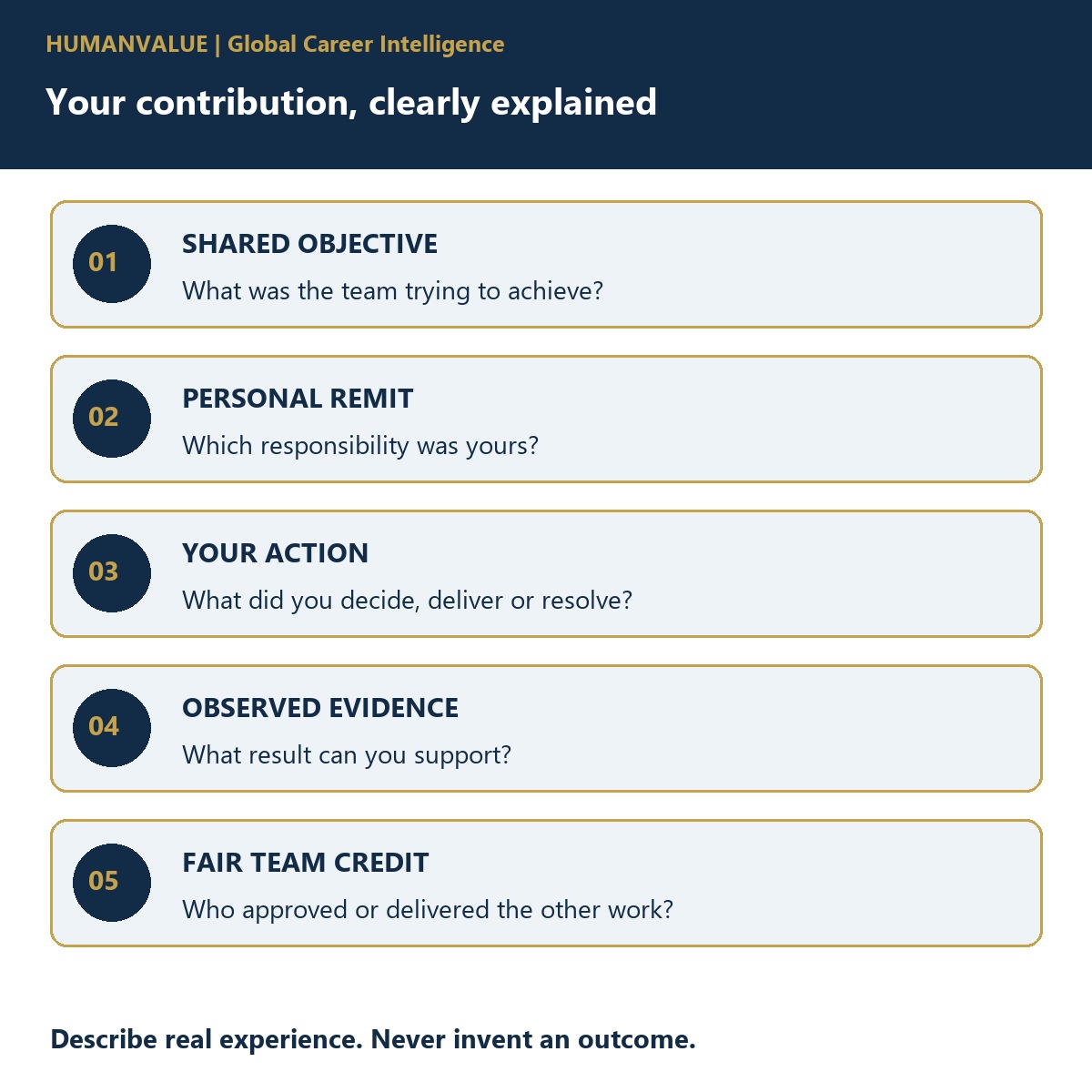
Begin by answering three different questions. What was the team trying to accomplish? What were you personally responsible for? What happened after your work? Confusing these layers creates inflated claims even when the applicant is trying to be accurate.
For example, someone who maintained a delivery tracker may have helped a project team identify missing documents. That is useful work. It does not automatically mean the person managed the project budget, supervised suppliers or caused the whole programme’s final outcome.
| Layer | Question to answer | Useful detail |
|---|---|---|
| Shared objective | What needed to be achieved? | The project purpose and relevant constraint |
| Your remit | What did you own or support? | Your assigned task, authority and reporting line |
| Personal action | What did you actually do? | Method, judgement, communication and follow-up |
| Observed result | What changed, and how do you know? | A documented output or appropriately qualified outcome |
| Boundary | What was decided or delivered by others? | Approval, specialist work or collective responsibility |
A worked example: replace a broad claim with a defensible account
The following example is entirely fictional and is provided to demonstrate writing technique. Do not copy it as your own experience.
Overstated: “I led a regional project and ensured all reporting was delivered successfully.”
More precise: “I maintained the reporting tracker for a fictional three-office project. I compared incoming files with the agreed checklist, identified missing references and sent a consolidated query list to the office focal points. The project manager approved the final submission. My tracker showed which files were complete and which still required a decision.”
The revised version makes the contribution assessable without inventing a performance percentage. If the applicant genuinely had documented evidence that all required files arrived before the agreed deadline, that fact could be added with its scope and period. Without that evidence, the statement should stop at what can be supported.
Notice the verbs: maintained, compared, identified and sent. They explain action. “Led” might be correct for a different candidate, but should be supported by actual leadership responsibility. Avoid downgrading real responsibility, too: if you owned the workstream and made the relevant decisions, explain that clearly.
Prepare for follow-up questions, not a memorised speech
The UN Human Resources competency-interview resource recommends structuring answers around situation, action and result, including both achievements and challenges. Use that structure to organise your thoughts, while following the instructions for the actual interview.
Keep the background short enough that the panel can understand your actions. Explain the obstacle, the options you considered and why you chose your approach. Be ready for questions such as: who authorised the change, what did you do when a colleague disagreed, and what would you do differently?
A setback can provide useful evidence when you explain it honestly. Perhaps the first communication was unclear, a dependency was missed or an assumption proved wrong. Describe the correction and the learning. Do not rewrite a delayed or incomplete project as an unqualified success simply because the interview asks about achievement.
Make international context understandable
A reviewer in another country may not know your employer’s internal acronyms, local job grades or administrative structure. Explain the function in plain language: “the office contact responsible for collecting reports” can be clearer than an unexplained abbreviation. Retain an accurate official job title and add a short functional explanation where helpful.
If time zones, languages or different organisational procedures affected the work, describe the actual consequence. “I agreed a cut-off time with colleagues in two time zones and recorded unresolved questions in the handover note” says more than “excellent cross-cultural communication”. Do not add countries, languages or stakeholders that were not involved.
Separate a local-currency amount from an international comparison. If a financial figure is necessary, identify its currency and period, and explain whether you managed, monitored or merely recorded it. Avoid adding a current exchange-rate conversion unless required and properly sourced.
Use evidence without exposing confidential material
You can describe your method without uploading a former employer’s client list, internal report or unpublished budget. Check permission and the receiving organisation’s instructions before supplying work samples. An anonymised description can still reveal sensitive details when the project is easily identifiable.
Where disclosure is not permitted, explain the type of output and your role in producing it. If you create a demonstration with invented data, label it clearly as a demonstration and keep it separate from employment achievements. Never present a newly created sample as a document used by a real client.
Questions applicants often ask
Can I use “we” in an interview?
Yes, when describing collective work. Then explain what you personally did. Using “I” for your actions and “we” for the team’s result can preserve both clarity and fair credit.
What if I have no reliable numerical result?
Describe a verifiable qualitative result: a decision recorded, a process clarified or an output accepted by the responsible person. Explain the evidence and avoid implying that an unmeasured improvement was quantified.
Can voluntary or academic project work count?
It can help demonstrate relevant behaviour, but whether it satisfies required professional experience depends on the vacancy’s rules. Identify the context accurately and do not relabel an academic exercise as paid employment.
Turn your experience into a coherent application
Before submitting, compare your form, CV and interview notes. Dates, job titles, responsibilities and results should agree. Remove unsupported superlatives and check that each important statement answers a requirement. Ask a reviewer to identify the exact action you took; if they cannot, revise the account.
The HumanValue Learning Center’s CV & Application Pack Lab is a relevant resource to review when improving application materials. Confirm its current scope against your needs. For work samples that show your communication method, read our tested technical-writing quickstart guide. For assessing an offer after selection, use the international offer comparison guide.
Editorial note: HumanValue career guidance supports preparation; selection, employment eligibility and recruitment decisions remain with the relevant employer and authorities. Primary-source guidance was checked on 8 November 2026.