

HumanValue Global Career Intelligence | Prepared 8 November 2026
A credible technical-writing portfolio helps a reader complete a task and shows how the instructions were checked. For African professionals exploring international documentation roles, a concise API quickstart can demonstrate audience awareness, technical investigation and careful revision. The strongest sample includes the guide, a test record and an explanation of decisions.
You do not need to describe a commercial client assignment you have never done. Choose a small, authorised learning environment, label the project clearly and document the work you actually performed. This is a portfolio route, not a promise of a remote vacancy, eligibility to work in another country or proficiency with every developer tool.
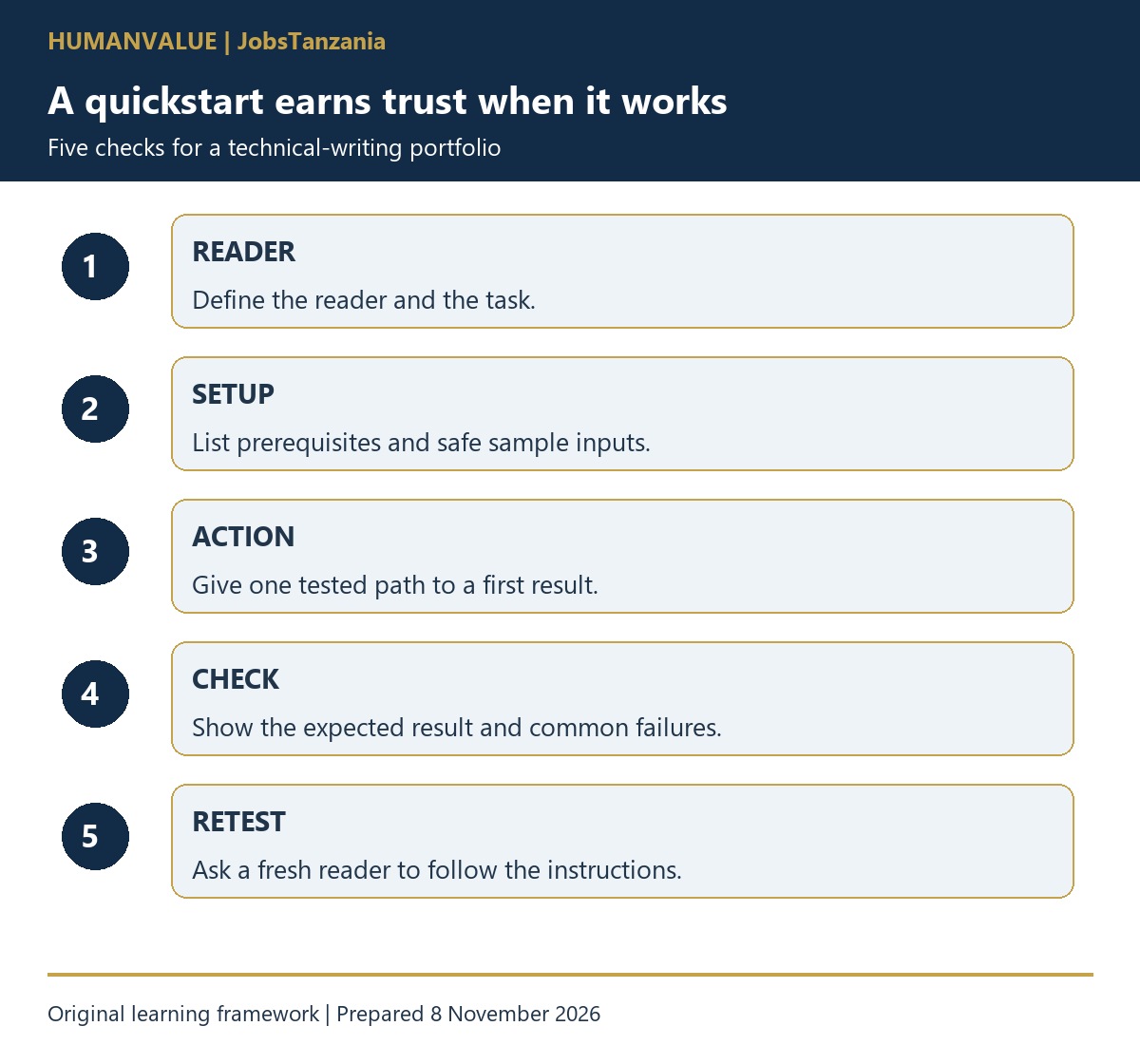
1. Define one reader and one first result
Begin with a short reader statement. For example: “A junior developer can run commands on their computer but has not used this practice API.” Then choose one outcome: retrieve one sample record, create a fictional item in an approved sandbox or inspect the response from a local demonstration service.
A quickstart becomes difficult when it tries to explain the entire product before the reader sees a result. Keep the first task bounded. Put detailed concepts, alternative workflows and advanced configuration in separate notes. Explain where the quickstart stops so the reader knows what they have and have not achieved.
2. Choose a safe and reproducible environment
Use a documented learning service or a local demonstration project that you are permitted to use. Read its current instructions, limits and terms. Select an exercise that needs no real customer data, production credentials or paid transaction. If a key is required, explain its safe handling without publishing the key or a screenshot that exposes it.
Record the environment, tool versions, operating system and date of testing. A guide tested on one setup should say so. If another operating system uses different shell syntax, either test that variation or state that it is outside the sample’s verified scope. Guessing at cross-platform commands weakens an otherwise careful portfolio.
3. Outline the reader journey before drafting
| Section | Question the reader needs answered |
|---|---|
| Purpose | What useful first result will I produce? |
| Prerequisites | What access, tools and prior knowledge must I have? |
| Preparation | Where do I work, and which safe sample values do I use? |
| Procedure | What ordered actions should I perform? |
| Verification | What result shows that the task succeeded? |
| Troubleshooting | Which common failure can I recognise and investigate safely? |
| Cleanup and next step | What should I remove or close, and where can I learn more? |
Write prerequisites as checkable conditions. “Know APIs” is broad. “Be able to open a terminal and edit a local text file” describes a clearer starting point. Define necessary terms where they first appear, and use the same name for the same object throughout.
When you are ready to connect the sample to a vacancy, the HumanValue CV & Application Pack Lab provides a structured way to organise evidence, compare a CV with a job description and track applications. Its application-preparation scope is separate from the technical knowledge you must demonstrate in a documentation role.
4. Write steps that lead to an observable result
Each numbered step should ask the reader to do something specific. State the working location when it matters. Distinguish text the reader enters from output they should expect. Use fictional values consistently and explain where a reader must substitute their own authorised value. Avoid relying on colour or a screenshot alone to communicate an instruction.
Include the smallest result that confirms progress. An API request may return a response, but the reader still needs to know which field or status matters for this exercise. If an output varies, explain the relevant pattern rather than promising an exact value that may change.
The Google technical-writing learning resources cover planning and authoring technical documentation and link to style and accessibility material. Use them as learning references while developing your own sample. A completed practice guide is not a Google qualification or evidence of employment there.
5. Keep a test log while you work
Start from the prerequisites in a clean learning setup and follow the draft exactly. Record the step, expected result, observed result, environment and revision needed. If a command only worked because you had an unmentioned setting from an earlier experiment, add that prerequisite or remove the dependency.
| Finding | Revision | Retest |
|---|---|---|
| Reader did not know which folder to use | Add the working-directory instruction before the command | Repeat from a fresh folder |
| Output description assumed a fixed sample identifier | Explain which returned field to inspect | Check with another permitted sample |
| Error message did not explain the missing prerequisite | Add a safe diagnostic check and documentation link | Reproduce the error in the learning environment |
These are invented examples of findings, not claims that a particular service produced them. In your portfolio, replace them with the observations you genuinely recorded. Do not copy an attractive test log and present it as testing you performed.
6. Ask a fresh reader to use the guide
Give a peer the guide and ask them to attempt the task without live coaching. Obtain their agreement to participate and avoid collecting unnecessary personal information. Note where they pause, what they ask and which result they believe means success. An unclear instruction may be more valuable feedback than a spelling correction.
Revise the guide, test the changed steps and write a brief reflection. A small peer review cannot establish that documentation works for every audience. It can demonstrate that you seek evidence and improve an explanation rather than assuming that a clear sentence in your own mind is clear to everyone.
7. Present the work to an international employer
Package a readable guide, short audience statement, dated test record, revision summary and source list. Explain whether you built the demonstration service or documented someone else’s authorised public project. Give credit to external code and follow its licence. Check portfolio access from a signed-out view before sending the link.
Read the actual role for required technical knowledge, language, collaboration tools, working hours and eligible hiring locations. Technical-writing roles vary widely; a first API guide is one piece of evidence, not a substitute for every requirement.
Your next step: Choose a safe learning task and define its first successful result in one sentence. Explore Global Career Intelligence for related preparation and the HumanValue Learning Center for relevant skills support. Build the sample around a reader’s success and keep a truthful record of how you checked it.
For the collaboration side of international documentation work, explore the asynchronous handover portfolio exercise.