


Research checked: 28 October 2026 | Audience: Tanzanian and East African job seekers
Quick answer: To compete for inventory controller, stock clerk or warehouse administrator roles in Tanzania, learn to reconcile a physical count with a system balance, explain every variance, document an adjustment trail and communicate the business risk. A strong candidate can demonstrate these skills with a small, fictional stock-count workbook before an interview. You do not need to claim SAP expertise you have never used. You need to show how you prevent a wrong quantity from becoming a wrong purchasing, dispatch or financial decision.
Why inventory employers ask for evidence, not only certificates
A warehouse may hold construction spares in Dar es Salaam, medicines in Mwanza, agricultural inputs in Morogoro or food products in Arusha. In each setting, the employer needs trustworthy stock information. A CV saying “managed inventory” does not reveal whether the applicant can trace a shortage, isolate a receiving error or explain why a count cannot be posted without approval.
The National Bureau of Statistics' 2024 Integrated Labour Force Survey documents Tanzania's diverse employment landscape. It does not tell us how many inventory-controller vacancies exist today, and this article makes no such claim. The practical hiring lesson is narrower: transferable recordkeeping and reconciliation skills matter across sectors, but each employer's software and controls differ.
The four records every stock candidate should understand
Goods received note (GRN). This records what was accepted from a supplier. A purchase order for 120 units does not prove that 120 usable units arrived. The receiving team may have counted 116, rejected two damaged items and held two pending inspection. Record actual accepted quantities and the document reference.
Stock ledger or ERP movement history. This should explain opening balance, receipts, issues, returns, transfers and adjustments. An ERP screen is a representation of transactions; it is not independent proof that the physical shelf matches.
Physical count sheet. Record item code, location, count date, count team and actual units. Blind counts, where the counter is not shown the system quantity, can reduce confirmation bias. Separate items in quarantine or awaiting quality release.
Variance investigation note. Compare the expected and counted quantities, identify plausible causes and list evidence checked. Do not alter the ledger simply to make the difference disappear. A supervisor or authorised inventory controller should approve corrections under company policy.
A realistic 20-minute stock variance interview test
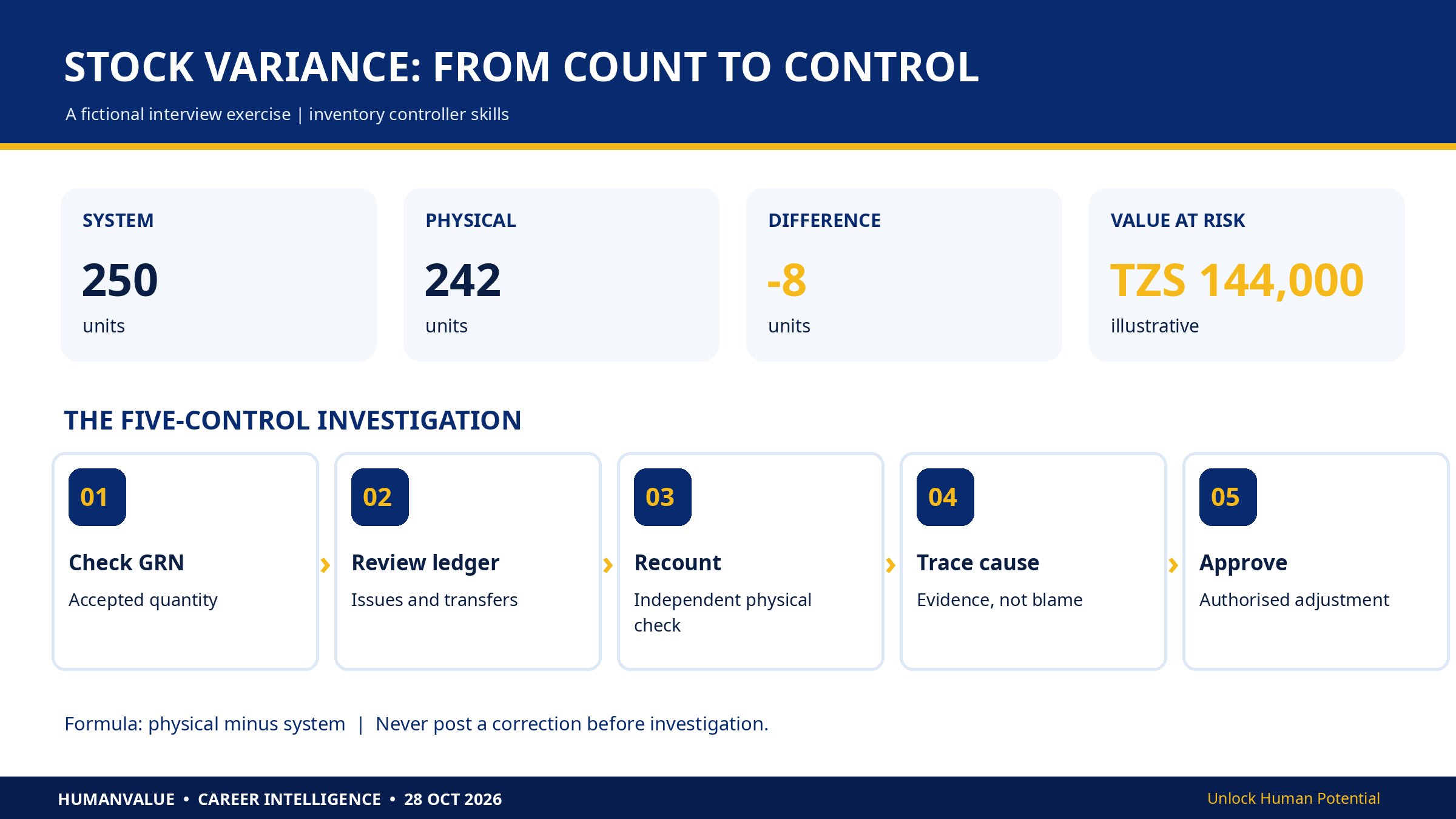
Consider a fictional warehouse holding spare-parts item SP-041. The system shows 250 units. A physical count finds 242. The apparent variance is minus eight units, calculated as counted quantity minus system quantity. At a fictional unit cost of TZS 18,000, the provisional value at risk is TZS 144,000. That is not automatically a loss: eight units could be in a staging area, recorded against the wrong bin, issued without a completed transaction or counted incorrectly.
The candidate's task is to produce four outputs: (1) a reconciliation line showing 250, 242, -8 and -3.2%; (2) a list of three evidence sources to inspect; (3) an escalation note to the supervisor; and (4) a proposed preventive control. A credible answer checks dispatch notes, bin transfers, recent receipts, damaged-goods logs and a second independent count. A weak answer posts an eight-unit adjustment before investigation.
A useful Excel layout is Item | Location | System | Physical | Difference | Unit cost | Value difference | Suspected cause | Evidence | Owner | Approval status. The formulas are straightforward: =D2-C2 for difference and =E2*F2 for value. The challenge is the judgement behind the numbers.
How to build a proof portfolio in seven days
Day 1: Set up fictional master data. Create 15 to 25 item codes, units of measure and bin locations. Include a few deliberately similar descriptions to test whether you can prevent item-code confusion.
Day 2: Simulate receiving. Enter a purchase order, delivery note and GRN. Show one partial delivery and one rejected quantity. Reconcile accepted stock against supplier paperwork without inventing a real employer's data.
Day 3: Simulate issues and transfers. Record an internal issue, a bin-to-bin transfer and a customer dispatch. Every movement should have a date, document number, responsible person and quantity.
Day 4: Conduct a mock cycle count. Hide the system balance, count the fictional stock and create two variances. Recount one item. Explain why the other needs an investigation.
Day 5: Prepare a one-page dashboard. Show count accuracy, unresolved variances, items awaiting approval and ageing of discrepancies. Define each KPI so the denominator is clear.
Day 6: Write the manager's update. Summarise the difference, possible operational impact, verified evidence and decision requested. Avoid accusatory language about staff until facts are established.
Day 7: Rehearse the interview. Explain your workbook in three minutes: what you controlled, where the error appeared, how you tested causes and what you would improve. Save a PDF summary and keep the editable Excel workbook available for demonstration.
What to say if you have never used SAP or another ERP
Employers may list SAP, Odoo, Microsoft Dynamics or a bespoke system. Say exactly what you know. If you have used Excel stock cards and understand movement controls, explain that experience and describe your plan to learn the employer's system. Do not put “SAP expert” on a CV after watching a tutorial. A practical sentence is: “I can reconcile GRNs, bin transfers and count sheets in Excel, and I would need supervised training on your ERP approval workflow.”
The HumanValue Learning Center currently lists Warehouse, Inventory & Logistics Management with ERP and Excel, a three-hour recorded course at TZS 50,000. The separate Practical Warehouse & Logistics Toolkit is TZS 20,000 and includes a handbook, exercises and a spreadsheet model; it is a separate product without a certificate. Prices were checked on 28 October 2026 and should be rechecked at checkout. Training builds capability; it does not guarantee an interview or a job.
Turn the exercise into an evidence-based CV
Replace “responsible for stock management” with a truthful, specific statement. For a self-created simulation, say: “Built a fictional 20-SKU inventory reconciliation workbook with GRN, cycle-count and variance-investigation sheets; documented controls and escalation decisions.” For actual employment, use real results only when you are authorised to disclose them and can support the figures.
In interviews, distinguish stock accuracy from stock availability. A perfectly accurate record of an out-of-stock item does not mean replenishment is working. Explain reorder points, supplier lead times and safety stock as separate planning questions. For sensitive products such as pharmaceuticals, safety and quality controls take priority over speed.
Common mistakes that can cost an offer
Candidates sometimes treat an Excel formula as the entire control. It is not. Other mistakes include mixing units (cartons and pieces), ignoring stock held in transit, failing to record the time of the count, deleting negative values, counting damaged goods as saleable stock, and treating a discrepancy as proof of theft. An interviewer will notice whether you ask for supporting evidence before deciding.
A practical next step through JobsTanzania
Search current logistics and warehouse opportunities and read each employer's stated requirements before applying. If you need a structured learning path, compare the two verified HumanValue warehouse products and choose the course or toolkit that addresses your actual gap. For application positioning, Job Seeker Premium is listed at TZS 30,000 for 30 days, with career guidance, CV and interview tools and priority alerts. Ordinary local job applications remain free; Premium does not guarantee placement.
Frequently asked questions
Can I become an inventory controller without a logistics degree?
Some employers accept related experience and demonstrable controls; others require specific qualifications. Match the actual advert and do not claim universal eligibility. A clear reconciliation exercise can strengthen evidence but cannot replace a mandatory credential.
Is Excel enough for an ERP-based warehouse job?
Excel can demonstrate logic, accuracy and reporting. It does not replace experience with the employer's ERP transactions, permissions or controls. Describe the difference openly.
Should I attach my employer's real stock report to applications?
No, unless you have explicit permission and have removed confidential information. A clearly labelled fictional workbook is safer and often more useful for explaining your reasoning.
What should I check before paying for training?
Confirm the live syllabus, delivery format, assessment and certificate terms, product price and your own skills gap. The HumanValue course and toolkit are different products.
Sources and editorial note: NBS ILFS 2024; HumanValue Learning Center; Warehouse toolkit; Seeker Premium. All stock examples are fictional training scenarios, not vacancy, salary or placement claims.