


HumanValue Career Intelligence | Tanzania | Researched 8 November 2026
A transport administrator’s renewal tracker should show which vehicle record needs attention, who owns the next action and what evidence confirms completion. A coloured cell or a payment receipt is not enough to establish that a renewal has been issued or that a vehicle is authorised for a particular journey.
For jobseekers supporting Tanzanian fleets, useful administration combines accurate identifiers, clear dates, reliable document references and timely escalation. This guide explains how to organise that work and demonstrate the skill with invented data. It is not a complete legal compliance checklist; requirements depend on the vehicle, activity and relevant authority.
Start with the fleet’s actual document requirements
Ask the responsible fleet manager which documents apply to each vehicle and activity. A company car, a goods vehicle and a passenger-service vehicle should not automatically receive identical document rows. Cross-border use or a change in operating activity may require a separate review.
Record the requirement owner as well as the administrative owner. The administrator may gather documents, monitor dates and prepare an application, while a manager, insurer or regulator makes a decision. Do not infer authority from possession of the file.
For the relevant mainland services, LATRA’s official application guidance directs users to RRIMS through its website. The RRIMS portal lists vehicle and operator licensing among its services. Use the applicable official guidance for the actual activity rather than treating a general article as permission to operate.
Give each row one clear purpose
A practical structure is one row per vehicle-document combination, linked to the employer’s vehicle register. Keep the identifier consistent across the tracker and source documents. For a public practice file, use invented fleet codes rather than real registration numbers, chassis numbers or driver details.
Separate the document’s effective dates from your internal action dates. An internal reminder is a management choice; it is not a regulator’s statutory deadline. Record the source of each important date so that another person can check it.
| Field group | What to record | Control question |
|---|---|---|
| Vehicle and document | Fleet code, document type and source reference | Does this row match the correct vehicle and requirement? |
| Validity | Effective date and expiry shown on the authoritative record | Have the dates been checked rather than copied from memory? |
| Internal planning | Preparation date, review date and action owner | Is there enough time to resolve missing information? |
| Application progress | Not started, preparing, submitted or queried | What evidence supports the current status? |
| Completion evidence | Issued document reference and verification record where applicable | Has issuance been confirmed? |
| Decision or exception | Outstanding question and responsible manager | Who decides the operational response? |
Keep application, payment and issuance distinct
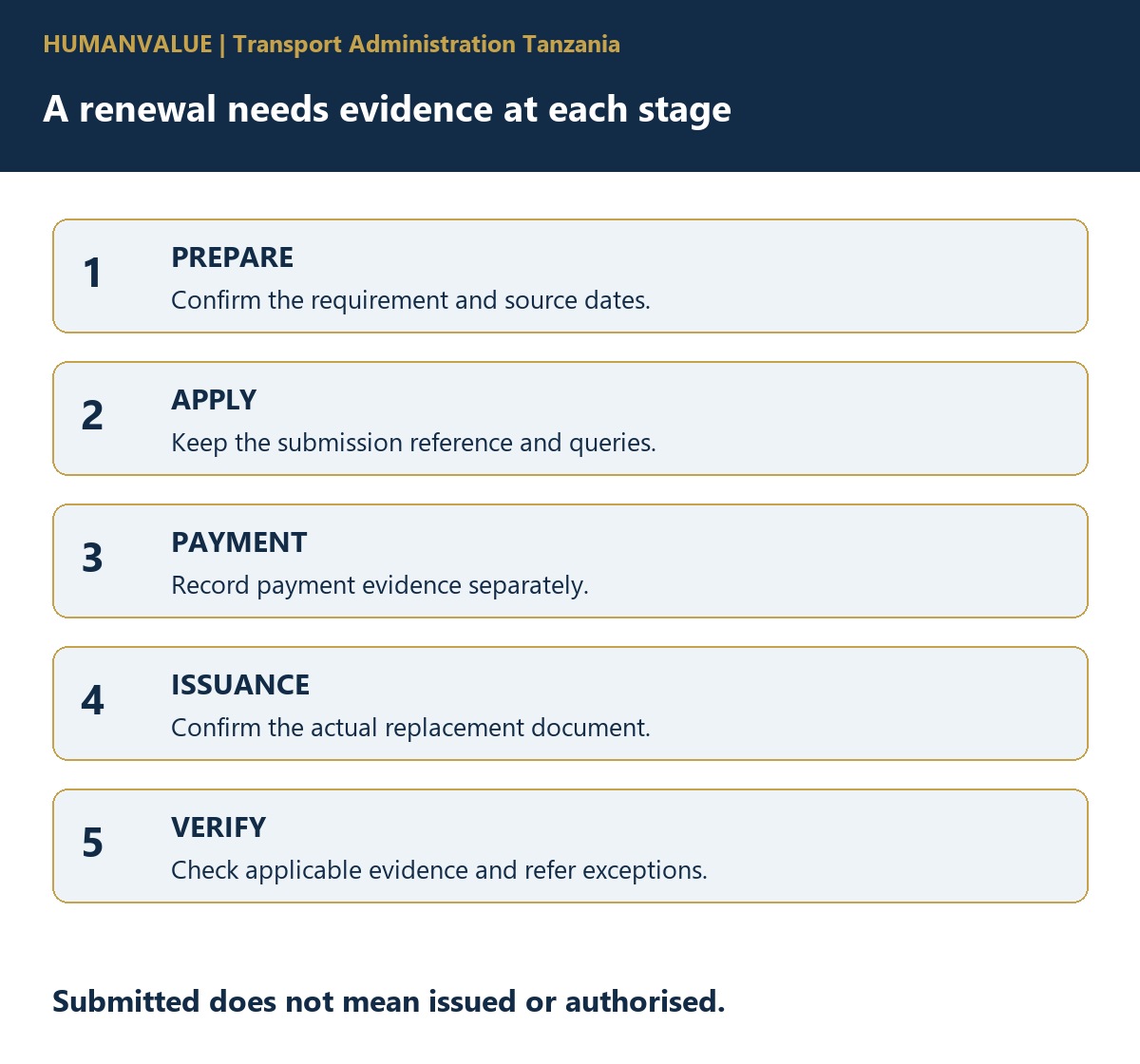
A submitted application can still need clarification. A payment can be associated with an application without proving that the final document has been issued. Your tracker should preserve those distinctions instead of using a single “done” box for every step.
For insurance administration, TIRA’s TIRAMIS verification portal provides a cover-note verification service with several search types, including registration number and cover-note reference. Use the correct identifier and record the result according to the employer’s procedure. Resolve discrepancies with the insurer or relevant authority.
A verification result is part of the evidence for that specific record. It does not establish that every other document, operating condition or journey requirement has been satisfied. Keep an unresolved discrepancy visible and refer the operational decision to the authorised manager.
A fictional three-vehicle practice case
Create an invented file with fleet codes V-001, V-002 and V-003. In the exercise, one document for V-001 expires on 30 November 2026. V-002 has a renewal application reference but no issued replacement in the supplied evidence. V-003 has conflicting expiry dates in the tracker and scanned source document.
For V-001, plan the next administrative steps using an internal review date chosen for the exercise. Label that date as an internal planning assumption. For V-002, retain “submitted; issuance not confirmed” rather than marking it renewed. For V-003, flag the discrepancy and identify who should verify the authoritative date.
Fictional manager update: “V-002 has a recorded renewal application reference, but the supplied file contains no issued replacement. I have kept the renewal status open and listed the evidence still needed. Please confirm the authorised operational decision while the document position is being resolved.”
This case demonstrates judgement and traceability. It does not depict a real fleet or imply that an application receipt allows a vehicle to continue operating.
Use spreadsheet controls that make uncertainty visible
Choose unambiguous date formatting and confirm that the spreadsheet stores dates as dates rather than text. Test any days-to-expiry calculation against simple known examples. Explain whether the result uses calendar days and which reference date it uses.
Conditional colours can help draw attention, but pair them with a written status and action. Otherwise, someone viewing a printed copy or using a different display may miss the meaning. A green cell should never conceal an unverified source date.
Use controlled status labels and check for duplicate vehicle-document rows. Keep a correction history or agreed change record. Avoid embedding sensitive scans in a practice workbook or distributing unrestricted links to operational documents.
Review exceptions with the person who can decide
A useful review is organised around decisions: an unclear requirement, a missing source document, a queried application or an approaching expiry. Explain what has been checked, what remains unknown and who has the next action.
Do not invent a universal renewal lead time or guarantee a processing period. The manager should plan for the applicable process, the condition of the records and the time needed to resolve queries. Keep operational planning separate from your prediction of when an authority or provider may respond.
Questions candidates and supervisors ask
Is a reminder tracker a compliance certificate?
No. It is an administrative tool. The underlying requirements, documents and authorised decisions still need to be checked for the actual vehicle and activity.
Can I copy last year’s expiry date and add a year?
Use the dates on the newly issued authoritative record. Do not assume that every replacement has the same period or that an application has already been approved.
What should I show in an interview?
Present an invented tracker with clear definitions, a query log and an example manager update. Explain the limits of your authority and label every practice assumption. Do not share a former employer’s fleet records without permission.
Develop the coordination skill, not just the workbook
The HumanValue Learning Center’s Workplace Excel Essentials is relevant to review for date handling, structured records and readable summaries. Match its scope to your learning needs; regulatory interpretation and operational authorisation remain separate responsibilities.
For careful changes to a record, read our Kiswahili correction-history guide. For communicating unresolved dependencies, use the guide to a clear blocked-work update. Reliable transport administration means that another person can see the evidence, understand the uncertainty and make the right decision.