

Quick answer: the Green List is a residence pathway, not a job list of guaranteed offers
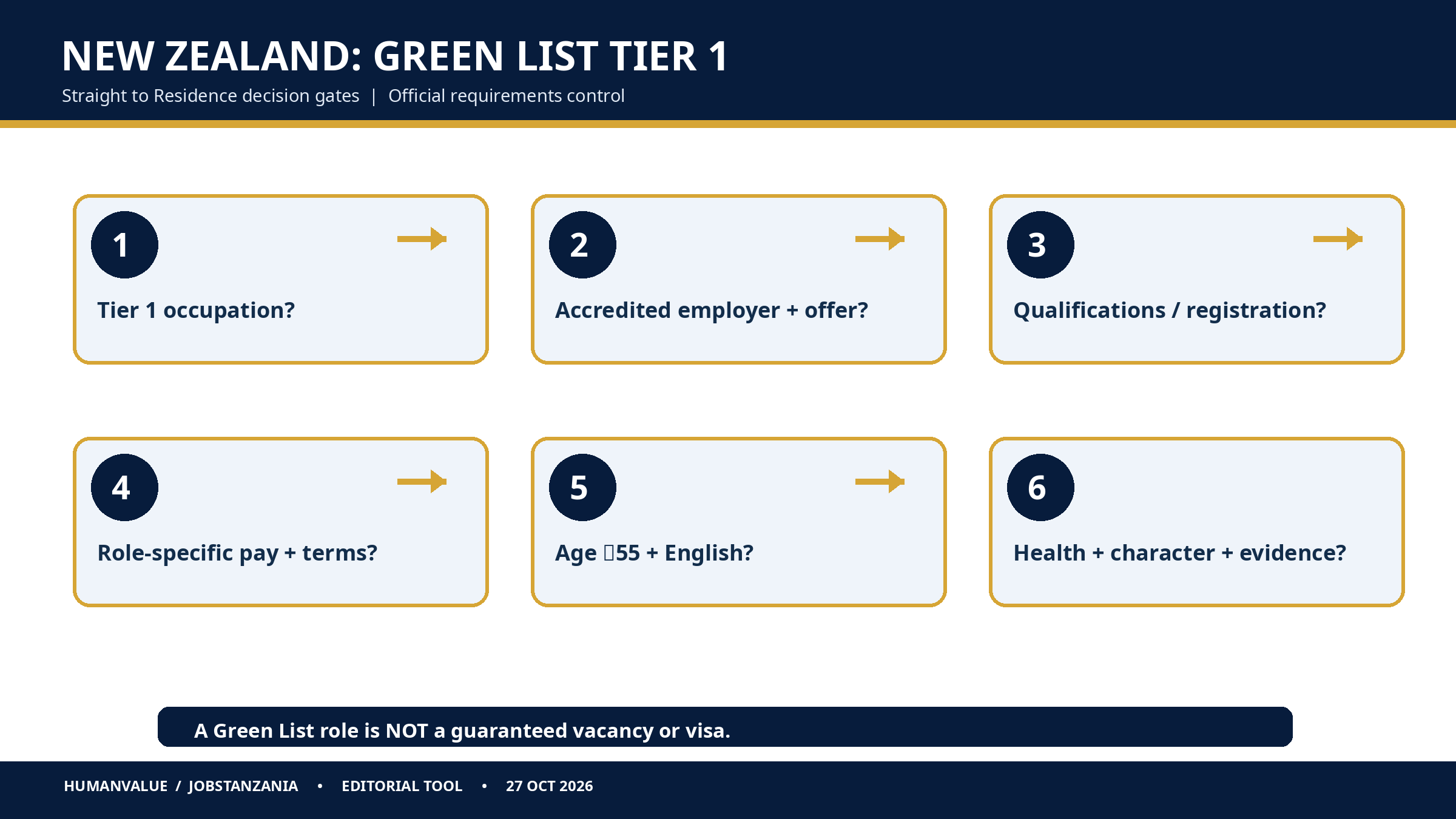
New Zealand's Straight to Residence Visa may be available to an eligible person aged 55 or younger who is working in, or has a qualifying offer for, a Tier 1 Green List occupation with an accredited employer. The applicant must also meet the role-specific qualification, registration and pay requirements, plus English, health and character requirements. A job title that sounds similar to a Green List occupation is not enough. The actual duties and official occupation conditions must match.
This guide is designed for professionals in Tanzania and across Africa comparing international career routes. It is not a vacancy advertisement, an eligibility decision or a claim that JobsTanzania has a New Zealand sponsoring employer. The source of truth is Immigration New Zealand's Straight to Residence Visa page and its Green List occupation search.
Tier 1 and Tier 2 are different pathways
Immigration New Zealand divides Green List occupations into two tiers. Tier 1 may lead to the Straight to Residence route when the applicant meets the relevant requirements. Tier 2 generally requires 24 months of qualifying work in New Zealand before applying under the Work to Residence pathway. Treating the tiers as interchangeable is a costly mistake.
A candidate should search the exact occupation and inspect the conditions attached to it. Some roles require professional registration; others specify qualification level, experience or a particular wage threshold. The list can change, so save a dated copy of the requirement you relied on and recheck before submitting an application.
An engineering professional may hold a relevant degree yet still need to establish whether the qualification matches the New Zealand framework or whether a professional registration route applies. A healthcare professional may need local registration before being able to practise. A high salary does not automatically cure a missing mandatory qualification or registration.
Gate one: identify a genuine Tier 1 occupation
Begin with the official Green List roles search. Record the occupation name, tier, duties, qualification conditions, registration body if applicable and wage rule. Avoid making the decision from a screenshot circulated on social media or a recruiter’s marketing poster.
Prepare a one-page role-matching note. On the left, describe your real duties and responsibilities; on the right, identify the official occupation requirements. If a mismatch is substantial, do not rename your role merely to fit a category. Your CV, employment letters and any professional assessment must be truthful and consistent.
For regulated work, start with the competent New Zealand registration authority. Immigration eligibility and the legal right to practise a profession are related but not identical. An offer letter that omits a required registration condition may be insufficient.
Gate two: verify the accredited employer and real offer
The official pathway requires a job or qualifying offer with an accredited employer. Verify the legal business name and accreditation through Immigration New Zealand's employer resources, and then verify the specific vacancy using the employer's own recruitment channels. Employer accreditation alone does not establish that the business has a vacancy for you or has agreed to hire you.
Ask for a written offer with duties, location, hours, pay, duration and conditions. Check that the role is full-time under the visa rules and that the offer meets the required duration and other conditions. If you are still in Tanzania, clarify whether the employer is prepared to employ an overseas candidate and what practical onboarding or registration steps are required.
Never purchase a job offer from an intermediary. Be cautious when asked to pay a personal account for an “accreditation slot,” when the supposed employer will not speak directly or when the contract contradicts the official job description. An immigration decision cannot be guaranteed by an agent, recruiter or training provider.
Gate three: check qualifications, registration and pay together
A Green List role may have specific requirements that are stricter than a general occupational description. Check whether an overseas qualification needs assessment and whether professional registration must be completed before the visa application. Keep degree certificates, transcripts, professional licences and evidence of experience in a consistent file.
Pay is also role-specific. Do not assume that one universal annual salary threshold applies to all Tier 1 occupations. The official list identifies the applicable rule, and some rates are linked to the immigration median wage or a stated multiplier. Verify the requirement for the particular occupation on the application date rather than relying on a generic internet calculator.
Illustrative example: a Tanzanian engineer receives an offer from an accredited New Zealand firm. Before celebrating, the engineer compares the job's actual duties with the listed occupation, checks the required qualification or registration, confirms the wage and contract terms, and reviews personal residence requirements. This is a hypothetical decision process, not a real offer or a finding that the engineer qualifies.
Gate four: personal eligibility and supporting evidence
The Straight to Residence Visa overview states an age limit of 55 years or younger when applying, together with English, health and character requirements. The visa may include an eligible partner and dependent children aged 24 or younger, subject to the current rules. Each family member's evidence and costs should be assessed separately.
Build an evidence checklist: passport and identity records; authentic job offer and employer details; qualifications and any assessments; registration evidence where required; English evidence; medical and police documentation; and family relationship documents if relevant. The exact accepted evidence and validity periods are set by Immigration New Zealand and may change. Do not order expensive tests before checking the current instructions.
Budget beyond the visa application. The official page currently displays a fee from NZD 6,450 and an indicative processing measure of 80% within 3.5 months. Those figures are not a personalised quotation or guaranteed decision time. Add qualification assessment, translations, registration, medicals, travel, accommodation and emergency funds as applicable.
Can you apply from Africa?
Immigration New Zealand's official pathway explains that a qualifying Tier 1 applicant may be able to apply from outside New Zealand. That does not mean an overseas candidate can apply without a genuine qualifying job or offer. It also does not mean that every Green List employer recruits internationally. The search for a real employer is a separate and often demanding process.
Prepare a New Zealand-facing CV that presents truthful duties, relevant outcomes and professional registration status. If an employer asks about availability, explain your current location and immigration status accurately. Never describe yourself as “visa approved” before receiving a decision from the immigration authority.
Compare the employer's job description with your evidence. A civil engineer may need project design and compliance examples; a health professional may need clinical registration and supervised practice records; an ICT specialist may need architecture, systems reliability and delivery outcomes. Each sector requires its own evidence rather than a generic “international CV.”
A 30-day preparation plan that avoids premature spending
Week one: identify three target occupations and confirm their exact Green List tier and requirements. Eliminate roles for which you clearly lack a mandatory licence or qualification, rather than paying for speculative application support.
Week two: collect truthful experience records, qualification documents and professional references. Identify gaps in employer-verifiable evidence. Ask the appropriate registration or assessment body about its procedure when necessary.
Week three: shortlist genuine employers and vacancies, check accreditation, and tailor your CV to actual duties. Track the vacancy source, application date, sponsorship response and any request for additional evidence. Treat no response as no response, not as an implied approval.
Week four: review the realistic cost, time and risk of the route. If you receive a serious offer, confirm all conditions with the official authority or a properly licensed immigration adviser. If you do not, continue professional development without making non-refundable commitments on the assumption that a job will appear.
How HumanValue can help without overstating the service
The public JobsTanzania International Opportunities catalogue primarily promotes Europe and UAE programmes and lists a TZS 50,000 career-readiness assessment for programme fit, CV and documents. It does not establish that HumanValue has a New Zealand Green List employer, placement programme or authority to decide residence applications. Do not pay for an unrelated European assessment believing it buys New Zealand sponsorship.
A candidate may still benefit from general career preparation through the HumanValue Learning Center or an ATS CV review, provided the scope fits their needs. Official New Zealand immigration requirements and any regulated advice remain separate. The safest next step is to check the Tier 1 occupation and accredited employer first, then decide whether optional CV or career support adds value.
Frequently asked questions
Does a Green List occupation guarantee a visa?
No. The occupation, genuine qualifying offer, accredited employer, role-specific conditions and personal eligibility must all be satisfied. Immigration New Zealand makes the decision.
Can I apply for Tier 1 without first working in New Zealand?
The official pathway can allow qualifying applicants to apply from overseas. You still need a qualifying job or offer and must meet the full visa conditions.
Is Tier 2 the same as Straight to Residence?
No. Tier 2 generally leads to Work to Residence after qualifying work in New Zealand, not an immediate Straight to Residence application.
Is the listed processing time guaranteed?
No. A published processing statistic describes recent processing performance, not your individual result. Document checks, registration and other issues can extend the process.
Does JobsTanzania sell New Zealand sponsorship?
No New Zealand sponsorship service was verified in the public catalogue checked for this article. Use the official employer and visa verification routes.
Editorial sources and scope
Official Immigration New Zealand visa and Green List pages linked above, checked 27 October 2026. Visa conditions, costs and processing information may change. No vacancy, sponsor, placement or visa outcome is promised.