

Quick answer: prove that you can coordinate work, not just attend meetings
A Tanzanian graduate does not need to claim to have managed a multimillion-shilling project to demonstrate useful coordination skills. A credible entry-level portfolio can show a small, well-defined initiative with a task register, owners, dates, risks, meeting decisions, a progress report and a final handover. These artefacts tell an employer what you can actually organise. They are more persuasive than listing “leadership, teamwork and Microsoft Office” without examples.
The practical challenge is to build evidence without misrepresenting experience. This guide uses a fictional office-improvement project as a learning exercise, not as a real client assignment or vacancy. It offers a 21-day route from a blank spreadsheet to a portfolio you can discuss in an interview. For live opportunities, start with JobsTanzania Jobs, then match the evidence to the requirements of each actual advert.
What a project coordinator really controls
A project manager may be accountable for budget, scope and major decisions; a coordinator often maintains the operational rhythm that makes those decisions executable. Typical responsibilities can include updating task lists, preparing meeting notes, chasing approvals, organising records, checking dependencies and raising problems early. Titles differ across NGOs, construction firms, technology businesses, universities and service companies, so the vacancy description matters more than a generic definition.
A coordinator should distinguish activity, output and outcome. Sending reminders is activity. Producing an approved weekly action log is an output. Reducing avoidable missed handovers would be an outcome, but you should claim that result only when you have measured it. For a learning portfolio, record simulated outputs and explicitly label the numbers as fictional. Never paste a former employer's confidential schedule or contact list into a public portfolio.
A useful interview question is: “What happened when an owner missed a deadline?” Your answer should explain the evidence you reviewed, who you notified, what alternative you proposed and how you recorded the decision. Avoid pretending that you could unilaterally change the project's budget or promise delivery dates.
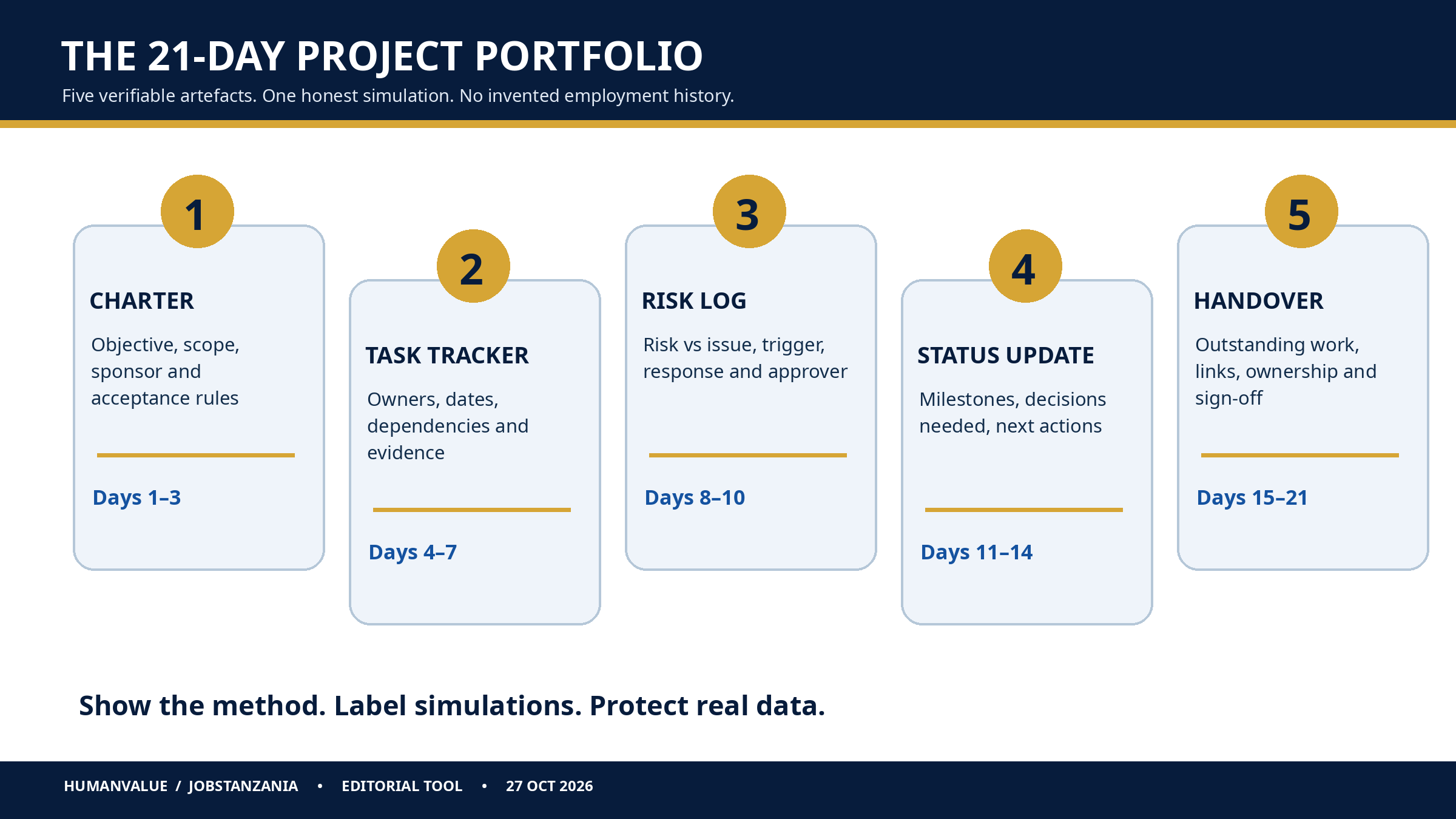
Day 1 to 3: write a one-page project charter
Choose a manageable exercise: organise a fictional three-day induction programme for twelve new employees at a Dar es Salaam service company. The charter should state the problem, sponsor, objective, deliverables, exclusions, assumed budget, decision owner and completion criteria. For example, the objective may be to prepare an approved induction agenda, training attendance sheet and equipment-readiness checklist by a specified fictional date.
Define what is outside the project. The exercise does not recruit employees, procure actual equipment or collect real employee details. Exclusions prevent a portfolio from becoming a vague claim to have managed everything. List assumptions separately from facts. If a training room is assumed available, record it as an assumption until a sponsor confirms it.
Make the acceptance criteria observable. “Improve onboarding” is too broad. “Produce a complete agenda, a named session owner for each topic and a sign-off checklist” can be checked. Add a version number and a revision date to the charter. This small discipline helps employers see that you understand controlled documents.
Day 4 to 7: build the task tracker in Excel
Create columns for task ID, deliverable, responsible role, planned start, due date, status, dependency, evidence link and next action. Use fictional role labels rather than real names. Keep dates in actual date format, not inconsistent strings. Convert the range into a table so it can be filtered by owner, deadline or status. Microsoft's official guide explains sorting data in Excel tables.
Add a simple traffic-light rule: green for completed, amber for work due soon, red for overdue. Do not use colour as the only signal; include text status for accessibility. A delayed task is not automatically a failed project. Note the cause, impact and decision required. A dashboard should show how many tasks are open and overdue, but should not pretend that a percentage-complete formula captures the quality of the work.
For example, if the room booking depends on sponsor approval, mark that dependency. When approval is late, update the risk log and propose a backup room. Your role is to make the consequence visible. A supervisor can then decide whether to accept the change.
Day 8 to 10: create a risk and issue register
A risk is something that may happen; an issue has already happened. Use separate fields for likelihood, impact, trigger, owner, response and review date. Example risk: “The trainer may be unavailable on day two.” Example issue: “The trainer has confirmed unavailability.” The second entry needs an action and decision, not another probability score.
Keep a change log beside the risk register. If the fictional sponsor moves the induction date, record the old date, proposed new date, reason, approver and effect on related tasks. An audit trail is more valuable than silently overwriting a cell. You do not need complex project software to demonstrate this habit.
Use three risk responses in the exercise: reduce the likelihood, reduce the impact or accept the risk with a contingency. A coordinator should not mark a serious safety or legal issue “accepted” without the responsible decision-maker's authorisation. The portfolio should make escalation responsibilities explicit.
Day 11 to 14: turn meetings into accountable decisions
Prepare a short agenda before each fictional meeting. Afterward, produce minutes that separate discussion from decisions and actions. An action entry needs a verb, owner and due date. “Discuss equipment” is not an action; “Facilities to confirm laptop availability by Thursday” is.
Design a stakeholder update that can be read in one minute: overall status, completed deliverables, next milestones, decisions needed and top three risks. Put the decision request near the top. Senior managers often need a choice and its consequences, not a long narrative of every email sent.
Practise explaining one missed milestone without blaming colleagues. A professional update might say: “Training materials remain pending because the content owner has not approved the draft. Two alternative dates are available; sponsor decision requested by Friday.” In a real role, share such details only with authorised recipients.
Day 15 to 18: show quality checks and handover
Build a quality checklist for the induction pack. Does the agenda match the approved dates? Are every session's owners identified? Are links working? Are there duplicate tasks? Does the attendee form collect only necessary information? A coordinator adds value by finding avoidable errors before a stakeholder does.
Create a handover sheet with outstanding actions, document location, owners, known risks and next review date. This demonstrates that a project does not end when the coordinator leaves a meeting. A good handover lets the next person continue without searching through private messages.
If your portfolio contains screenshots, use a dummy dataset and mark the document simulation for learning. Remove personal identifiers and proprietary branding. Tanzania's Personal Data Protection Act is an important reference when handling real people’s information. The legal obligations depend on the circumstances; a public sample should not contain real applicants' data.
Day 19 to 21: present a compact evidence portfolio
Choose five artefacts: one-page charter, Excel tracker, risk-and-issue register, stakeholder update and handover checklist. Give each a two-sentence caption: the problem addressed and the decision it supports. Add a short retrospective explaining what you would improve next time. The point is not to make every document visually elaborate. It is to show consistency, traceability and judgment.
Prepare a two-minute interview explanation. State that the case is simulated. Describe the objective, your method, a sample issue, your escalation and the final deliverables. Then connect that method to a real vacancy: an NGO programme assistant may prioritise donor reporting and event coordination, while a construction project assistant may prioritise site documentation, procurement follow-up and schedule discipline.
Example CV evidence statement
Simulated portfolio project, clearly labelled: “Developed a 21-day induction coordination exercise, including a 20-task Excel tracker, issue register, stakeholder update and final handover checklist.” Do not place this under paid employment history. Put it under “Projects” or “Portfolio exercises” and disclose its nature. If you later apply the method to genuine work, replace the simulated evidence with authorised real results.
Where HumanValue fits naturally
The Workplace Excel Essentials in Tanzania course is publicly listed at TZS 20,000. It is relevant to task registers, sorting, filtering and reporting, not a guarantee of project employment. If you already know Excel, you may not need the course; build the portfolio first and identify your real gap.
After selecting a genuine vacancy, use the free ATS CV scanner or compare the Job Seeker Premium support at its listed TZS 30,000 for 30 days. Paid support is optional; ordinary applications remain free. The strongest CTA is practical: complete one portfolio example, then tailor your CV to one verified vacancy.
Frequently asked questions
Can a fresh graduate apply for project coordinator jobs?
Some positions accept early-career applicants; others require sector experience. Read the actual vacancy and distinguish mandatory qualifications from preferences. A portfolio helps explain readiness but cannot replace a required professional licence or years of experience.
Must I buy project management software?
No. A clean spreadsheet, meeting notes and versioned documents can demonstrate core coordination habits. Use specialist tools when a target employer requires them or when project complexity justifies the cost.
Can I use confidential employer files as evidence?
Not without appropriate authorisation and protection. Build a fictional case or obtain permission for a genuinely anonymised example. Removing names alone may not remove all identifying information.
Is a 21-day portfolio equivalent to certification?
No. It is a learning exercise showing work samples. Formal certificates, professional membership and recognised qualifications have separate requirements.
Editorial sources and scope
Practical workflow designed for this article; Microsoft Excel documentation and Tanzania's official personal-data law linked above. Catalogue information checked 27 October 2026. The case, dates, task counts and examples are fictional teaching materials, not vacancy or placement claims.