


Being shortlisted is not the finish line; it is the point where preparation becomes measurable. Tanzania's Public Service Recruitment Secretariat coordinates recruitment activities including shortlisting and organising interview panels and interviews for public institutions. Candidates therefore need more than generic confidence: they need role knowledge, controlled documents, evidence of competence and disciplined execution.
PSRS published a new call for interviews for various public institutions on 5 October 2026. That makes preparation immediately relevant, but candidates must use the official notice for their own interview details. HumanValue's framework below is deliberately role-neutral: it helps candidates prepare for written, practical and oral assessments without pretending that every institution uses the same test.
|
KEY ANSWER: Verify your official notice first, then prepare across five gates: documents, role knowledge, technical or practical capability, competency evidence and interview-day execution. Never rely on a generic checklist where the official PSRS instructions say something different. |
Gate 1: Verify the official interview notice before you prepare
Research / continue: Official PSRS/Ajira interview calls
Research / continue: JobsTanzania Jobs
Start with the official PSRS/Ajira announcement. Confirm that your name or interview number appears where applicable, identify the recruiting institution and role, and record the exact date, reporting time, venue and assessment type. Do not depend on a forwarded screenshot when the official source is available.
Read every instruction, not only the candidate list. Different notices can specify different documents, identification requirements or stages. If an unofficial website, WhatsApp message or friend gives advice that conflicts with the official notice, follow the official notice and seek clarification through legitimate channels.
Plan transport and accommodation early when the venue is outside your home area. Build a buffer for traffic, unfamiliar locations and document checks. Interview-day stress often begins as a logistics failure, not a knowledge failure.
Gate 2: Build a controlled document pack
Research / continue: PSRS Rules of Operation: certificate inspection and interview rules
Research / continue: HumanValue ATS Scanner
Create one physical folder and one secure digital backup. Include only the documents required or legitimately useful for the stage. Arrange them in a logical order so you can retrieve an item without searching through loose papers.
Check names, dates and qualifications for consistency across the application, CV and supporting documents. If there is a legitimate difference — for example a legal name change — prepare the proper supporting explanation rather than improvising at the venue.
Do not hand sensitive originals to unofficial agents or send identity documents to unknown contacts. Recruitment information should be verified through official channels.
|
48-HOUR CHECK |
WHAT TO CONFIRM |
ACTION |
|
Official notice |
Date, time, venue, role, assessment stage |
Save/print the current notice |
|
Identity |
Required ID exactly as instructed |
Place in document folder |
|
Qualifications |
Certificates/transcripts where instructed |
Arrange originals/copies as required |
|
Application record |
Role and claims submitted |
Review for consistency |
|
Travel |
Route, reporting time, contingency |
Plan arrival buffer |
Gate 3: Convert the job description into a revision map
Research / continue: HumanValue Learning Center
Do not revise everything you have ever studied. Break the target role into six to ten capability areas. For an accountant, these might include reporting, controls, reconciliation, budgeting and public-sector financial discipline. For ICT, they might include systems, networks, security, databases, support and troubleshooting. For an HR role, they might include recruitment, records, labour practice, performance and employee relations.
For each area, prepare three layers: definition or principle, practical application and one example. This structure works for written and oral questions because it prevents memorised definitions from becoming disconnected from work.
Review the institution's lawful mandate and the role's contribution to it using official information. You do not need to pretend to know internal matters. You do need to understand what the institution exists to deliver and how your function supports that outcome.
PSRS INTERVIEW READINESS — 5 GATES
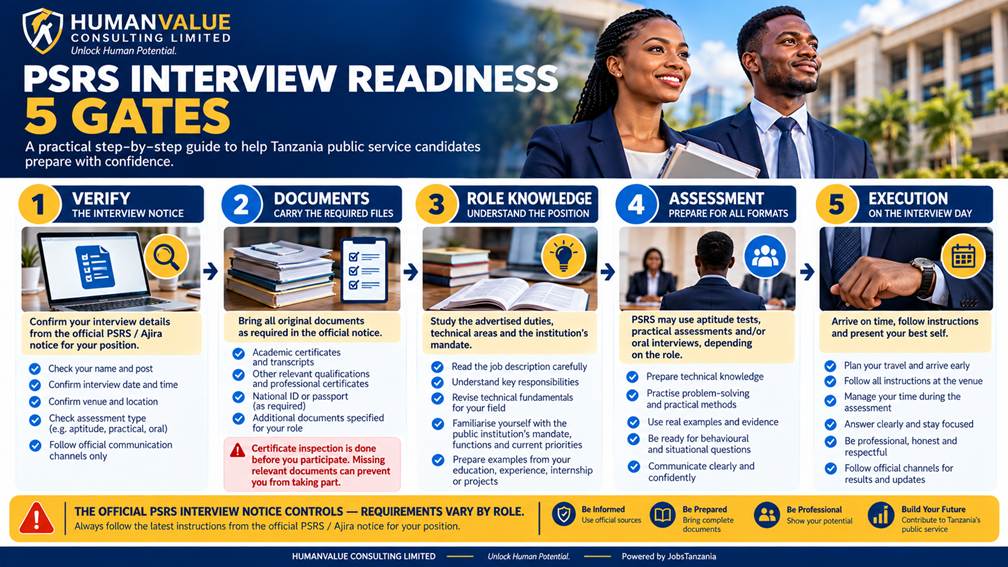
Place after the preparation map. The visual should function as a mobile-friendly last-48-hours checklist and clearly state that official PSRS instructions take precedence.
Written interview: accuracy before speed
Written assessments may test technical knowledge, reasoning, communication or role-specific judgement. Read the instructions twice. Note the number of questions, marks and available time, then allocate time deliberately. A technically correct answer can still lose value if it ignores the question verb.
Where a question asks you to explain, compare, calculate, recommend or analyse, respond to that verb. Use short headings or numbered logic where appropriate. Show working for calculations when useful. If you are unsure, state a defensible assumption rather than burying the answer in unrelated information.
Reserve final minutes for review. Check unanswered items, units, names, calculations and whether your conclusion matches your analysis. Avoid adding invented facts simply to make an answer sound complete.
Practical interview: show method, control and verification
Some roles can include practical assessment. PSRS has published practical interview results for technical positions, which confirms why candidates should prepare for demonstration as well as conversation. The exact task depends on the role and notice.
During a practical task, first understand the required output. Work systematically, protect data and safety, and verify the result. In ICT, that could mean testing before declaring a fault resolved. In finance, it could mean reconciling totals and documenting assumptions. In administration, it could mean accuracy, formatting and records discipline.
If a tool behaves unexpectedly, do not panic or hide the issue. Explain what you are checking and use a structured troubleshooting approach. Assessors can learn from your method even when the task contains ambiguity.
Oral interview: answer with evidence, not slogans
Prepare at least six evidence stories from study, internship, employment, volunteering or projects. Useful themes include problem solving, teamwork, integrity, customer service, conflict, deadline pressure, learning, leadership and technical judgement.
Use a compact structure: Context — what was happening; Responsibility — what you had to achieve; Action — what you personally did; Result — what changed; Lesson — what you learned. Keep the answer focused on your contribution while acknowledging the team.
When asked a technical question, define the principle, explain how you would apply it and mention a control or verification step. When asked what you would do in a difficult scenario, identify the risk, follow lawful policy, communicate appropriately and document material actions.
Questions you should be ready to answer
Why are you interested in this role and institution? Your answer should connect the public-service outcome, the role and your evidence — not only job security.
What makes you suitable? Select three requirements from the role and prove them with concise evidence. Avoid saying you are hardworking without examples.
Tell us about a difficult problem. Choose a real situation, explain your decision process and show the result. If the result was imperfect, explain the lesson and improvement.
How would you handle an instruction that appears improper? Show respect for lawful authority while protecting integrity: clarify, refer to policy or procedure, escalate appropriately where necessary and avoid concealing misconduct.
Where do you need development? Choose a genuine but manageable gap and explain the action already being taken. Do not disguise a strength as a weakness.
The final 24 hours
Stop trying to learn an entire profession overnight. Review your capability map, six evidence stories, key definitions, calculations or technical procedures and the institution's mandate. Pack documents, clothing and travel items before evening.
Sleep and hydration affect recall and judgement. Avoid arriving exhausted because of last-minute revision. Set multiple alarms if necessary and leave enough time for the reporting process.
At the venue, follow instructions, protect your documents and avoid being destabilised by other candidates' speculation about questions or scores. Your task is to execute your own preparation.
After the interview: control what happens next
Write down the questions you remember and assess your own performance while it is fresh. Separate knowledge gaps from communication gaps and time-management gaps. This creates a useful development record even if the outcome is unsuccessful.
Follow official PSRS channels for results and placement information. Do not pay anyone who claims they can change a score or guarantee placement. Keep your phone and email details monitored, but verify suspicious messages independently.
If you are not selected, use the experience diagnostically. A result is not a complete judgement of your career value. Identify the stage that needs work — application fit, technical knowledge, practical execution or interview evidence — and improve that stage before the next opportunity.
|
PREPARE FOR THE ASSESSMENT, NOT JUST THE QUESTIONS |
|
NEED STRUCTURED, EVIDENCE-LED ASSESSMENT? |
Public-sector jobs: requirements to check before interview
The interview starts with the job advertisement. PSRS rules require academic certificates, other documents and qualifications to be inspected against the advertisement before an interviewee is allowed to participate. If the relevant documents are missing, the candidate may be excluded from the interview. This is why candidates should prepare from the exact vacancy notice rather than from a generic interview checklist.
Across 2026 PSRS advertisements, recurring application conditions include attaching the required academic or professional certificates and transcripts, professional registration or practising documents where applicable, a birth certificate, a recent passport-size photo in the Recruitment Portal, and three reputable referees. Foreign academic certificates must be recognised by the relevant Tanzanian authorities; some posts with GPA requirements also require the applicable TCU calculation evidence. Requirements vary by vacancy, so the specific advertisement controls.
For interview preparation, PSRS Rules of Operation provide for three assessment types as the need arises: aptitude, practical and oral interviews. A practical assessment can be used where the cadre requires demonstration of ability with particular equipment or work methods. Candidates should therefore prepare for the assessment format stated in the official notice, not assume every role will use the same sequence.
Job seekers should also protect the integrity of the process. Use the official PSRS/Ajira channels to confirm vacancies, interview calls and results. Do not pay anyone who claims to guarantee a public-service job, score or workstation.
Official PSRS/Ajira resources: Current vacancies and interview calls
JobsTanzania career tools: Browse Jobs | Free ATS Scanner | HumanValue Learning Center
Turn the vacancy requirements into an interview plan. Compare your CV with the advertised role using the free HumanValue ATS Scanner, close genuine capability gaps through the HumanValue Learning Center, and use HumanValue career support for structured CV and interview preparation. HumanValue and JobsTanzania do not influence PSRS selection and no paid service guarantees employment.
Frequently Asked Questions
Where should I confirm my PSRS interview details?
Use the official Public Service Recruitment Secretariat/Ajira source and the specific call-for-interview notice for your role. Third-party summaries can help with discovery but should not replace the official notice.
Are all PSRS interviews written and oral?
No. Assessment stages vary by role and recruitment exercise. Some technical roles can include practical assessment. Follow the official notice for your own process.
What documents should I carry?
Carry exactly what the official notice requires. General checklists should never override the current PSRS instructions.
How should I answer competency questions if I am a fresh graduate?
Use truthful evidence from university projects, internship, field work, volunteering or other relevant responsibilities. Focus on your decision, action, result and lesson rather than inventing employment experience.
Can HumanValue or JobsTanzania influence PSRS selection?
No. HumanValue and JobsTanzania can support career preparation and information, but PSRS and the relevant public institutions control the official recruitment and selection process.